


The 1 Mistake Investors Make When the Market Stalls, and How to Avoid It
Key Points
The stock market has soared in recent years, but this year, we’ve seen both ups and downs.
Investors have worried about the economy and rising inflation -- and the impact on companies.
- 10 stocks we like better than S&P 500 Index ›
The S&P 500 has roared higher in recent years, but in 2026, the path hasn't been as smooth. Artificial intelligence (AI) stocks have driven both movements. Investors piled into these players in the earliest stages of the AI boom, then thought twice about buying amid headwinds this year. Concerns have included the general economic environment as well as the AI spending picture.
Against this backdrop, you may be thinking more and more about potential market declines or stagnation -- and what you should do in such a situation. Here's the one mistake investors make when the market stalls, and how to avoid it.
Missed Nvidia in 2009? This Rare Signal Is Flashing Again. In 2009, a "Double Down" signal flashed for a little-known chipmaker called Nvidia. For the first time in years, that same "Total Conviction" signal is flashing for a company 1/100th the size of Nvidia. Continue »

Image source: Getty Images.
AI stocks have fueled market gains
First, though, a quick summary of what's happened so far. AI stocks have fueled market gains because, in many cases, they've generated mammoth revenue growth. Here, I'm talking about developers of AI chips and cloud service providers. And in other cases, investors have looked to the future, seeing that users of AI may greatly benefit too.
After three years of gains, though, rising inflation this year and general economic uncertainty have weighed on investors' minds. Investors have also worried that big tech companies may be overspending on the AI build-out. All of this has resulted in ups and downs for the S&P 500.
Now, this brings me to the idea of the market stalling. When this happens, the one mistake investors often make is to panic and sell stocks. They might see their positions losing value and even hear that the earnings environment in the near future looks difficult. These elements may push investors to rush to get out of their positions before they lose more money.
You haven't "lost" until you've sold
But it's important to remember that you haven't actually "lost" unless you've sold your stocks. So, what should you do in such a situation? You should hold onto your stocks through the turmoil and keep your eye on the long-term picture.
Over time, the S&P 500 has consistently recovered and advanced after downturns and even crashes.
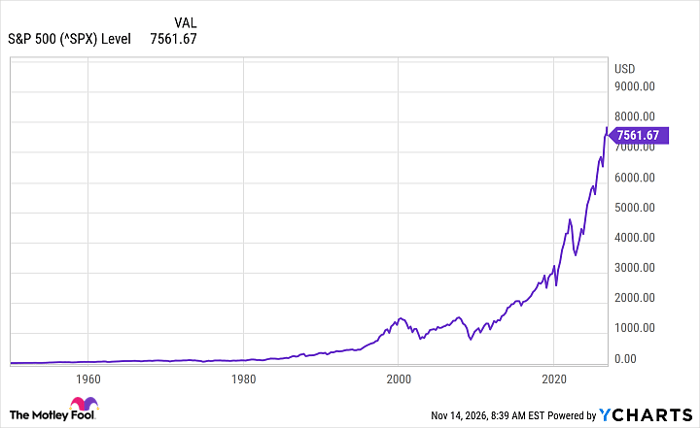
^SPX data by YCharts
These downward movements are part of a normal market cycle -- and so are the brighter times. This means you can expect the market to eventually climb once again.
As for each stock, of course, there will always be some that don't fully recover or take years to do so. That's why it's important to diversify across many stocks and favor quality companies with solid long-term prospects.
So, when the market stalls, if you opt to hold onto your positions instead of panic-selling, you may set yourself up for a big win over the long run.
Should you buy stock in S&P 500 Index right now?
Before you buy stock in S&P 500 Index, consider this:
The Motley Fool Stock Advisor analyst team just identified what they believe are the 10 best stocks for investors to buy now… and S&P 500 Index wasn’t one of them. The 10 stocks that made the cut could produce monster returns in the coming years.
Consider when Netflix made this list on December 17, 2004... if you invested $1,000 at the time of our recommendation, you’d have $335,171!* Or when Nvidia made this list on April 15, 2005... if you invested $1,000 at the time of our recommendation, you’d have $1,000,640!*
Now, it’s worth noting Stock Advisor’s total average return is 823% — a market-crushing outperformance compared to 208% for the S&P 500. Don't miss the latest top 10 list, available with Stock Advisor, and join an investing community built by individual investors for individual investors.
See the 10 stocks »
*Stock Advisor returns as of November 15, 2026.
Adria Cimino has no position in any of the stocks mentioned. The Motley Fool has no position in any of the stocks mentioned. The Motley Fool has a disclosure policy.
Recommended Articles


