


This 27-Year-Old Warning From Warren Buffett Is More Important Than Ever for Investors Today
Key Points
Warren Buffett gave a series of speeches in 1999 as the internet was reshaping business.
He looked back at the technological revolutions of aviation and the automobile.
Successfully investing in those technologies has never been easy, and Buffett offered a simple lesson.
- Motley Fool Issues Rare "Total Conviction" Buy Alert ›
Warren Buffett became a professional investor before the microchip was invented. It's safe to say he's seen quite a few transformative technologies come to market, each with a tremendous impact on society.
In the late 1990s, as the internet was revolutionizing just about every industry, Buffett didn't deny that fact. He even said the internet had the potential to completely upend retail but stopped short of investing in any e-commerce companies.
Missed Nvidia in 2009? This Rare Signal Is Flashing Again. In 2009, a "Double Down" signal flashed for a little-known chipmaker called Nvidia. For the first time in years, that same "Total Conviction" signal is flashing for a company 1/100th the size of Nvidia. Continue »
In 1999, he gave a series of talks that included a stark warning for investors enamored by the booming internet industry. The key lesson from those speeches, summarized in a Fortune Magazine article, is possibly more relevant than ever for stock investors today.
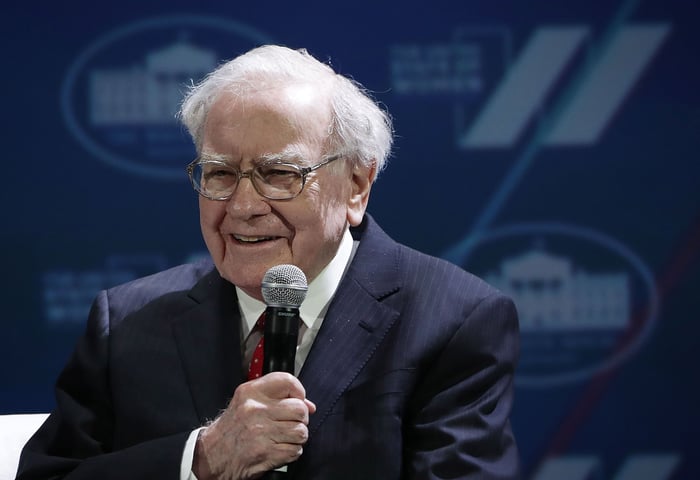
Image source: Getty Images.
Will artificial intelligence make investors rich?
The technology changes, but the challenge for investors remains the same. "The key to investing is not assessing how much an industry is going to affect society, or how much it will grow," Buffett explained.
There's no doubt that artificial intelligence, for example, is having a tremendous impact on society, and it's growing very quickly. But there are other technologies before AI that have had just as large impacts. Specifically, Buffett calls out the automobile and aviation industries in his 1999 speeches.
He describes how the auto industry in the United States had 2,000 manufacturers at one point. "If you had foreseen in the early days of cars how this industry would develop, you would have said, 'Here is the road to riches,'" Buffett said. But by the 1990s, there were only three automakers left, and none of them have been particularly great investments.
Aviation made it possible to travel around the world in hours instead of days. But Buffett once called the airline industry a "bottomless pit" into which investors have poured money. In the Fortune article, he notes that the aviation industry's total profits through 1992 were $0. That's despite the massive impact it's had on travel.
That's a big worry for investors today. The artificial intelligence industry requires a ton of capital to build data centers. But with significant competition among compute providers and frontier AI labs, it's too early to tell how much profit there actually is in the business.
What's more, it's impossible to know which companies, if any, will emerge as the profit makers in the long run. The winners may only be obvious in hindsight, just as they were with previous technological revolutions.
That said, investors can make some guesses, and Buffett provides the exact criterion they need to use to make smart guesses.
The key to investing
I cut off Buffett's quote earlier. "The key to investing is not assessing how much an industry is going to affect society, or how much it will grow," Buffett said, "but rather determining the competitive advantage of any given company and, above all, the durability of that advantage."
As with all of Buffett's investments, he focused on companies with wide moats.
It's interesting that Buffett decided to participate in the AI investment with his initial purchase of Alphabet (NASDAQ:GOOG) (NASDAQ:GOOGL) for Berkshire Hathaway (NYSE:BRKA) (NYSE:BRKB) in 2025. Greg Abel has since made it one of the company's largest equity holdings, with additional purchases in 2026.
Alphabet appears to have a moat around its AI business that's allowed it to invest aggressively in compute capacity. Its full stack, which goes from chip design to cloud infrastructure to its full-fledged platforms, including its Gemini models, to its consumer-facing applications in Search and the Gemini app, and the backend advertising business, ensures it can produce high returns on its invested capital.
Google Cloud CEO Thomas Kurian said its payback period for servers was less than two years and its custom Tensor Processing Unit servers took half the time to recoup the company's investment. That's far faster than most of its competitors, indicating a moat.
By comparison, neocloud companies that build and sell commodity-like servers don't have any moat around their business. As supply constraints on compute capacity ease, the price they can charge customers will drop.
On the software side, investors need to assess whether the leading frontier labs have established a moat. Anthropic and OpenAI offer leading models today, but sustaining that lead requires significant investment in further development and training. Meanwhile, they're competing with Alphabet and other well-capitalized tech companies with immensely profitable businesses outside of AI development.
Considering that artificial intelligence-linked companies now account for around half of the S&P 500's (SNPINDEX:^GSPC) market cap, trillions of dollars' worth of forthcoming bonds are helping drive the U.S. economy, and the continued build-out is helping drive the U.S. economy, Buffett's 27-year-old warning is more important than ever.
Should you buy stock in Berkshire Hathaway right now?
Before you buy stock in Berkshire Hathaway, consider this:
The Motley Fool Stock Advisor analyst team just identified what they believe are the 10 best stocks for investors to buy now… and Berkshire Hathaway wasn’t one of them. The 10 stocks that made the cut could produce monster returns in the coming years.
Consider when Netflix made this list on December 17, 2004... if you invested $1,000 at the time of our recommendation, you’d have $335,171!* Or when Nvidia made this list on April 15, 2005... if you invested $1,000 at the time of our recommendation, you’d have $1,000,640!*
Now, it’s worth noting Stock Advisor’s total average return is 823% — a market-crushing outperformance compared to 208% for the S&P 500. Don't miss the latest top 10 list, available with Stock Advisor, and join an investing community built by individual investors for individual investors.
See the 10 stocks »
*Stock Advisor returns as of November 15, 2026.
Adam Levy has positions in Alphabet. The Motley Fool has positions in and recommends Alphabet and Berkshire Hathaway. The Motley Fool has a disclosure policy.
Recommended Articles


