


Jensen Huang Steps Down as CEO. Is Nvidia Still a Buy?
Key Points
Jensen Huang has been instrumental in catapulting Nvidia into the company it is today.
Huang made several key decisions that paid off big time for investors.
Nvidia’s organization structure is heavily dependent on one person, which poses a key person risk without Huang.
- Motley Fool Issues Rare "Total Conviction" Buy Alert ›
Nvidia (NASDAQ:NVDA) has been tethered to the spotlight since Nov. 8, when founder and then-CEO Jensen Huang admitted to having an affair with Alice Huang.
Alice Huang (no relation to Jensen) was an executive at a Singapore-based Nvidia customer. And reports indicate that U.S. officials and the FBI are investigating the relationship because Alice Huang is suspected of being a Chinese intelligence operative. On Nov. 10, Nvidia hired a prominent New York law firm to initiate an independent investigation into the affair.
Missed AI’s "Act 1"? Act 2 Could Be 15x Bigger. Most investors think they missed the AI boat because they didn't buy Nvidia in 2005. But according to our analysts, we’re only at the end of "Act 1"—the R&D phase. "Act 2" is the global rollout. Continue »
The situation escalated after market close on Nov. 11, when the New York Times reported that Jensen Huang had a romantic relationship with Nvidia's vice president of healthcare, Kimberly Powell. On Nov. 12, reports surfaced of a possible third affair with a second employee. That same day, Nvidia published a press release, announcing that Huang had resigned, with CFO Colette Kress taking over as interim CEO.
As of market close on Nov. 12, Nvidia is down a staggering 27.5% in the last month. Here's how the recent news surrounding Huang impacts Nvidia's investment thesis and whether the growth stock is still a buy.
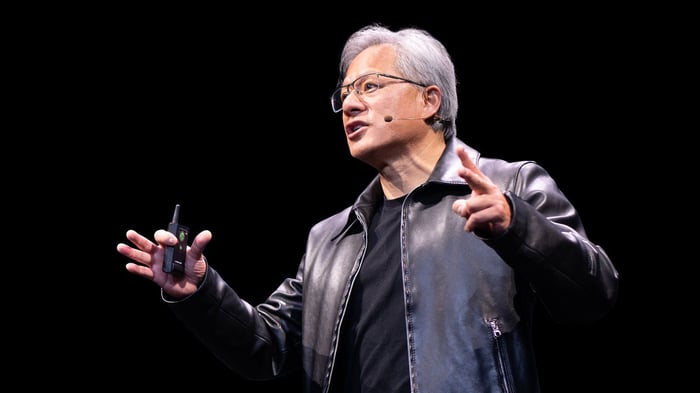
Jensen Huang. Image source: Nvidia.
The face of Nvidia
Jensen Huang was arguably the most important CEO in the world. He co-founded Nvidia with Chris Malachowsky and Curtis Priem 33 years ago and possesses a rare balance of technical, strategic, marketing, and leadership skills.
I recently read The Nvidia Way: Jensen Huang and the Making of a Tech Giant by Tae Kim. It's an excellent book that serves as both a history of Nvidia and a biography of Huang. And the biggest takeaway I had from the book is that Huang is arguably more integral to Nvidia than Steve Jobs was to Apple (NASDAQ:AAPL), Bill Gates was to Microsoft, or Jeff Bezos was to Amazon.
Tim Cook was able to catapult Apple's market cap up severalfold, even after Jobs's passing, by leveraging Apple's integrated ecosystem of products and services. Nvidia is different. When it comes to artificial intelligence (AI) in the semiconductor industry, competition is fierce, and innovation is paramount. Huang has made several key decisions throughout the company's history. And without them, it's highly unlikely the tech stock would be where it is today.
Nvidia's rise to stardom
Huang was a firm believer in parallel computing and the graphics processing unit (GPU) -- a term Nvidia helped coin when it debuted the GeForce 256 in 1999 -- and labeled it the world's first GPU. He was also adamant about CUDA, which is Nvidia's software architecture used by developers with Nvidia GPUs.
By integrating hardware and software, Nvidia paved a runway for repeat business in an industry where a hot product can leapfrog the moats of even the most entrenched industry leaders. After all, Huang saw this in the early days of Nvidia, when the company almost went bankrupt multiple times because it developed products too infrequently and bet the farm on a single launch.
Huang also has an impeccable work ethic and top-to-bottom devotion to Nvidia -- arguably to a fault. Nvidia's organization structure positioned Huang like Jupiter, surrounded by dozens of direct reports that orbit him like moons. This wasn’t just so Huang could keep tabs. It's so that he can contribute through spontaneous bursts of creativity.
To complement this workflow, Nvidia has whiteboards scattered throughout meeting rooms for ideation and real-time problem-solving. The knowledge and willingness to break concepts down, start from scratch, and hold frequent open discussions have become essential parts of Nvidia's corporate culture. And it remains to be seen if that will persist under new leadership.
Huang has also been a firm proponent of AI. And it's a key reason why Nvidia was able to shift its end markets from gaming, professional visualization, and automotive to data centers in just a few years. Gaining a foothold in AI was one thing. But Nvidia has continued to push the bounds of innovation through incredibly impressive product upgrades.
Nvidia could have easily taken its foot off the gas after announcing its Grace Blackwell architecture in March 2024. Blackwell unlocked massive efficiency improvements and cost reductions in AI training. But Nvidia really outdid itself with Vera Rubin, which it announced in January 2026.
Rubin's full-stack platform includes six chips, allowing Nvidia to control a larger share of data center infrastructure. Rubin's cost reductions and efficiency improvements compared to Blackwell are so massive that hyperscalers are lining up at the door to place orders. On the Aug. 26 Q2 fiscal 2027 earnings call, Nvidia said that it began shipping Rubin in August and expects it to account for 20% of its Q3 data center revenue, which it will report on Nov. 17.
Take a pause on Nvidia stock for the time being
Reports of three affairs, an internal investigation, an FBI probe, and now Jensen Huang resigning as CEO directly impact the investment thesis. Until we get answers on the extent of the damage and the next long-term CEO, the stock simply isn't as strong a buy as it used to be -- even with a valuation that's ridiculously cheap for such a high-quality business.
I wouldn't sell Nvidia simply because the company's operating leverage and market position are impossible to ignore. But it's hard to imagine Nvidia without Jensen Huang's leadership. The situation would be different if Huang had a clear successor, but there's nothing of the kind at Nvidia, which poses a major key-person risk.
At the very least, Nvidia must overhaul its organizational structure. Poor character aside, I'd expect any replacement to fall short of Huang's caliber as a CEO. And that's legitimately concerning for investors.
As tempting as the sell-off looks at first glance, investors are better off waiting for the dust to settle. I'd much rather buy the stock at a higher price with greater clarity than bottom-fish in waters this murky.
Should you buy stock in Nvidia right now?
Before you buy stock in Nvidia, consider this:
The Motley Fool Stock Advisor analyst team just identified what they believe are the 10 best stocks for investors to buy now… and Nvidia wasn’t one of them. The 10 stocks that made the cut could produce monster returns in the coming years.
Consider when Netflix made this list on December 17, 2004... if you invested $1,000 at the time of our recommendation, you’d have $338,083!* Or when Nvidia made this list on April 15, 2005... if you invested $1,000 at the time of our recommendation, you’d have $1,021,163!*
Now, it’s worth noting Stock Advisor’s total average return is 830% — a market-crushing outperformance compared to 209% for the S&P 500. Don't miss the latest top 10 list, available with Stock Advisor, and join an investing community built by individual investors for individual investors.
See the 10 stocks »
*Stock Advisor returns as of November 13, 2026.
Daniel Foelber has positions in Nvidia. The Motley Fool has positions in and recommends Amazon, Apple, Microsoft, and Nvidia. The Motley Fool has a disclosure policy.
Recommended Articles


