


SoundHound AI Stock Is Down Almost 60% in 2026, but Wall Street Thinks It Can Soar 155% By the End of 2027. Here’s Why It Could Be One of the Best Buys Amid the Tech Sell-Off.
Key Points
SoundHound AI's cost-saving actions are likely to boost investor confidence in the stock next year.
Analysts expect the company to significantly reduce its losses in 2027.
SoundHound's strong revenue growth and its move toward profitability could supercharge the stock over the coming year.
- Motley Fool Issues Rare "Total Conviction" Buy Alert ›
Shares of SoundHound AI (NASDAQ:SOUN) have been clobbered on the stock market this year, losing nearly 60% of their value as of this writing.
The conversational voice artificial intelligence (AI) solutions provider has struggled on the stock market amid widening losses. However, analysts seem bullish about SoundHound AI's potential over the coming year. Let's see why that may be the case.
Missed Nvidia in 2009? This Rare Signal Is Flashing Again. In 2009, a "Double Down" signal flashed for a little-known chipmaker called Nvidia. For the first time in years, that same "Total Conviction" signal is flashing for a company 1/100th the size of Nvidia. Continue »

Image source: Getty Images.
Wall Street sees tremendous potential in SoundHound AI stock
SoundHound AI's median 12-month price target of $10 implies a potential 156% jump over the coming year. Even better, six of the seven analysts covering SoundHound rate the stock as a buy. The stock has one hold rating.
Another interesting factor to note is that SoundHound's Street-low price target of $5 implies the stock could jump 28% over the next year. It is easy to see why Wall Street seems to think that the worst is behind SoundHound.
After all, the stock has a price-to-sales ratio of just 7.7, which is well below the sales multiple of 26 at the end of 2025. Importantly, SoundHound continues to clock healthy growth, which explains why the stock has become significantly cheaper this year following its steep pullback. Also, a closer look at SoundHound's latest quarterly report suggests that the primary reason the stock has been under pressure this year won't last long.
Here's why the stock could live up to Wall Street's expectations
SoundHound released its Q3 results on Nov. 5. The company's revenue increased by 48.5% from the year-ago period to $62.4 million. However, its non-GAAP net loss per share increased to $0.05 from $0.03 in the year-ago period. SoundHound's margins shrank last quarter due to acquisition-related and product development costs.
However, there were many positive takeaways from SoundHound's quarterly report. The company now expects $255 million in revenue in 2026 at the midpoint of its guidance range, up from the earlier estimate of $245 million. The updated guidance implies a potential jump of 51% in the top line this year. What's more, SoundHound expects revenue to grow by 47% in 2027 to $375 million.
More importantly, SoundHound AI expects significant cost savings following the acquisition of LivePerson. Specifically, the company sees annualized cost synergies worth $120 million in 2027. It will initiate $80 million in cost-saving actions in 2026 itself. At the same time, SoundHound has been dialing down contracts that were negatively impacting its gross margin.
The company believes that these moves will help it achieve sustained positive adjusted earnings before interest, taxes, depreciation, and amortization (EBITDA) in the second half of 2027. SoundHound management notes that it can become adjusted EBITDA positive in the second half of next year, even at the bottom end of its $350-$400 million revenue guidance range.
This probably explains why analysts expect SoundHound AI's per-share loss to shrink in 2027.
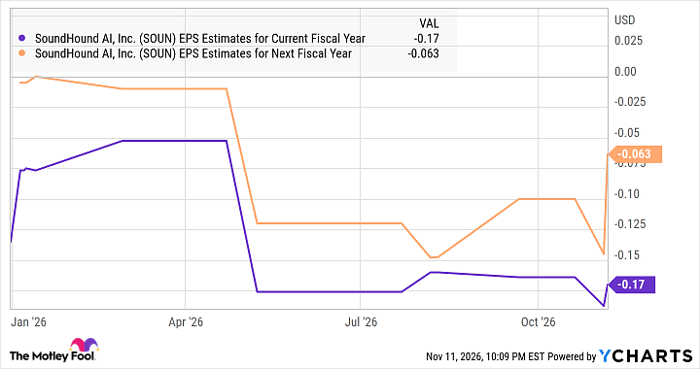
SOUN EPS Estimates for Current Fiscal Year data by YCharts
Additionally, we have seen that SoundHound is on track to maintain its robust revenue growth rate next year. SoundHound's sales multiple of 8 is almost in line with the U.S. technology sector's price-to-sales ratio. However, I won't be surprised to see SoundHound trading at a higher sales multiple a year from now. The company's solid revenue growth and reduced losses could boost investor confidence in the stock and lead the market to reward it with a higher multiple.
Assuming SoundHound trades at even 10 times sales and achieves the midpoint of its 2027 revenue target, its market cap could jump to $3.75 billion. That's 96% higher than SoundHound's current market cap, suggesting the company could indeed deliver the phenomenal gains Wall Street expects.
So, investors looking to buy a solid stock trading at an attractive valuation right now can consider using SoundHound AI’s brutal sell-off in 2026 to accumulate its shares, as the points discussed above suggest the New Year could be a much better one for the company.
Should you buy stock in SoundHound AI right now?
Before you buy stock in SoundHound AI, consider this:
The Motley Fool Stock Advisor analyst team just identified what they believe are the 10 best stocks for investors to buy now… and SoundHound AI wasn’t one of them. The 10 stocks that made the cut could produce monster returns in the coming years.
Consider when Netflix made this list on December 17, 2004... if you invested $1,000 at the time of our recommendation, you’d have $348,060!* Or when Nvidia made this list on April 15, 2005... if you invested $1,000 at the time of our recommendation, you’d have $1,067,492!*
Now, it’s worth noting Stock Advisor’s total average return is 849% — a market-crushing outperformance compared to 210% for the S&P 500. Don't miss the latest top 10 list, available with Stock Advisor, and join an investing community built by individual investors for individual investors.
See the 10 stocks »
*Stock Advisor returns as of November 12, 2026.
Harsh Chauhan has no position in any of the stocks mentioned. The Motley Fool has positions in and recommends SoundHound AI. The Motley Fool has a disclosure policy.
Recommended Articles


