


2 Years Until the Next Election. What Long-Term Investors Should Do With the Next 24 Months.
Key Points
Research from U.S. Bancorp suggests that most of the time, elections don’t matter for stock market returns.
In any given one-year period, the S&P 500 goes up about 74% of the time.
The Vanguard S&P 500 ETF has delivered annualized returns of about 14.8% for the past 16 years.
- These 10 stocks could mint the next wave of millionaires ›
The 2026 midterm elections delivered a sweeping victory for the Democratic Party and a rebuke to President Donald Trump. Well-known red states like Texas turned mostly blue. Democrats will soon control the U.S. House and Senate by strong margins.
Depending on how you voted last week, you might be feeling the thrill of victory or the disappointment of defeat. But try not to let your political views affect how you invest. Even if your chosen candidates fall short at the polls, long-term investors are usually better off ignoring elections and focusing on fundamentals like economic growth, inflation, and corporate earnings.
Missed Nvidia in 2009? This Rare Signal Is Flashing Again. In 2009, a "Double Down" signal flashed for a little-known chipmaker called Nvidia. For the first time in years, that same "Total Conviction" signal is flashing for a company 1/100th the size of Nvidia. Continue »
Let's look at why elections don't matter much for your investments, and how to use the next 24 months before the 2028 elections to set up your portfolio for long-term success.
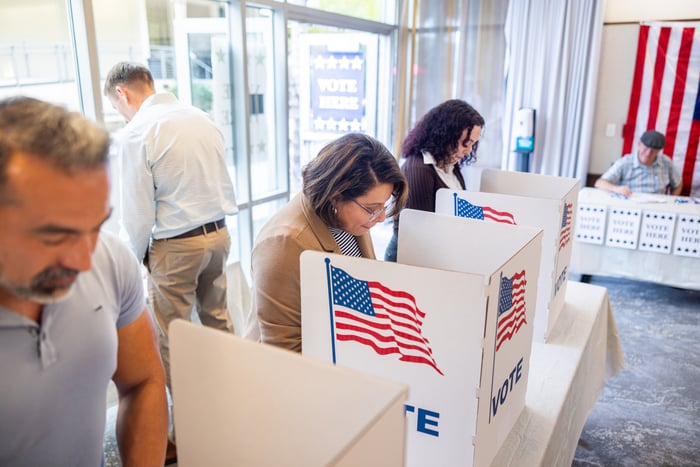
Image source: Getty Images.
Elections don't matter? Not for long-term investors
It's not correct to say that "elections don't matter." The parties in power have a massive impact on public policy. Decisions in state capitals and Washington, D.C., affect the everyday lives of hundreds of millions of Americans and countless others around the world.
The election of different politicians and parties can also be good or bad news for specific companies or industries. Different parties in power can enact new taxes or regulations that harm some companies, or create new incentives or government spending plans that benefit others.
For example, the recent midterm election showed a wide bipartisan backlash against artificial intelligence (AI) data centers. If a politician gets elected promising to limit or slow down the construction of AI data centers and follows through on that pledge, that could be bad news for semiconductor stocks or other AI-related stocks.
But in the long run, U.S. politicians from both parties don't tend to hurt stock market growth. 2024 research from U.S. Bancorp found that, in the medium- to long-term, elections have "minimal impact" on financial market performance. The bank's analysis also found that economic and inflation trends have a larger impact than election results on market returns.
Remember: The S&P 500 tends to go up
Politicians have a lot of power, but they don't control the U.S. economy. Over the long run, American businesses tend to get better at solving problems, creating must-have products, and delivering strong earnings for shareholders. The S&P 500 (SNPINDEX: ^GSPC) goes up most of the time, regardless of who's in power in government.
Over the past 98 years, since 1928, the S&P 500 has delivered positive one-year returns in 72 of those years. That means you have about a 67% chance of earning a positive return from buying and holding an S&P 500 ETF for one year.
If you hold your stocks even longer, the chances get better. According to S&P 500 historical returns data compiled by Capital Group , holding the S&P 500 for three years delivers a positive return 88% of the time. A five-year holding period delivers positive returns 93% of the time. And 10-year periods deliver positive returns close to 100% of the time.
There's no 100% guaranteed "sure thing" in investing. But simply buying and holding the S&P 500 tends to deliver.
For example, the Vanguard S&P 500 ETF (NYSEMKT: VOO) has delivered strong returns for long-term investors. VOO has delivered annualized returns of about 14.9% in the past 16 years, 15.5% in the past 10 years, and 12% in the past five years.
How to invest before the 2028 election
How should you invest for the next two years? For most people, the answer is to just keep buying stocks according to your long-term plan. Don't make any drastic moves based on short-term fears and doubts or try to predict the future.
Even if you have strong convictions about what the latest election is going to do for specific companies or sectors, the rest of the market might have already priced in those outcomes. For example, if you believe the Democrats' big win will be bad for AI data centers and semiconductor stocks ... millions of other investors might believe that too, and they might have already made that trade. The market can move faster than you.
If you're seriously losing sleep or suffering anxiety about your stocks, you might want to make a few changes in your portfolio. You might want to consider diversifying or de-risking by adding more bonds to your investment mix.
But if you're really in this for the long term, two years isn't a big deal. Keep buying a diversified portfolio of stocks. Hold on to them for at least five years. Let the economy do its work for you.
Missed Nvidia in 2009? This Rare Signal Is Flashing Again
In 2009, a "Double Down" signal flashed for a little-known chipmaker called Nvidia. If you’d invested $5,000 then, you’d be sitting on $2,195,396 today.*
Now, for the first time in years, that same "Total Conviction" signal is flashing for a company 1/100th the size of Nvidia. It’s a key player in the $1.8 trillion space race, and with the stock recently sitting 20% off its highs, the window to get in early is closing fast.
Continue »
*Stock Advisor returns as of November 12, 2026.
Ben Gran has no position in any of the stocks mentioned. The Motley Fool has positions in and recommends U.S. Bancorp and Vanguard S&P 500 ETF. The Motley Fool has a disclosure policy.
Recommended Articles


