


Prediction: 2 Stocks That Will Be Worth More Than Amazon 5 Years From Now
Key Points
Amazon’s AI spending flows to suppliers like TSMC and Broadcom, which also collect from every Amazon rival.
Broadcom’s $63 billion, bank-financed Anthropic deal shows how deep demand for custom AI chips runs.
Last week’s Nvidia and chip sell-off proves the AI trade is real but far from steady.
- Motley Fool Issues Rare "Total Conviction" Buy Alert ›
Amazon (NASDAQ: AMZN) is worth about $2.9 trillion as of this writing. That is a hard number to pass, and Amazon is not standing still. It is pouring money into data centers, custom chips, and robotics at a pace few companies can match.
That spending has to go somewhere, though. Every dollar Amazon spends on AI hardware flows to a supplier, and two of those suppliers sit in a position Amazon can't replicate. They collect from Amazon, and from every one of Amazon's rivals, at the same time. Those suppliers are Taiwan Semiconductor Manufacturing (NYSE: TSM) and Broadcom (NASDAQ: AVGO), and I think both will pass Amazon in market value by 2031. Here's why.
Missed Nvidia in 2009? This Rare Signal Is Flashing Again. In 2009, a "Double Down" signal flashed for a little-known chipmaker called Nvidia. For the first time in years, that same "Total Conviction" signal is flashing for a company 1/100th the size of Nvidia. Continue »
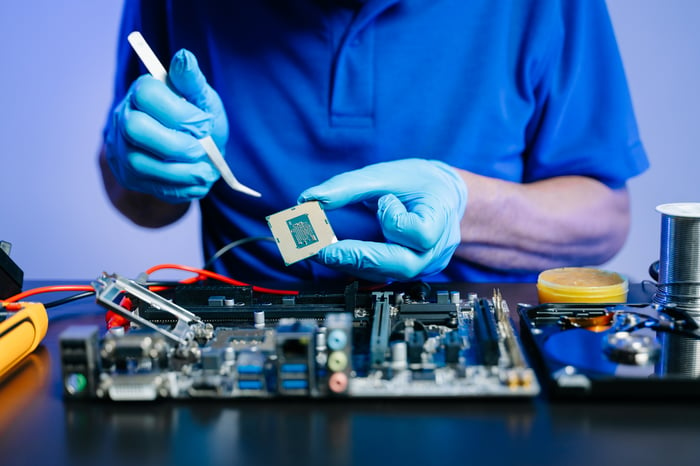
Image source: Getty Images.
Taiwan Semiconductor builds the chips everyone else designs
Taiwan Semiconductor, or TSMC, is a foundry. It doesn't design chips. It manufactures them for companies that do, which means it gets paid whether Nvidia (NASDAQ: NVDA) wins, Advanced Micro Devices (NASDAQ: AMD) wins, or Amazon's in-house Trainium chip wins. Amazon designs Trainium to lower its reliance on Nvidia, and then it sends that design to TSMC to be built. The customer and the competitor end up at the same factory door.
TSMC is worth around $1.8 trillion today, so the gap between it and Amazon is the smaller of the two. What closes it, to me, is the Arizona project. TSMC has raised its planned U.S. investment from $12 billion in 2020 to $265 billion, and in July it said it intends to add more fabs for 2-nanometer and smaller chips plus more advanced packaging plants. The second Arizona fab is aiming for volume production in the second half of 2027, and the third is slated for the company's N2 and A16 processes before the decade ends.
Why does that matter beyond the headline? Advanced packaging, the step where chips get stacked and connected, is the bottleneck in AI hardware right now. Owning that step on U.S. soil, next to the customers who need it, turns TSMC from an overseas supplier into local infrastructure.
Broadcom is the stock that has to grow the most
Broadcom sits at around $1.56 trillion, which means it needs to gain about 70% on Amazon over five years, before accounting for Amazon's own growth. That is the harder call, and it is the one I feel better about.
Broadcom builds custom AI accelerators, which it calls XPUs, for the companies that want an alternative to buying Nvidia chips off the shelf. On Oct. 26, Bank of America (NYSE: BAC), Blackstone (NYSE: BX), Citi (NYSE: C), and Morgan Stanley (NYSE: MS) announced a $63 billion financing structure to buy Broadcom accelerators and networking gear and lease them to Anthropic, with deliveries starting in 2027. Four of the largest financial firms in the world built a vehicle to finance one customer's purchases of one chipmaker's hardware. Broadcom is backing part of the deal with residual value support, which tells you how confident it is that the gear holds its worth.
That same month, Broadcom rolled out new networking products at the OCP Global Summit. Networking is the quieter half of its story. When thousands of accelerators run as one system, the switches connecting them matter as much as the chips, and Broadcom is one of a few companies that sells both.
What investors should take from this
Passing Amazon is not the point of owning either stock. The point is understanding where AI money goes once it leaves the companies building data centers. Amazon has to win its own race. TSMC and Broadcom get paid no matter who wins, as long as the race keeps running. That said, the AI race has hit some turbulence, especially in the last couple of months.
Look at Nvidia this week for proof. On Thursday last week, the Philadelphia Semiconductor Index had its worst day since April 2025, the Nasdaq Composite closed in correction territory, and Nvidia shed more than 9% on fears that a new Congress could slow the data center build-out.
Then, on Sunday, Nvidia's board announced an independent review into reports that CEO Jensen Huang was the target of a foreign intelligence effort. The stock opened down about 8% on Monday, erasing about $350 billion in value before clawing some of it back. None of that had anything to do with chip demand. It was politics one day, and a governance headline the next. The most valuable company in the world still moved like a small-cap.
That is what a market finding its footing looks like. The AI trade is real, but it is not yet steady, and anyone buying TSMC or Broadcom on this thesis should expect more weeks like this one.
Should you buy stock in Taiwan Semiconductor Manufacturing right now?
Before you buy stock in Taiwan Semiconductor Manufacturing, consider this:
The Motley Fool Stock Advisor analyst team just identified what they believe are the 10 best stocks for investors to buy now… and Taiwan Semiconductor Manufacturing wasn’t one of them. The 10 stocks that made the cut could produce monster returns in the coming years.
Consider when Netflix made this list on December 17, 2004... if you invested $1,000 at the time of our recommendation, you’d have $341,157!* Or when Nvidia made this list on April 15, 2005... if you invested $1,000 at the time of our recommendation, you’d have $1,037,753!*
Now, it’s worth noting Stock Advisor’s total average return is 834% — a market-crushing outperformance compared to 207% for the S&P 500. Don't miss the latest top 10 list, available with Stock Advisor, and join an investing community built by individual investors for individual investors.
See the 10 stocks »
*Stock Advisor returns as of November 11, 2026.
Citigroup is an advertising partner of Motley Fool Money. Bank of America is an advertising partner of Motley Fool Money. Micah Zimmerman has no position in any of the stocks mentioned. The Motley Fool has positions in and recommends Advanced Micro Devices, Amazon, Blackstone, Broadcom, Nvidia, and Taiwan Semiconductor Manufacturing. The Motley Fool has a disclosure policy.
Recommended Articles


