


Is the Micron Sell-Off a Buying Opportunity or a Falling Knife?
Key Points
High demand and the resulting shortage of memory hardware have given Micron unprecedented pricing power.
Micron's fiscal year 2026 revenue and net income increased 256% and 895%, respectively, year over year.
- Motley Fool Issues Rare "Total Conviction" Buy Alert ›
Chipmaker Micron Technology (NASDAQ: MU) has been on a generational run over the past couple of years. Since the start of 2025, the stock is up over 773%, outperforming every S&P 500 company except SanDisk (as of Nov. 9). Despite Micron's historic run, the past month has been brutal, with the stock down over 28%.
Missed Nvidia in 2009? This Rare Signal Is Flashing Again. In 2009, a "Double Down" signal flashed for a little-known chipmaker called Nvidia. For the first time in years, that same "Total Conviction" signal is flashing for a company 1/100th the size of Nvidia. Continue »
Given this sharp pullback, is the Micron sell-off a falling knife and a warning sign of what's to come, or is now the time to buy the dip on one of the artificial intelligence (AI) boom's premier companies? For investors with time on their side, I believe it's the latter.

Image source: The Motley Fool.
Riding the memory cycle high
Micron's surge into the limelight has come at the hands of the current AI gold rush. It makes memory hardware and chips that are vital pieces of the AI infrastructure puzzle. As AI hyperscalers (companies that own and operate massive cloud infrastructure) continue to build data centers, demand for this hardware has skyrocketed.
This has worked in Micron's favor, as it has used increased demand -- and the supply shortage it has created -- to flex its pricing power.
In fiscal year 2026 (ended Sept. 3), Micron made $133.2 billion in revenue, up 256% from the $37.4 billion it made in fiscal 2025. Its net income and operating cash flow (cash made from daily operations) growth were arguably more impressive, up 895% and 412%, respectively.
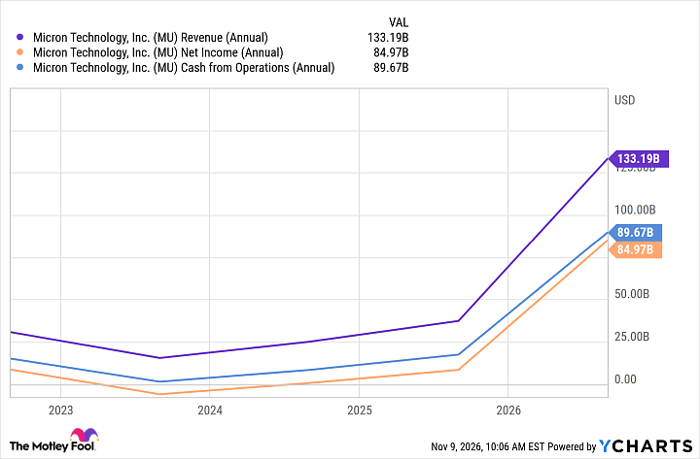
MU Revenue (Annual) data by YCharts
Micron's business has been flourishing, no doubt, but a major reason for its recent stock struggles is broader AI bubble fears (many top AI stocks have struggled over the past month) and concerns about whether the memory market -- which is notoriously cyclical -- has peaked.
Is Micron a buy right now?
Micron's stock journey has been rewarding but far from smooth. It has been one of the most volatile AI stocks, and that's likely to continue. If you can't stomach its high volatility and hold through the rough patches, it's likely not the investment for you right now.
However, if you're interested in Micron but want to reduce some of the risk, I would dollar-cost average and slowly but surely build a stake rather than investing a lump sum. For example, instead of investing $200 at once, consider breaking that into $50 weekly investments.
You might miss sudden surges (like the 6% gain on Nov. 9), but it also keeps you from investing a lump sum right before a sharp drop. Micron likely won't repeat its returns from the past two years, but it's still a good long-term option. Just be prepared for an inevitable slowdown whenever the memory market is on the downside of the cycle, whenever that may be.
Should you buy stock in Micron Technology right now?
Before you buy stock in Micron Technology, consider this:
The Motley Fool Stock Advisor analyst team just identified what they believe are the 10 best stocks for investors to buy now… and Micron Technology wasn’t one of them. The 10 stocks that made the cut could produce monster returns in the coming years.
Consider when Netflix made this list on December 17, 2004... if you invested $1,000 at the time of our recommendation, you’d have $341,157!* Or when Nvidia made this list on April 15, 2005... if you invested $1,000 at the time of our recommendation, you’d have $1,037,753!*
Now, it’s worth noting Stock Advisor’s total average return is 834% — a market-crushing outperformance compared to 207% for the S&P 500. Don't miss the latest top 10 list, available with Stock Advisor, and join an investing community built by individual investors for individual investors.
See the 10 stocks »
*Stock Advisor returns as of November 11, 2026.
Stefon Walters has no position in any of the stocks mentioned. The Motley Fool has positions in and recommends Micron Technology. The Motley Fool has a disclosure policy.
Recommended Articles


