


This Semiconductor ETF Just Had Its Worst Day Since March 2020
Key Points
A variety of headwinds, some political, are weighing on chip stocks.
Election results make for an easy scapegoat, but there are also some stock-specific issues hindering this ETF.
- Motley Fool Issues Rare "Total Conviction" Buy Alert ›
Technology stocks were drubbed on Thursday, Nov. 5, as investors priced in the impact of Tuesday's midterm election results.
Amid a blue tsunami that saw Democrats take control of both chambers of Congress and a host of gubernatorial victories, fears are rising that data center construction could stall and artificial intelligence (AI) regulations could enter the spotlight. Semiconductor stocks are epicenters of the calamity.
Missed Nvidia in 2009? This Rare Signal Is Flashing Again. In 2009, a "Double Down" signal flashed for a little-known chipmaker called Nvidia. For the first time in years, that same "Total Conviction" signal is flashing for a company 1/100th the size of Nvidia. Continue »
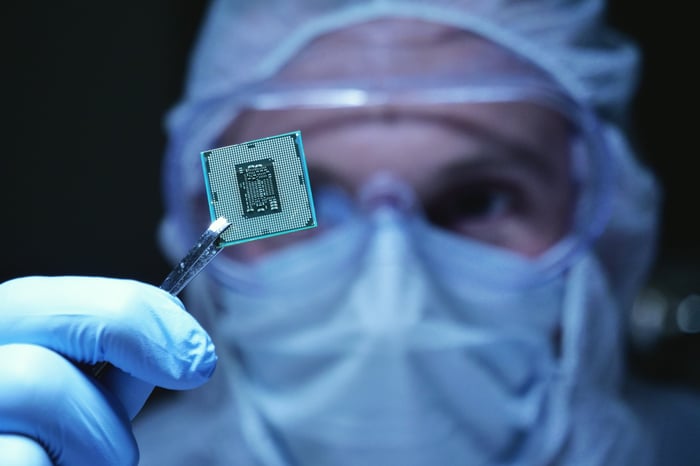
The iShares Semiconductor ETF just posted its worst intraday slide in over six years. Image source: Getty Images.
Just look at the iShares Semiconductor ETF (NASDAQ: SOXX). The second-largest exchange-traded fund (ETF) in the semiconductor category slid 12.1% on Thursday, notching its worst intraday decline since March 2020, when stocks slumped into a bear market due to the coronavirus pandemic. Let's see if this ETF's weakness is a warning sign or a buy-on-the-dip opportunity.
Speaking of bear markets ...
Unfortunately, the iShares ETF's Nov. 5 slide isn't a one-off event. It comes on the heels of an 8.2% drop on Oct. 30. That is to say, in the span of about a week, this ETF has had its fifth- and seventh-worst intraday showings ever, and that's saying something, because the fund is more than 25 years old. The fund is now down 30% over the past month and trades nearly 38% below its 52-week high. In short, it's in a bear market.
Yes, election results make for an easy scapegoat for chip stocks' recent misfortunes, but there are also some stock-specific issues hindering this ETF. For example, Qualcomm (NASDAQ: QCOM), the fund's eighth-largest holding, tumbled on Thursday after reporting a 26% decline in fiscal fourth-quarter smartphone chip sales.
Micron Technology (NASDAQ: MU) is another offender hailing from this ETF's roster. That stock, the iShares fund's fourth-largest component, plunged 17% on Thursday amid fears that memory chip shortages could pinch the broader tech sector and that, if data centers stall, demand for memory chips will slump. Memory chip demand is pertinent to the iShares ETF because the fund holds several other memory names in addition to Micron.
Add in election results that some experts say represent a "total repudiation" of AI, and these are perilous times for semiconductor stocks and related ETFs.
Perspective and maybe opportunity
There's no denying that "bloodbath" is an accurate description of the week for semiconductor stocks, but in turbulent times, perspective is most valuable. On that note, investors interested in kicking in the tires on the iShares ETF or individual chip names may be heartened to know that it's not uncommon for markets to immediately overreact to election results before cooler heads prevail over the subsequent weeks and months.
Second, and admittedly this is a wild card, anti-AI/data center stances make for good campaign trail fodder, but post-election reality is different for politicians. That reality includes the burning desire (in most cases) to win the next election, and railing against cash-rich tech companies that can fund opposition in primary or general elections may not be the ticket to future political victory for this year's winners.
So there may be an opportunity with chip stocks and ETFs, and the silver lining is that prospective buyers acting in the near term will benefit from better pricing than was available just a few weeks ago.
Should you buy stock in iShares Trust - iShares Semiconductor ETF right now?
Before you buy stock in iShares Trust - iShares Semiconductor ETF, consider this:
The Motley Fool Stock Advisor analyst team just identified what they believe are the 10 best stocks for investors to buy now… and iShares Trust - iShares Semiconductor ETF wasn’t one of them. The 10 stocks that made the cut could produce monster returns in the coming years.
Consider when Netflix made this list on December 17, 2004... if you invested $1,000 at the time of our recommendation, you’d have $341,966!* Or when Nvidia made this list on April 15, 2005... if you invested $1,000 at the time of our recommendation, you’d have $1,146,819!*
Now, it’s worth noting Stock Advisor’s total average return is 852% — a market-crushing outperformance compared to 203% for the S&P 500. Don't miss the latest top 10 list, available with Stock Advisor, and join an investing community built by individual investors for individual investors.
See the 10 stocks »
*Stock Advisor returns as of November 8, 2026.
Todd Shriber has no position in any of the stocks mentioned. The Motley Fool has positions in and recommends Micron Technology, Qualcomm, and iShares Trust-iShares Semiconductor ETF. The Motley Fool has a disclosure policy.
Recommended Articles


