


Warren Buffett Warned Investors About This Number 27 Years Ago. It's Never Been Higher. Should AI Investors Worry?
Key Points
After-tax corporate profits hit 13% of U.S. GDP in the second quarter, the highest in government records going back to 1947 and more than double the level Buffett called a stretch.
A big driver is AI spending: Amazon, Alphabet, Microsoft, and Meta spent about $202 billion on property and equipment last quarter, and much of it became revenue for Nvidia and CoreWeave.
Buffett's warning has looked wrong for two decades, but his bigger lesson applies to AI stocks today, and Berkshire's own earnings report on Saturday shows where it is putting its cash: a record $9.6 billion in stock buybacks.
- Motley Fool Issues Rare "Total Conviction" Buy Alert ›
In 1999, near the peak of the dot-com boom, Warren Buffett explained in a Fortune magazine article, drawn from speeches he gave that year, why stock investors were expecting too much. One of his reasons: "In my opinion, you have to be wildly optimistic to believe that corporate profits as a percent of GDP can, for any sustained period, hold much above 6%."
At the time, after-tax corporate profits were running right around 6% of GDP. In the second quarter of 2026, they stood at about 13%, according to Commerce Department data. That's not just a more than doubling since 1999; it's also orporate profits are at their highest share of GDP on record, going back to 1947, topping the previous peak of 12.7% in 2021, and it's above every full year since the government's annual records begin in 1929.
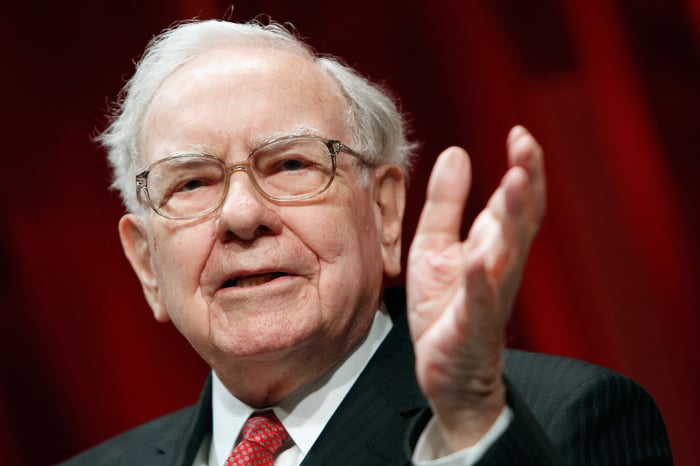
Warren Buffett. Image source: Getty Images.
Missed Nvidia in 2009? This Rare Signal Is Flashing Again. In 2009, a "Double Down" signal flashed for a little-known chipmaker called Nvidia. For the first time in years, that same "Total Conviction" signal is flashing for a company 1/100th the size of Nvidia. Continue »
Buffett Has Been Wrong About This for Years
To be fair, investors who sold on Buffett's warning would have missed a lot. Profits have topped 6% of GDP in 95 of the 106 quarters since 2000, and stocks have soared.
But his reasoning is worth a second look now. "If corporate investors, in aggregate, are going to eat an ever-growing portion of the American economic pie, some other group will have to settle for a smaller portion," he wrote. In other words, when profits take a record share of the economy, someone else, usually workers, is getting less. Some economists now think that is about to reverse.
Where the Record Profits Come From
Tech drove about two-thirds of this year's earnings growth, research firm TS Lombard estimated in a Nov. 5 report, with energy companies adding much of the rest.
Much of that tech profit traces back to a handful of spenders. Here's what four of them paid for property and equipment, mostly data centers and the chips inside them, in the quarter that ended Sept. 30, according to their quarterly filings:
- Amazon (NASDAQ:AMZN): $77.3 billion, up from $35.1 billion a year earlier
- Alphabet (NASDAQ:GOOGL): $51.4 billion, up from $24.0 billion
- Microsoft (NASDAQ:MSFT): $39.4 billion, up from $19.4 billion
- Meta Platforms (NASDAQ:META): $34.0 billion, up from $18.8 billion
That's about $202 billion in one quarter, more than double the $97 billion a year earlier. Another important thing to note: One company's spending is often another's revenue. Data centers accounted for $89.0 billion of Nvidia's (NASDAQ:NVDA) $96.2 billion in sales in its quarter ended July 26, or about 92%. CoreWeave (NASDAQ:CRWV), which rents out AI computing power, had $103.7 billion in contracted future revenue as of June 30, but also $35.6 billion in debt and a $626 million quarterly loss.
TS Lombard economist Dario Perkins estimates that more than 80% of AI-related revenue still comes from spending within the AI industry itself, rather than from outside customers paying for AI services. If that spending slows, he warned, those "paper earnings" will disappear.
The Other Half of Buffett's Warning
Buffett's "smaller portion" argument is the part that could matter in 2027. Employers added 165,000 jobs in October, and unemployment fell to 4.1% from 4.2%, the Labor Department reported Friday. TS Lombard expects that hiring to push wages up, raising companies' labor costs, while the firm's Freya Beamish expects the Federal Reserve to keep raising interest rates.
Investors got a preview of how fragile sentiment is. On Thursday, the Invesco QQQ Trust (NASDAQ:QQQ), which tracks the Nasdaq 100, fell 6.5%, its worst day since March 2020. It bounced 1.4% on Friday, and the U.S. stock market is still up about $5 trillion in value this year, according to Apollo chief economist Torsten Slok. But CoreWeave's bonds now yield more than 16%, CNBC reported, a sign lenders are nervous.
What Would Buffett Do?
In the same 1999 article, Buffett pointed out that cars and airplanes changed the world, yet most of the companies that built them were terrible investments. His lesson: "The key to investing is not assessing how much an industry is going to affect society, or how much it will grow, but rather determining the competitive advantage of any given company and, above all, the durability of that advantage."
For AI stocks, that means separating the companies that control their own fate from those that depend on someone else's budget. Amazon, Alphabet, Microsoft and Meta can choose to spend less, which would leave more cash for profits and buybacks. Nvidia has a powerful advantage, but much of its sales depend on those budgets. CoreWeave depends on them, as well as on borrowed money.
What Berkshire Did This Quarter
Berkshire Hathaway (NYSE:BRKB), now run by CEO Greg Abel, gave its own answer on Saturday. In its third-quarter report, it said it bought back about $9.6 billion of its own stock during the quarter, the most in any quarter in its history based on its past filings, bringing the year's total to about $14.4 billion. A year earlier, it hadn't bought back any shares in the first nine months of 2025.
Berkshire repurchases shares only when its CEO believes the price is below the company's intrinsic value, "conservatively determined," its filing says. In other words, while Wall Street argues about AI, Berkshire's best idea this quarter was a collection of railroads, utilities, insurers and manufacturers.
This isn't a reason to dump tech stocks. But record profit margins rarely last forever. If you want to buy the dip, Buffett's advice would seem to favor durable businesses with cash to spare, and you should add gradually and watch Nvidia's next quarterly report, expected Nov. 17.
Missed AI’s "Act 1"? Act 2 Could Be 14x Bigger
Most investors think they missed the AI boat because they didn't buy Nvidia in 2005.
But according to our analysts, we’re only at the end of "Act 1"—the R&D phase. "Act 2" is the global rollout, a massive technology build-out that Google’s CEO says could be more profound than fire or electricity.
While everyone watches the chip designers, one "backbone" company provides the critical technology that Nvidia and AMD literally cannot function without. We’ve detailed this under-the-radar player in our new AI Playbook.
Continue »
Jonathan Ponciano has no position in any of the stocks mentioned. The Motley Fool has positions in and recommends Alphabet, Amazon, Berkshire Hathaway, Meta Platforms, Microsoft, and Nvidia. The Motley Fool has a disclosure policy.
Recommended Articles


