


Democrats Just Swept Congress. Here's What History Says the S&P 500 Does Next.
Key Points
Democrats took control of both the House and the Senate with Tuesday's election.
History points to strong returns over the next 12 months.
Investors should pay attention to potential policies affecting corporate earnings and consumers and focus on fundamentals.
- Motley Fool Issues Rare "Total Conviction" Buy Alert ›
American voters made it clear on Tuesday that they want to see some changes in Washington, D.C., and in their states' executive offices. Democrats flipped both the House and Senate, leaving President Donald Trump with a divided government. The new government could face challenges in enacting legislation, as the executive branch stands in the way of the legislature and vice versa. As such, investors may be wondering how the Democrats' sweep in the midterms will affect the major stock indexes: the S&P 500 (SNPINDEX: ^GSPC) and the Nasdaq Composite (NASDAQINDEX: ^IXIC).
Based on what history can tell us, there's some good news for investors. But there are some important details about today's market and the Democrats' political stance that could play an important role for some of today's biggest companies.
Missed Nvidia in 2009? This Rare Signal Is Flashing Again. In 2009, a "Double Down" signal flashed for a little-known chipmaker called Nvidia. For the first time in years, that same "Total Conviction" signal is flashing for a company 1/100th the size of Nvidia. Continue »
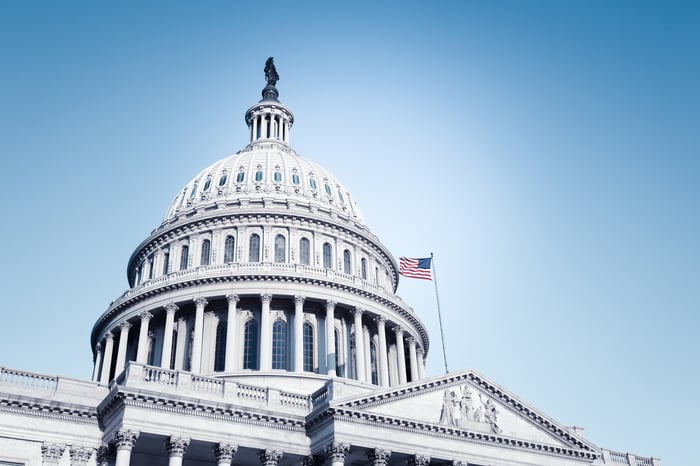
Image source: Getty Images.
How will a divided government affect the stock market?
The run-up to midterm elections is a historically tough time for the market to make progress. Uncertainty about the election's outcome and its effect on corporations and consumers tends to weigh on stock prices. But once the results are clear, investors typically see prices rise steadily. In fact, the S&P 500 has climbed in 20 of the last 20 12-month periods following the midterm elections. The average market return for those periods is 14.7%.
Midterm elections often leave a divided government. In 16 of the 21 midterm elections since 1946 (including 2026), voters opted for a legislature in opposition to the executive branch. On average, a split government resulted in slightly worse 12-month performance following the election than unified governments, but not by a significant margin (14.6% versus 14.9%). In fact, the nine elections for a Democrat-controlled Congress while a Republican held the Presidency led to the highest average returns of any scenario, a 16.2% average 12-month gain.
That said, the sample size is relatively small. Drawing historical conclusions based on just a handful of samples isn't a good basis for investing. What's more important is how the new legislation could change policies affecting both consumers and corporations, ultimately reflected in stock prices.
Will a Democrat-controlled Congress help or hurt stocks?
As mentioned, the new government could face challenges in enacting legislation due to a divided legislature and executive branch. However, Democrats could lay significant groundwork for new policies and regulations if the party takes control of the Presidency in 2029. What's more, several big states elected Democrats as governors. Since markets are always forward-looking, stock prices could reflect potential future outcomes before any laws are passed.
Artificial intelligence stocks may come under pressure, as this year's midterms were seen as an opposition to limited regulations for building new data centers. Democrats could force delays in new construction as they work with companies to develop frameworks to reduce the effects on water and electricity supplies and prices.
AI is at the center of today's stock market and economy. A slowdown in spending on new data centers due to regulatory hurdles could have far-reaching effects. Since more than 30% of the S&P 500 is accounted for by stocks with direct ties to artificial intelligence, and an even higher percentage of the tech-heavy Nasdaq is tied to the trend, any downturn in the sector will weigh heavily on both indexes.
While history suggests a Democrat-controlled Congress could be good for stocks over the next 12 months, investors should pay attention to how proposed policies from the new legislative branch could ultimately affect corporate earnings. Remember to take those proposals with a grain of salt, too, as they're far from guaranteed to come to fruition. Their final forms will likely look much different than idealized proposals.
Some companies could benefit from more regulations and restrictions imposed by Democrats, while others will face challenges. The same is true in any political environment. Investors who can take a long-term outlook on a business, researching companies with strong and sustainable competitive advantages, can do well investing regardless of who controls Congress or the Presidency.
Should you buy stock in S&P 500 Index right now?
Before you buy stock in S&P 500 Index, consider this:
The Motley Fool Stock Advisor analyst team just identified what they believe are the 10 best stocks for investors to buy now… and S&P 500 Index wasn’t one of them. The 10 stocks that made the cut could produce monster returns in the coming years.
Consider when Netflix made this list on December 17, 2004... if you invested $1,000 at the time of our recommendation, you’d have $353,560!* Or when Nvidia made this list on April 15, 2005... if you invested $1,000 at the time of our recommendation, you’d have $1,115,850!*
Now, it’s worth noting Stock Advisor’s total average return is 852% — a market-crushing outperformance compared to 203% for the S&P 500. Don't miss the latest top 10 list, available with Stock Advisor, and join an investing community built by individual investors for individual investors.
See the 10 stocks »
*Stock Advisor returns as of November 7, 2026.
Adam Levy has no position in any of the stocks mentioned. The Motley Fool has no position in any of the stocks mentioned. The Motley Fool has a disclosure policy.
Recommended Articles


