


A Recession Is Coming Eventually. Here's Warren Buffett's Best Investing Advice.
Key Points
Many investors think the economy is overdue for another recession. If history is any indication, they are right.
Buffett's six-plus decades running Berkshire Hathaway have made him arguably the best investor of all time.
Over those many years, he's also accumulated some solid insights he likes to share with other investors.
- 10 stocks we like better than Berkshire Hathaway ›
Other than a two-month recession during the brunt of the COVID-19 pandemic, the economy has not experienced a recession since the Great Recession in 2008, which wiped out trillions of capital and will not soon be forgotten.
However, given that it's now been nearly 20 years since the Great Recession and there is mounting pressure on consumers, some investors are anxious, believing it's only a matter of time.
Missed Nvidia in 2009? This Rare Signal Is Flashing Again. In 2009, a "Double Down" signal flashed for a little-known chipmaker called Nvidia. For the first time in years, that same "Total Conviction" signal is flashing for a company 1/100th the size of Nvidia. Continue »
While it's difficult to time, a recession is certainly coming eventually. Here's Warren Buffett's best investing advice to cope with a recession.
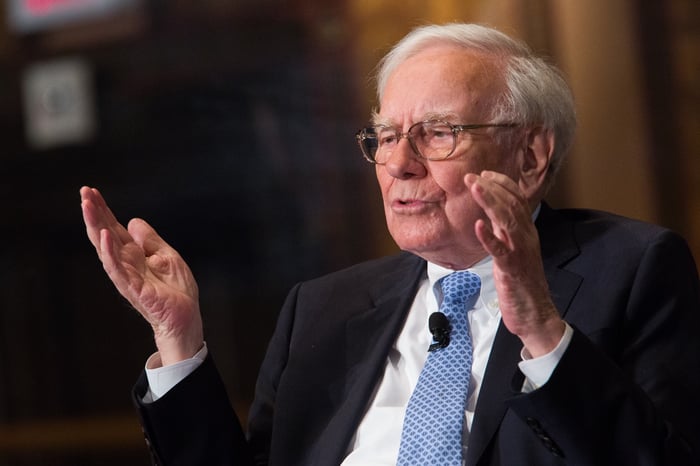
Image source: Getty Images.
Avoid panic selling
I don't say that a recession is coming to scare people, but simply because history suggests it's a normal part of the business cycle. In fact, the U.S. economy is long overdue for a recession.
According to Kiplinger, since the end of World War II, the U.S. economy has experienced 12 recessions, averaging one every 6.5 years. It's hard to know why there hasn't been a recession since 2008, but I suspect all of the money printing ordered by the Federal Reserve has at least partly delayed one.
Either way, I don't think the economy has seen its last recession. While recessions are not fun while they are happening, they don't last forever, and the economy and stock market typically emerge stronger on the other side.
Investors should prepare by reviewing prior advice from Warren Buffett, the esteemed former CEO of Berkshire Hathaway. Buffett helped build Berkshire into one of the world's largest companies, and has made many shareholders rich along the way.
During his over six decades at the helm of Berkshire, Buffett steered the company through numerous downturns. One critical piece of advice from the Oracle of Omaha is to avoid panic selling. When a recession hits, many unprepared investors become emotional and fearful, instantly dumping their stocks, even if the long-term business fundamentals are sound.
When the market is struggling, many stocks sell off. But that's not because the companies are going out of business. Rather, investors are racing for the sidelines to try and avoid further losses. Investors should remember that many institutional investors are focused on 12- to 18-month returns. Their portfolios are often judged against the market, which they need to beat to show investors that the high fees they pay to invest with them are worth it.
Large institutional investors account for the majority of flows, so when they sell, stock prices move.
This doesn't mean you should never sell when a stock drops, but make sure you are selling because the long-term fundamental thesis no longer works, and not simply because you are panicking. That's why knowing what you own is critical.
Be opportunistic
The other great piece of advice for recession investing from Buffett is, "Be fearful when others are greedy and be greedy only when others are fearful." Long-term investors can treat recessions as opportunities, as they offer a unique chance to buy stocks at lower entry points.
If a company's thesis is not busted when the market is selling off, and it has a good management team and a strong enough balance sheet to withstand temporary headwinds, then this is the time to move in and buy the stock at a cheap valuation. One or two bad quarters don't make or break a stock.
Buffett has played contrarian on numerous occasions and been rewarded for his even-tempered patience. For instance, in the three years following the Great Recession in 2008, Buffett made contrarian bets on Goldman Sachs, Bank of America, and GE Aerospace (then known as General Electric), all of which paid off handsomely.
I would caution investors against interpreting this advice as simply buying the dip on any and every stock that falls. Often, stocks trade lower for good reason. Investors must determine why a stock is down, whether the headwinds are temporary, whether a company can survive a sustained economic downturn, and what the long-term prospects are.
But for patient, long-term investors willing to do the work and take the plunge during a market downturn, the rewards are often substantial.
Should you buy stock in Berkshire Hathaway right now?
Before you buy stock in Berkshire Hathaway, consider this:
The Motley Fool Stock Advisor analyst team just identified what they believe are the 10 best stocks for investors to buy now… and Berkshire Hathaway wasn’t one of them. The 10 stocks that made the cut could produce monster returns in the coming years.
Consider when Netflix made this list on December 17, 2004... if you invested $1,000 at the time of our recommendation, you’d have $353,560!* Or when Nvidia made this list on April 15, 2005... if you invested $1,000 at the time of our recommendation, you’d have $1,115,850!*
Now, it’s worth noting Stock Advisor’s total average return is 852% — a market-crushing outperformance compared to 203% for the S&P 500. Don't miss the latest top 10 list, available with Stock Advisor, and join an investing community built by individual investors for individual investors.
See the 10 stocks »
*Stock Advisor returns as of November 6, 2026.
Bank of America is an advertising partner of Motley Fool Money. Bram Berkowitz has no position in any of the stocks mentioned. The Motley Fool has positions in and recommends Berkshire Hathaway, GE Aerospace, and Goldman Sachs Group. The Motley Fool has a disclosure policy.
Recommended Articles


