


CME vs. Nu: Which Financial Stock Is a Better Buy for 2027?
Key Points
CME Group dominates the global derivatives market with industry-leading net margins.
Nu is rapidly scaling its digital banking platform across Latin America with high revenue growth.
Which of these financial giants is the better fit for your portfolio in 2027?
- 10 stocks we like better than CME Group ›
Investors looking for exposure to the financial sector often choose between stability and growth. This comparison evaluates the established CME Group (NASDAQ:CME) against the high-growth challenger Nu (NYSE:NU).
CME operates the world's largest marketplace for futures and options, benefiting from market volatility. Nu, also known as Nubank, provides digital-first banking services to over 140 million customers in Latin America. While one offers reliable cash flow, the other provides aggressive expansion in emerging markets.
The case for CME
CME Group operates as a pillar among financial stocks, serving a vast array of clients including professional traders and central banks. It maintains an exclusive index partnership with S&P Global (NYSE:SPGI) and recently expanded into AI-related tradable products. One clearing firm accounted for nearly 12% of transaction fees in 2025. Customer concentration like this adds a layer of risk to the business.
In its latest annual report, filed for fiscal 2025, revenue reached approximately $6.5 billion, representing a growth rate of roughly 6.4% over the prior year. The company reported net income of nearly $4 billion, resulting in a net margin of 62% for the period.
As of CME's December 2025 balance sheet, the debt-to-equity ratio, which compares total debt to shareholder equity, is approximately 0.1. The current ratio, which measures the ability to pay short-term obligations with current assets, is nearly 1. Free cash flow for fiscal 2025 was close to $4.2 billion. FCF is the cash generated after accounting for capital expenditures.
The case for Nu
Nu is a dominant force in digital finance, having expanded from Brazil into Mexico and Colombia. The company utilizes a digital-first model to provide credit cards, personal loans, and investment accounts without the overhead of physical branches. Its latest expansion includes a launch in the United States, targeting a massive new market of tech-savvy consumers.
In its latest financial filings covering fiscal 2025, revenue reached nearly $15.9 billion, a 43% increase over the previous year. The company posted net income of approximately $2.9 billion, resulting in a net margin of roughly 18.1%. This growth reflects the rapid adoption of digital banking services across its primary geographic markets.
As of Nu's December 2025 balance sheet, the debt-to-equity ratio is approximately 0.5. The current ratio is nearly 0.6. Free cash flow reached nearly $3.5 billion in fiscal 2025, providing the capital needed to fund its ongoing international expansion.
Risk profile comparison
CME Group faces intense competition from established rivals such as Intercontinental Exchange (NYSE:ICE) and Cboe Global Markets (NYSEMKT:CBOE). The company relies heavily on third-party technology partners like Google Cloud, creating a potential point of failure for its high-frequency trading platforms. Regulatory changes regarding digital asset trading or clearing operations could also increase operational costs or limit future growth opportunities.
Nu operates in emerging markets where economic volatility and shifting interest rates can impact loan delinquency rates. The company must compete with traditional regional banks and other digital entrants that are aggressively lowering fees to retain customers. Changes in financial regulations in Brazil or Mexico could also restrict its ability to offer certain high-margin credit products.
Valuation comparison
Nu appears cheaper using the P/S ratio, which compares market value to sales over the past 12 months, while CME Group carries a higher forward P/E.
| Metric | CME Group | Nu |
|---|---|---|
| Forward P/E | 24.7 | 17 |
| P/S ratio | 15.8 | 3.7 |
Valuation metrics include sourcing from Financial Modeling Prep (FMP) and may differ from other data providers.
Which stock would I buy for 2027?
Nu and CME Group are two companies in very different stages of their life cycle. CME Group is posting modest revenue growth but has an impressive 62% net margin. Meanwhile, Nu's revenue increased by more than 40% in fiscal 2025. Nu's net margin is not as high as CME Group's, but it's still respectable for a growing digital bank.
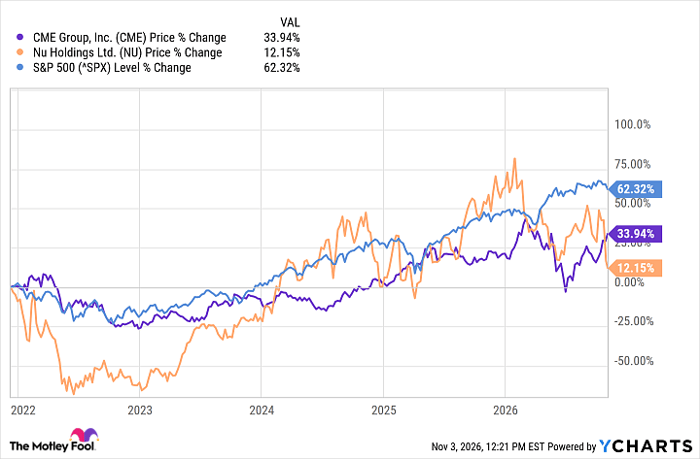
Here's how the two stocks have performed over the past five years:
CME data by YCharts
CME Group has bested Nu, but the more revealing part of this chart is the S&P 500's return. The index has outperformed CME Group and Nu by 28 and 50 percentage points, respectively. So if you owned either financial specialist over the past five years, you were trailing the market at multiple points -- and sometimes by quite a lot.
The other thing to note in the chart is Nu's volatility. It's not a big, boring bank, and that may make some investors nervous.
Past performance is no indication of future results, but sometimes neither stock is a particularly attractive buy. I'd sit this one out.
Should you buy stock in CME Group right now?
Before you buy stock in CME Group, consider this:
The Motley Fool Stock Advisor analyst team just identified what they believe are the 10 best stocks for investors to buy now… and CME Group wasn’t one of them. The 10 stocks that made the cut could produce monster returns in the coming years.
Consider when Netflix made this list on December 17, 2004... if you invested $1,000 at the time of our recommendation, you’d have $336,195!* Or when Nvidia made this list on April 15, 2005... if you invested $1,000 at the time of our recommendation, you’d have $1,241,567!*
Now, it’s worth noting Stock Advisor’s total average return is 875% — a market-crushing outperformance compared to 208% for the S&P 500. Don't miss the latest top 10 list, available with Stock Advisor, and join an investing community built by individual investors for individual investors.
See the 10 stocks »
*Stock Advisor returns as of November 4, 2026.
Erin Kennedy has positions in CME Group. The Motley Fool has positions in and recommends CME Group, Nu Holdings, and S&P Global. The Motley Fool recommends Cboe Global Markets and Intercontinental Exchange. The Motley Fool has a disclosure policy.
Recommended Articles


