


If a Stock Market Crash Is Coming, Warren Buffett Says This Is the Smartest Move Investors Can Make
Key Points
U.S. stocks remain firmly in bull market territory, but signs of weakness are emerging due to skepticism about the durability of the artificial intelligence boom.
During the last decade, the S&P 500 returned an average of 18% during the year following its first close in stock market correction territory.
During the last decade, the Nasdaq Composite returned an average of 21% during the year following its first close in stock market correction territory.
- 10 stocks we like better than S&P 500 Index ›
The S&P 500 (SNPINDEX:^GSPC) and Nasdaq Composite (NASDAQINDEX:^IXIC) have added 11% and 9%, respectively, year to date. Both indexes remain firmly in bull market territory, but signs of weakness are emerging beneath the surface due to skepticism about the durability of the artificial intelligence boom.
According to Morgan Stanley strategist Mike Wilson, about 60% of U.S. stocks are already in a bear market, having fallen more than 20% since June. And that weakness could spread to the broader market as elevated bond yields, rising interest rates, and rich valuations put additional pressure on stock prices.
If a stock market crash is coming, investors should follow Warren Buffett's advice.
Missed Nvidia in 2009? This Rare Signal Is Flashing Again. In 2009, a "Double Down" signal flashed for a little-known chipmaker called Nvidia. For the first time in years, that same "Total Conviction" signal is flashing for a company 1/100th the size of Nvidia. Continue »
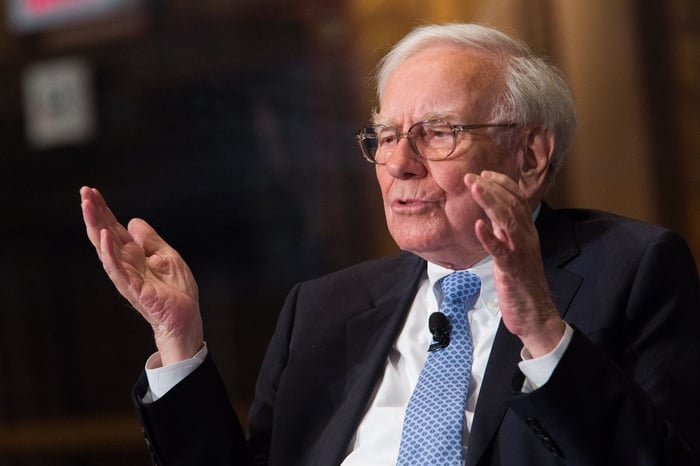
Image source: Getty Images.
Warren Buffett's advice for stock market investors
Warren Buffett is widely regarded as one of the greatest investors in history, having built Berkshire Hathaway into a trillion-dollar company through decades of disciplined, value-oriented investing. His impressive track record -- Berkshire stock increased 6,099,294% under his leadership between 1964 and 2025, outpacing the S&P 500's gain of 46,061% -- makes his perspective on stock market volatility particularly valuable.
Throughout his career, Buffett consistently emphasized the importance of maintaining a long-term perspective and taking advantage of market downturns to purchase high-quality stocks at discounted prices. "Widespread fear is your friend as an investor, because it serves up bargain purchases," he wrote in his 2016 shareholder letter.
There is an important caveat to that statement. No stock is worth buying simply because it has declined sharply. Buffett explained in his 1989 shareholder letter, "It's far better to buy a wonderful company at a fair price than a fair company at a wonderful price."
So, what qualifies as a wonderful company? Buffett favored businesses with pricing power built on a durable competitive moat. "The single-most important decision in evaluating a business is pricing power. If you've got the power to raise prices without losing business to a competitor, you've got a very good business."
Buffett offered an alternative explanation in his 1996 shareholder letter. "Your goal as an investor should simply be to purchase, at a rational price, a part interest in an easily-understandable business whose earnings are virtually certain to be materially higher five, ten, and twenty years from now."
Here's the big picture: Buffett's investment strategy centers on buying competitively advantaged businesses at reasonable prices and holding them for the long term. Stock market drawdowns can create particularly attractive buying opportunities. So, rather than panicking when equity prices are falling, investors should seize the chance to buy quality stocks at a discount.
Historically, U.S. stocks have rebounded quickly following corrections and bear markets
Reading between the lines, Warren Buffett believes the smartest move investors can make during a stock market drawdown is to buy the dip. And historical data supports that notion. Consider these statistics about past market corrections and bear markets.
- The S&P 500 has suffered six market corrections in the past decade, two of which became bear markets. Following its first close in correction territory, the index returned an average of 18% during the next year.
- The Nasdaq Composite has suffered nine market corrections in the past decade, four of which became bear markets. Following its first close in correction territory, the index returned an average of 21% during the next year.
Here's the big picture: Corrections and bear markets are relatively common. But the stock market has typically rebounded quickly, meaning investors must be ready to buy the dip when those opportunities arise. Panicking accomplishes nothing. Instead, follow Warren Buffett's advice and use drawdowns to buy quality stocks at discounted prices.
Should you buy stock in S&P 500 Index right now?
Before you buy stock in S&P 500 Index, consider this:
The Motley Fool Stock Advisor analyst team just identified what they believe are the 10 best stocks for investors to buy now… and S&P 500 Index wasn’t one of them. The 10 stocks that made the cut could produce monster returns in the coming years.
Consider when Netflix made this list on December 17, 2004... if you invested $1,000 at the time of our recommendation, you’d have $336,195!* Or when Nvidia made this list on April 15, 2005... if you invested $1,000 at the time of our recommendation, you’d have $1,241,567!*
Now, it’s worth noting Stock Advisor’s total average return is 875% — a market-crushing outperformance compared to 208% for the S&P 500. Don't miss the latest top 10 list, available with Stock Advisor, and join an investing community built by individual investors for individual investors.
See the 10 stocks »
*Stock Advisor returns as of November 4, 2026.
Trevor Jennewine has no position in any of the stocks mentioned. The Motley Fool has positions in and recommends Berkshire Hathaway. The Motley Fool has a disclosure policy.
Recommended Articles


