


Amazon Stock Price Forecast: Weak Earnings Trigger 12% Stock Plunge, Next Support Seen at $200 Mark
TradingKey - Amazon's results miss expectations, sending stock plummeting 12%; technicals face test of $200 level.
On October 29 Eastern Time, after tech giant Alphabet (GOOG) plummeted over 10% due to expanding CapEx, Amazon's (AMZN) newly released Q3 FY2026 earnings report followed suit, causing its stock price to tumble 12% in after-hours trading and face heavy ongoing downside pressure.
Although Amazon's AWS cloud revenue maintained high growth, multiple areas fell short of expectations, including a surge in capital expenditures (CapEx), free cash flow (FCF) turning negative, and a conservative Q4 outlook, as detailed below:
Financial Metrics | Reported Q3 2026 Data | Market Expectations | Wall Street Concerns & Core Crux |
|---|---|---|---|
AWS Cloud Revenue | $46 billion | $45.4 billion | YoY growth expanded to 39%, but failed to resolve the earnings impact |
Capital Expenditures | Annual plan raised to $220 billion | Higher than expected $195–200 billion | AI data centers and GPU procurement erode free cash flow |
Free Cash Flow | Turned negative (-$42.4 billion) | Maintained net inflows | Massive CapEx led to significant deterioration in FCF margin |
Q4 Holiday Season Outlook | Midpoint of guidance range missed expectations | High expectations for the shopping season | Rising retail e-commerce logistics costs put pressure on peak-season profit margins |
Hit by the disappointing earnings, Amazon's stock price not only surrendered the 200-day moving average and the short-term consolidation zone of $243–$245, but also broke through the strong support level of $224–$226 from June this year, pushing its technical pattern into a breakdown and bottom-seeking phase.
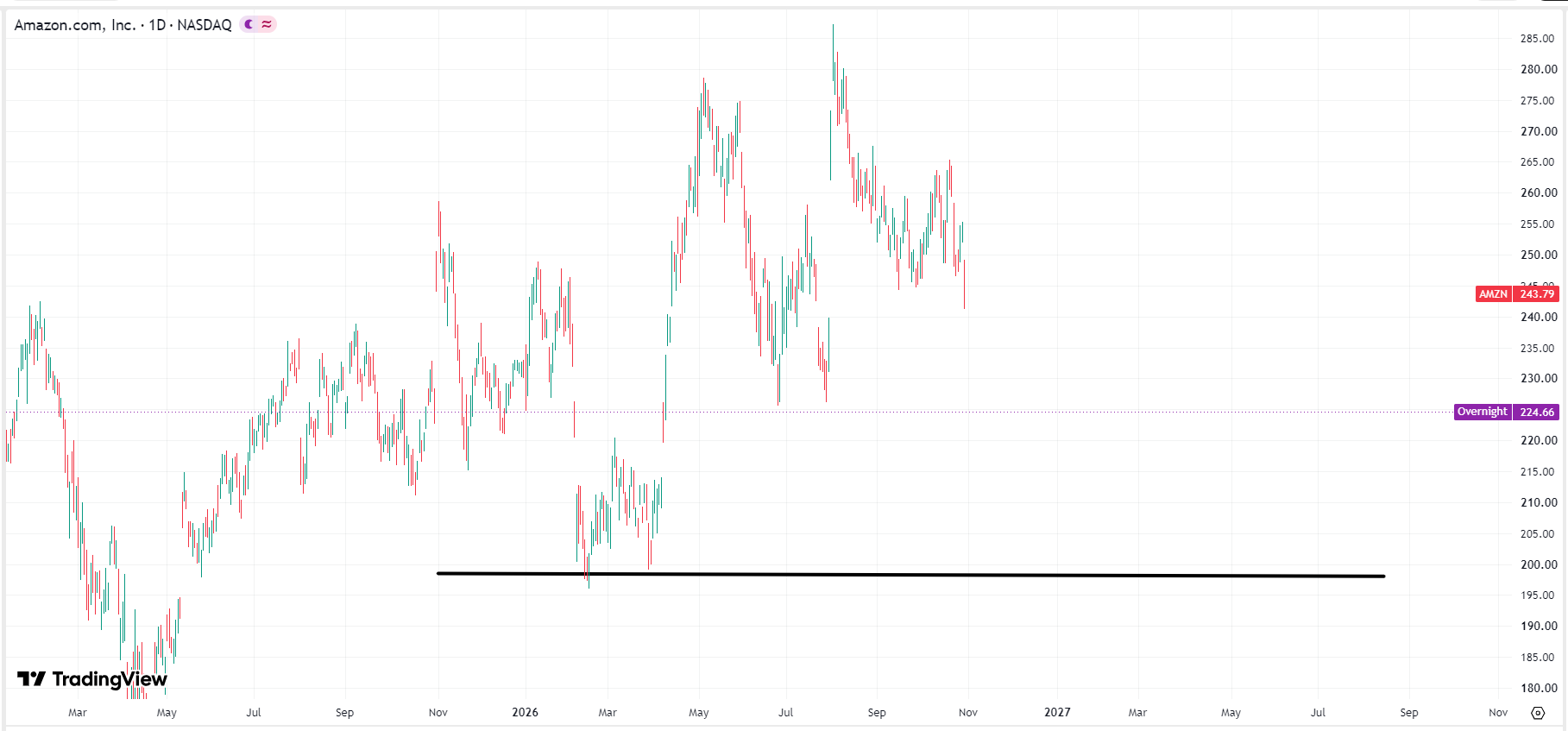 Amazon stock price chart, Source: TradingView
If collective selling pressure on major U.S. tech stocks fails to subside in the short term, AMZN's stock price will face retesting pressure toward the $200 round-number mark. This level is not only a key psychological threshold, but also represents the significant cost basis of major Wall Street sovereign wealth funds and long-term value funds established in early 2026, offering strong defensive attributes.
Furthermore, if the stock price approaches the $200 mark, Amazon's EV/EBITDA multiple will fall back to an extreme low for the past three years of around 12.5x–13.0x. Compared to AWS's rapid YoY growth rate of 39%, its valuation will appear exceptionally attractive, which is expected to trigger strong left-side buying defense from value investors and sovereign wealth funds, providing powerful spot support here.
Recommended Articles


