


Nasdaq futures fall 500 points as Amazon and Intel expose the demand side of the AI trade

Mitrade Insights — The Nasdaq Composite fell 1.38% to 26,184.72 on October 29, the S&P 500 slipped 0.30% to 7,720.39, and the Dow lost 0.25% to 52,342.56. Then the after-hours reports made it worse: Nasdaq-100 futures dropped more than 500 points as Amazon fell about 8% and Intel plunged 23%. Alphabet, down 12.6% in the regular session, had already wiped out roughly $500 billion of market value. The first read is that AI capex has become too expensive. The better read is that capex is fine — demand is not.
| Company | Headline | The number that matters | Stock reaction |
|---|---|---|---|
| Alphabet (GOOG) | Q3 revenue $127.6bn, +25% | Free cash flow -$9.07bn; capex $51.4bn; EPS $2.12 vs $3.02 expected | -12.6% regular; worst day on record |
| Amazon (AMZN) | Q3 revenue $201.9bn, +12%, a miss | FCF -$42.4bn vs +$7bn prior; capex >$77bn; holiday guide $240–247bn vs $244.5bn | -4.25% regular; -8% after hours |
| Intel (INTC) | Q3 beat: $16.51bn, EPS $0.52 | Q4 guide $15–16bn vs $17.05bn; EPS $0.25 vs $0.43; gross margin 38% vs 42.8% | -23% after hours; still +133% YTD |
| Microsoft (MSFT) | Azure +48% | Capex below expectations; FCF positive | -1.7% regular; the relative winner |
| Apple (AAPL) | No AI-capex exposure | — | +1.48%; the defensive bid |
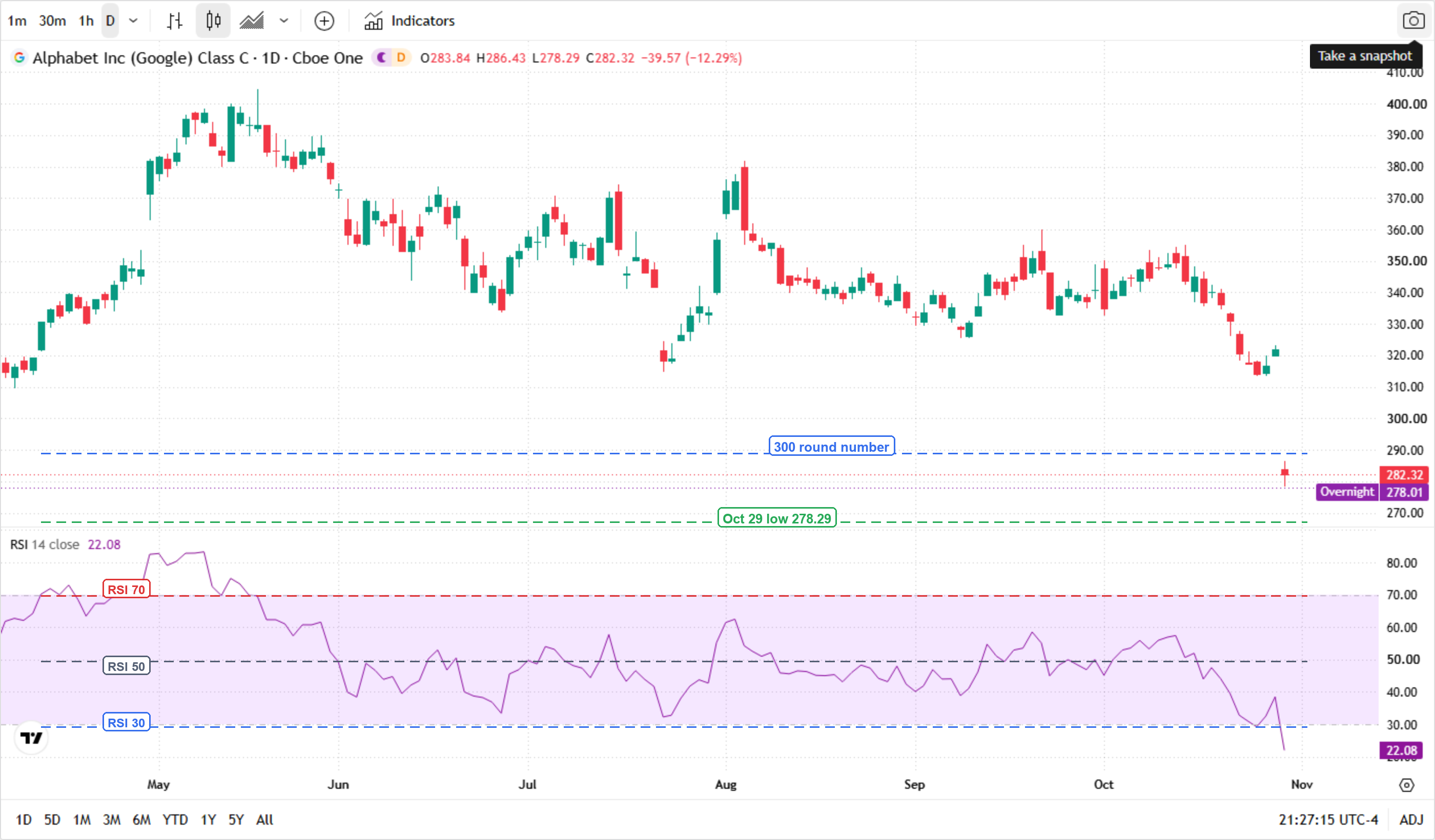
* Chart source: TradingView (GOOG daily).
The capex line is not the tell
The market's first reaction was to punish spending. Alphabet's capex of $51.4bn and Amazon's $77bn are enormous, and both produced negative free cash flow. But Microsoft also spent heavily, and its stock was the relative winner because Azure grew 48% and free cash flow stayed positive. The difference is not the size of the cheque; it is whether the spending is producing revenue.
Alphabet spent $51.4bn and still burned $9.07bn
Alphabet's cloud revenue grew 103%, faster than Azure. That should have been enough. Instead, the market focused on the -$9.07bn free cash flow and an EPS miss of $0.90. The lesson: in this phase of the AI trade, growth without cash conversion is being repriced. GOOG's RSI fell to 22.08, deeply oversold, but oversold is not a bottom when the business model is being re-rated.
Amazon's FCF went from +$7bn to -$42.4bn.
Amazon's swing is even larger. Free cash flow went from +$7bn in the prior quarter to -$42.4bn, and the holiday-quarter guide of $240–247bn was below the $244.5bn consensus. Online sales grew just 2%. The AI capex is going into AWS, but the retail engine is slowing — and retail is still the cash cow that funds the capex.
Amazon's holiday guide is the tell
If the problem were only capex, the market would punish Alphabet and Amazon and move on. But the demand signals are showing up in the old economy too.
$240–247bn vs $244.5bn; online sales +2%.
Amazon's holiday guide is the first read on the US consumer this season. A midpoint below consensus, with online sales up only 2%, says the consumer is still spending but not accelerating. That is consistent with the September retail data and with the 4.7% drop in Australian consumer sentiment — a global pattern, not a US one.
Intel's Q4 guide says the PC replacement cycle never came
Intel's Q3 beat was real: $16.51bn revenue and $0.52 EPS. But the Q4 guide of $15–16bn versus $17.05bn expected, and a gross margin of 38% versus 42.8%, says the PC and server replacement cycle that was supposed to arrive in 2026 has not. Intel is still up 133% year to date, which is why the stock could fall 23% in one session: the expectations, not the business, were the problem.
26,000 is the line; 26,700 is the pattern
The Nasdaq Composite closed at 26,184.72, below the 26,700 neckline of the August–September double bottom. The 26,000 round number is the first support; a close below it opens the October 26 low at 25,986. RSI(14) is 43.4, not oversold, so there is room to fall before the market finds a mechanical bid.
Nasdaq RSI 43, not oversold.
The index is not in panic territory: the VIX is 17.2, and the Dow fell only 0.25%. This is a rotation, not a crash. Money moved into Apple, Eli Lilly and defensives; it did not leave the market.
Two scenarios: reclaim 26,700 or lose 26,000
Scenario A — the bulls retake 26,700. If Amazon and Intel are seen as company-specific misses, and Microsoft's Azure momentum holds, the Nasdaq can reclaim the double-bottom neckline and target 27,000. The trigger is a close above 26,700 and a stabilisation in the SOX index.
Scenario B — 26,000 gives way. If the holiday guidance from other retailers confirms Amazon's caution, and Intel's weak guide spreads to the PC supply chain, the Nasdaq loses 26,000 and tests 25,500. The trigger is a close below 26,000 with the VIX above 20.
The bottom line: The AI trade is not over; it is maturing. The market has stopped paying for capex alone and started asking for revenue, cash flow and demand. That is a higher bar, and the companies that clear it — Microsoft so far — will lead the next leg. The ones that do not will keep trading like Alphabet and Intel did.
Read more
* The content presented above, whether from a third party or not, is considered as general advice only. This article should not be construed as containing investment advice, investment recommendations, an offer of or solicitation for any transactions in financial instruments.


