


Tesla's Free Cash Flow Beat: Good News, Bad News, and What It Means for the Future
Key Points
Optimus and Robotaxi timelines may be delayed, but capital discipline is evident.
Tesla surprised the market by generating $1.5 billion in free cash flow in the third quarter.
- These 10 stocks could mint the next wave of millionaires ›
Close watchers of Tesla (NASDAQ: TSLA) will have noticed something seemingly contradictory recently: Management lowered its 2026 capital spending forecast but also lined up $30 billion in credit. Let's look at what's going on and what it might mean for the stock's investment case.
Tesla's contradictory movements
The company's capital spending plans and its cash flow have been central to the debate around the stock. Management started the year expecting more than $20 billion in capital spending, and then raised that projection to more than $25 billion in July.
Missed AI’s "Act 1"? Act 2 Could Be 15x Bigger. Most investors think they missed the AI boat because they didn't buy Nvidia in 2005. But according to our analysts, we’re only at the end of "Act 1"—the R&D phase. "Act 2" is the global rollout. Continue »
These large amounts raised concerns that Tesla was pulling forward capital spending while pushing back expectations for growth in recurring revenue, earnings, and cash flow from Robotaxi/Cybercab and Optimus robot endeavor due to slower-than-expected progress.
Those fears were exacerbated by the $1.1 billion cash outflow in the second quarter. It's a mathematical reality that pulling forward capital spending and pushing out cash-flow expectations will lower a company's discounted cash flow valuation.
As such, it wasn't surprising when Tesla lined up $30 billion in credit, which it could use to support the business if necessary. That's might include funding a Robotaxi fleet rollout in 2027, as well as ongoing investments in Optimus and building out its infrastructure (chips, lithium, batteries, etc.).
What happened in the third quarter
Fast-forward to the recent third-quarter earnings report, and a few things appear to have changed:
- Management cut 2026 capital spending plans down to "approximately $20 billion."
- Instead of the $3.8 billion cash outflow and $7.9 billion in capital expenditure that Wall Street had penciled in (according to S&P Global Market Intelligence) for the quarter, Tesla generated $1.5 billion in free cash flow (FCF) while making only $4.7 billion in capital expenditures.
In other words, Tesla's near-term cash flow outlook is improving, and it has almost $36 billion in net cash, yet management arranged for as much as $30 billion in potential borrowing that it doesn't intend to draw in 2026.
Image source: The Motley Fool.
What's going on?
Chief Financial Officer Vaibhav Taneja reaffirmed that capital spending would continue to ramp up in future years but said the capital spending outlook for 2026 was revised to "approximately $20 billion for the current year as a result of managing our capital deployment efficiently and plan to fund it primarily from our cash flows from operations."
It's hard not to think some expenditures have been pushed back from 2026, and the reason -- in light of management's narrative around Robotaxi/Cybercab and Optimus -- I would guess is Optimus.
In January, Chief Executive Officer Elon Musk told investors Tesla would "probably unveil Optimus 3 in a few months." Still, the latest October update calls for "an Optimus video in a month or so." The good news is Musk confirmed "early production on our high-volume line in Fremont," California, but cautioned it would take "probably at least a year, maybe a little longer to get to that annualized rate to get to 20,000 units a week." As a reminder, the long-term goal is to produce 1 million Optimus units in Fremont.
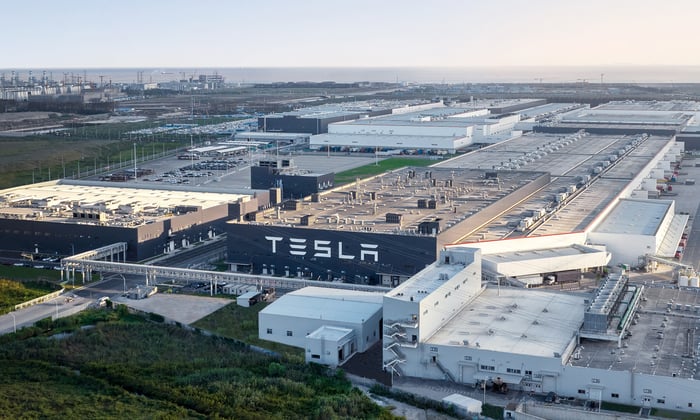
Image source: Tesla.
What it means to investors
On balance, it's good news. The bad news is that Optimus timelines appear to be slipping. Still, the good news is that Tesla is demonstrating the discipline to adjust expenditures in line with its development plans.
There's little doubt that Tesla will ramp up spending during the next few years, resulting in cash outflows. Management is signaling increased capital spending, and as Musk noted on the earnings call, "Cybercab is primarily going to be something that is offered as like transport as a service," implying a significant need for capital to build out its own Cybercab fleet rather than sell to third parties.
Tesla will ramp up spending, but the display of disciplined capital spending, the lining up of $30 billion in credit, and the return to FCF generation in the third quarter (partly due to increased automotive gross margins) are clear signs that Tesla can fund its expansion plans, including a huge ramp-up in Robotaxi/Cybercab production and deployment next year, even if Optimus timelines may have been pushed back. The recent results strengthen that argument.
Missed AI’s "Act 1"? Act 2 Could Be 14x Bigger
Most investors think they missed the AI boat because they didn't buy Nvidia in 2005.
But according to our analysts, we’re only at the end of "Act 1"—the R&D phase. "Act 2" is the global rollout, a massive technology build-out that Google’s CEO says could be more profound than fire or electricity.
While everyone watches the chip designers, one "backbone" company provides the critical technology that Nvidia and AMD literally cannot function without. We’ve detailed this under-the-radar player in our new AI Playbook.
Continue »
Lee Samaha has no position in any of the stocks mentioned. The Motley Fool has positions in and recommends S&P Global and Tesla. The Motley Fool has a disclosure policy.
Recommended Articles


