


Here's Why Micron Is a Top AI Stock to Buy Right Now
Key Points
Micron has had a great 2026, but it could have an even better 2027.
The memory-chip maker is taking advantage of extremely tight market conditions to shift its business model.
- 10 stocks we like better than Micron Technology ›
Micron (NASDAQ: MU) stock has had a tremendous performance in 2026; however, with such a great year behind it, there are many who are skeptical that it can keep doing well for shareholders in the future. After all, it has more than tripled year to date. Still, if you listen to management and consider the company's valuation, it's pretty clear that Micron could easily repeat its 2026 performance in 2027.
That would make it a smart artificial intelligence (AI) stock to buy now, but just how confident am I in this? I'd say my confidence rating is a 9 out of 10 that Micron will deliver impressive returns from here.
Missed AI’s "Act 1"? Act 2 Could Be 15x Bigger. Most investors think they missed the AI boat because they didn't buy Nvidia in 2005. But according to our analysts, we’re only at the end of "Act 1"—the R&D phase. "Act 2" is the global rollout. Continue »

Image source: Getty Images.
Micron is a key part of the AI build-out
Micron makes memory chips, which are critical components in several key pieces of data center hardware. Whether it's NAND memory for solid-state drives (SSDs) to store information for the long term or high bandwidth memory (HBM) that's embedded on computing units like graphics processing units (GPUs), Micron participates in many ways.
In fact, Micron and its industry peers have completely sold all the memory they have production capacity for this year. The memory chip industry was not prepared for the monstrous demand wave triggered by the AI build-out, and now those memory companies are scrambling to add production capacity to meet that demand. But this wasn't necessarily their fault.
There isn't a ton that differentiates one company's memory chips from another's, so these products are priced like commodities.
In times when supply and demand are normal, manufacturers compete on price to generate sales, and margins are low. This makes it difficult for companies like Micron to properly allocate capital for capacity expansion, because there just isn't a ton of money left during these periods, and having more capacity than is necessary just increases supply and helps to push prices down further.
As a result, the entire industry -- which is dominated by a handful of players -- didn't have much capacity to spare when the AI build-out sent demand for memory through the roof. However, Micron is taking steps to remedy this; it has multiple new production facilities coming online starting in mid-2027. Despite that soon-to-arrive new production, however, Micron management has informed investors that it expects that tightness in the memory market will be worse in 2027 and 2028 than it was in 2026. This bodes well for Micron's outlook, as chip prices should remain high even as supply increases. However, Micron is using these conditions as an opportunity to shift its business model.
Instead of leaving pricing to the mercy of short-term market demand, it is starting to enter into long-term supply agreements with its clients. These set price floors and ceilings on a share of its chip sales, and guarantee sales volumes across multiple years. This provides Micron with more predictable cash flows, enabling it to manage its business more effectively. Second, these are take-or-pay agreements, so Micron's revenue is practically locked in. In fact, 35% of Micron's revenue through 2030 is already known.
This should also give investors more confidence that Micron won't be as affected by a downturn in demand as it would have been during prior cycles. This should lead the market to boost the stock's price-to-earnings ratio to a level closer to where tech companies normally trade, but it hasn't yet.
Micron's stock is very cheap
Micron's stock trades for less than 5 times forward earnings.
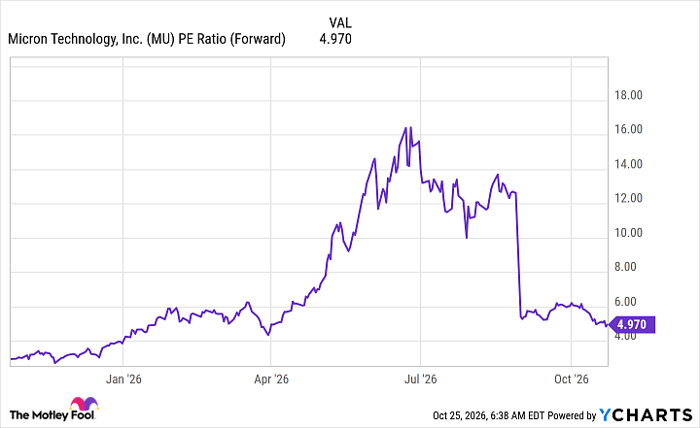
MU PE Ratio (Forward) data by YCharts.
That's the sort of valuation Wall Street reserves for a company the market expects to undergo a downturn in the near future. However, Micron's management team has already told investors that supply-and-demand conditions in 2027 and 2028 will be tight for memory, which means its margins will remain elevated and chip pricing will stay high. That will translate into excellent results for Micron, and if the stock returns to a 15-times forward earnings valuation, as it reached in June, it could triple again.
I think the only way Micron's stock doesn't have a phenomenal 2027 is if the market loses all faith in the AI build-out. However, I don't see that happening outside of a couple of months of bearish sentiment. Right now is one of those times, and investors should use this opportunity to buy shares of Micron cheap.
Should you buy stock in Micron Technology right now?
Before you buy stock in Micron Technology, consider this:
The Motley Fool Stock Advisor analyst team just identified what they believe are the 10 best stocks for investors to buy now… and Micron Technology wasn’t one of them. The 10 stocks that made the cut could produce monster returns in the coming years.
Consider when Netflix made this list on December 17, 2004... if you invested $1,000 at the time of our recommendation, you’d have $337,166!* Or when Nvidia made this list on April 15, 2005... if you invested $1,000 at the time of our recommendation, you’d have $1,339,143!*
Now, it’s worth noting Stock Advisor’s total average return is 904% — a market-crushing outperformance compared to 213% for the S&P 500. Don't miss the latest top 10 list, available with Stock Advisor, and join an investing community built by individual investors for individual investors.
See the 10 stocks »
*Stock Advisor returns as of October 28, 2026.
Keithen Drury has positions in Micron Technology. The Motley Fool has positions in and recommends Micron Technology. The Motley Fool has a disclosure policy.
Recommended Articles


