


Oracle Shares Jump Over 13% as H2 FY2028 Free Cash Flow Seen Turning Positive, CapEx to Decline in FY2029
TradingKey - Oracle (ORCL) shares jumped over 13% in short-term trading. Reportedly, the company announced at its Investor Day in Las Vegas on Wednesday that it expects to turn free cash flow positive in the second half of fiscal 2028, achieve at least $30 billion in free cash flow in fiscal 2029, and limit additional financing through fiscal 2030 to $20 billion.
Prior to this, investors generally expected the company's free cash flow to remain negative in fiscal 2029. Consequently, this guidance directly improved market expectations regarding when AI infrastructure buildouts will stop continually consuming cash.
Driven by the news, ORCL shares rose sharply, up 12.29% to $146.57 as of press time.
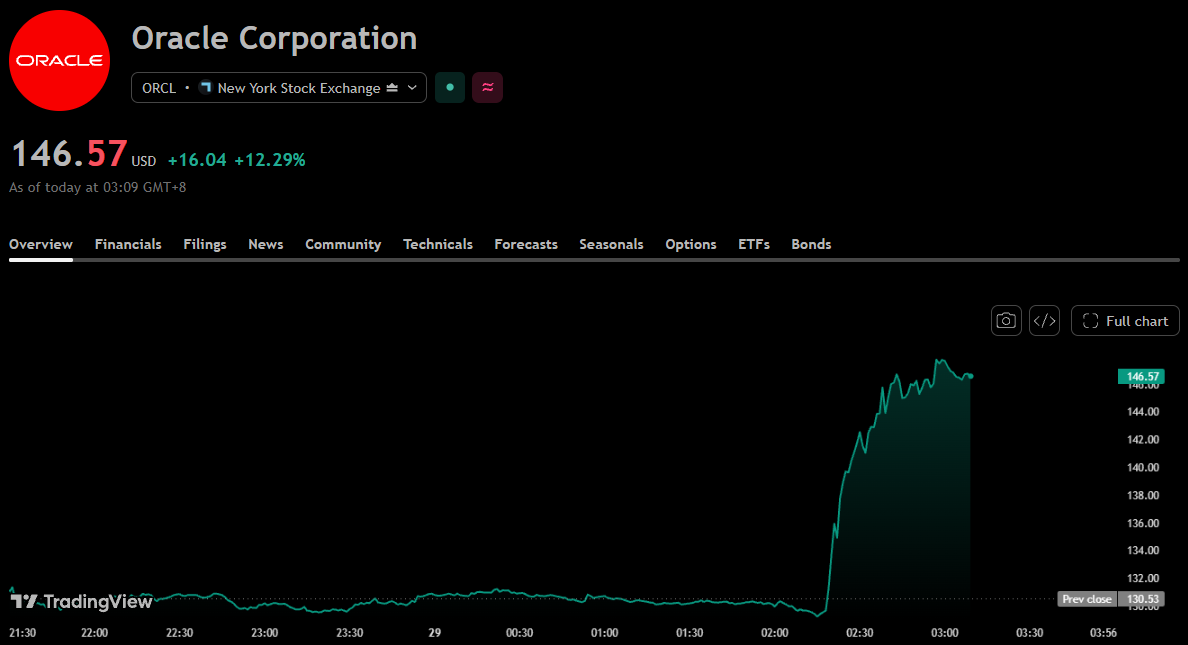
Oracle stock price chart, Source: TradingView
Oracle is expanding from a database software company into an AI computing power provider, building data centers at scale for clients such as OpenAI. While orders bring growth opportunities, equipment procurement and infrastructure construction require upfront capital investments, with revenue and cash returns coming later.
This time lag is already reflected in the financial data. For the fiscal year ending May 2026, Oracle's free cash flow was negative $23.7 billion. As of Tuesday's close, its stock price had fallen 33% year-to-date, with the market maintaining close focus on the scale of data center investments, delivery speeds, and whether construction capital can be converted into returns.
This update connects the cadence of construction with cash realization. Chief Financial Officer Hilary Maxson stated that the company expects to deliver an additional 7 gigawatts of data center capacity over the next few years, bringing total capacity to over 10 gigawatts by the end of fiscal 2028. As capacity is delivered, capital expenditures will peak in fiscal 2027 to 2028 before pulling back in fiscal 2029.
This means Oracle expects construction cash outflows to gradually decrease just as new capacity begins contributing to business revenue, jointly driving an improvement in free cash flow. The company further stated that starting in fiscal 2029, it will rely on its own funds to support growth.
Before free cash flow turns positive, Oracle also clarified its financing arrangements: through fiscal 2030, additional financing will not exceed $20 billion, split equally into $10 billion in equity financing and $10 billion in new debt, excluding the refinancing of existing debt. Previously, the company completed an at-the-market equity offering of $20 billion in the first quarter of fiscal 2027.
Clarifying the financing scale helps investors assess the extent of future equity dilution and debt increases. Oracle also projects that its net debt-to-adjusted EBITDA ratio will drop below 3.5x in fiscal 2029, and listed maintaining an investment-grade credit rating, paying dividends, and supporting growth as key capital allocation priorities.
Regarding growth targets, the company expects revenue for fiscal 2030 to exceed $225 billion, representing a compound annual growth rate of over 35% from fiscal 2026, with a non-GAAP operating margin of over 40% and non-GAAP EPS exceeding $21. Meanwhile, the company reiterated its guidance for fiscal 2027 revenue of at least $90 billion and non-GAAP EPS of $8.10.
Recommended Articles


