


Sandisk Stock Is Down 45% From Its High. History Suggests This Is What Happens Next.
Key Points
Sandisk sells flash memory and storage hardware that are vital to training and scaling AI.
A shortage in memory and storage hardware has given Sandisk significant pricing power.
Sandisk is notorious for its volatility, so investors should approach it with that in mind.
- 10 stocks we like better than Sandisk ›
In February 2025, Sandisk (NASDAQ: SNDK) spun off from Western Digital to become a stand-alone company for the second time, after Western Digital acquired it in May 2016. Since the spinoff, Sandisk has been one of the stock market's best performers, up nearly 3,400%.
Despite Sandisk's impressive track record, the past few months have been a roller-coaster ride. On June 25, the stock reached an all-time high, but it's now down 45% from that peak (as of Oct. 23). That's not ideal for those who bought near the peak, but history has some encouraging news for investors.
Missed AI’s "Act 1"? Act 2 Could Be 15x Bigger. Most investors think they missed the AI boat because they didn't buy Nvidia in 2005. But according to our analysts, we’re only at the end of "Act 1"—the R&D phase. "Act 2" is the global rollout. Continue »
Image source: The Motley Fool.
Why Sandisk stock has become popular over the past year
As one of the premier flash memory and storage hardware manufacturers, Sandisk is a huge beneficiary of the ongoing artificial intelligence trend. Major tech companies are rushing to build data centers and other AI infrastructure that require this hardware to train and scale AI.
This huge increase in demand has led to a supply shortage, which isn't ideal for AI hyperscalers (Amazon, Microsoft, Alphabet, and Meta Platforms), but it has worked in Sandisk's favor, giving it significant pricing power.
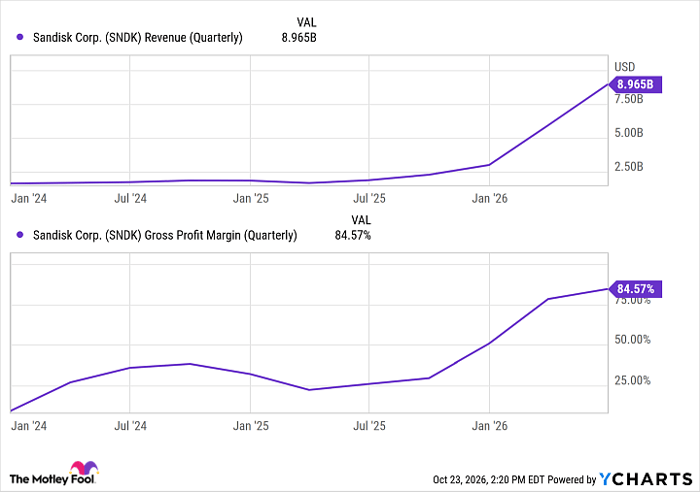
For perspective, in the fourth quarter of its fiscal 2026 (ended July 3), Sandisk's revenue jumped 372% year over year to $9 billion, with two-thirds of that coming from higher pricing and the other third coming from higher volumes. Its gross margins also expanded from 26% to 85%.
SNDK Revenue (Quarterly) data by YCharts
What history says about the stock
No one can predict how any stock will perform -- and past happenings don't guarantee future happenings -- but looking at historical performance helps you gauge how much volatility to expect. In the short time since Sandisk became a public company, one thing has been clear: High volatility is par for the course. For perspective, here are the times that Sandisk's stock has dropped by at least 20% in a short span just this year:
| High Date | Low Date | Percentage Decline |
|---|---|---|
| Feb. 3 | Feb. 10 | (22.1%) |
| March 19 | March 30 | (26.9%) |
| June 25 | July 2 | (25.3%) |
| July 10 | July 17 | (29.3%) |
| July 23 | July 29 | (36.9%) |
Data source: Google Finance.
These are just a few examples; the stock has had plenty of pullbacks throughout its trading history. The good news, though, is that the opposite is also true. Here are times when the stock has surged by at least 20% in a short span:
| Low Date | High Date | Percentage Increase |
|---|---|---|
| Jan. 2 | Feb. 3 | 152.7% |
| March 6 | March 18 | 42.9% |
| April 21 | May 6 | 56.1% |
| June 5 | June 25 | 49.7% |
| July 29 | Aug. 17 | 75.9% |
Data source: Google Finance.
Again, these are just a few examples, but the larger point is that history shows Sandisk's stock is notorious for huge price swings. Trying to time them or reacting to each one could be counterproductive and cause you to sell at a bad time, so the best approach is to keep your blinders on and ignore short-term price swings as much as possible.
Sandisk is a good company and could make for a good long-term investment, but don't invest without fully embracing the volatility and understanding that it operates in a cyclical industry. Right now, it's riding a high, but eventually, it will cool as the supply of memory hardware catches up to demand.
Should you buy stock in Sandisk right now?
Before you buy stock in Sandisk, consider this:
The Motley Fool Stock Advisor analyst team just identified what they believe are the 10 best stocks for investors to buy now… and Sandisk wasn’t one of them. The 10 stocks that made the cut could produce monster returns in the coming years.
Consider when Netflix made this list on December 17, 2004... if you invested $1,000 at the time of our recommendation, you’d have $337,166!* Or when Nvidia made this list on April 15, 2005... if you invested $1,000 at the time of our recommendation, you’d have $1,339,143!*
Now, it’s worth noting Stock Advisor’s total average return is 904% — a market-crushing outperformance compared to 213% for the S&P 500. Don't miss the latest top 10 list, available with Stock Advisor, and join an investing community built by individual investors for individual investors.
See the 10 stocks »
*Stock Advisor returns as of October 28, 2026.
Stefon Walters has positions in Microsoft. The Motley Fool has positions in and recommends Alphabet, Amazon, Meta Platforms, Microsoft, and Western Digital. The Motley Fool has a disclosure policy.
Recommended Articles


