


Here's What $10,000 Invested in SpaceX Could Be Worth in 2030
Key Points
SpaceX’s AI business is driving rapid revenue growth, alongside continued expansion at Starlink.
My bull case puts SpaceX’s annual revenue at $315 billion by 2030, while my bear case puts it near $100 billion.
Today’s valuation could limit shareholders’ gains even if the business performs well.
- 10 stocks we like better than Space Exploration Technologies ›
A $10,000 investment in SpaceX is a sizable bet on what Elon Musk's Space Exploration Technologies Corp (NASDAQ: SPCX) can deliver. Given the company's sweeping ambitions, what might that investment be worth in 2030?
Let's look at a bull and a bear case for SpaceX through the end of the decade and what each could mean for $10,000 invested today.
Missed AI’s "Act 1"? Act 2 Could Be 15x Bigger. Most investors think they missed the AI boat because they didn't buy Nvidia in 2005. But according to our analysts, we’re only at the end of "Act 1"—the R&D phase. "Act 2" is the global rollout. Continue »
SpaceX's three main businesses
First, what exactly does the company do? While it's known for its rockets, SpaceX's business now stretches well beyond launching things into orbit.
The company is divided into three main units: Space, Connectivity, and artificial intelligence (AI) -- or what the company now calls "Super Intelligence" (SI).
Space: This unit designs, builds, and launches rockets and spacecraft into orbit.
Connectivity: This unit includes Starlink, the company's fast-growing satellite internet business -- a major contributor to SpaceX's bottom line.
Super Intelligence: This unit houses the social media platform X, but much more significantly, it is the arm responsible for the AI chatbot Grok, as well as a major operation in providing AI compute to external clients like Anthropic, the creator of Claude.
AI drives SpaceX's explosive revenue growth
Ok, so how is SpaceX actually performing? Quite well.
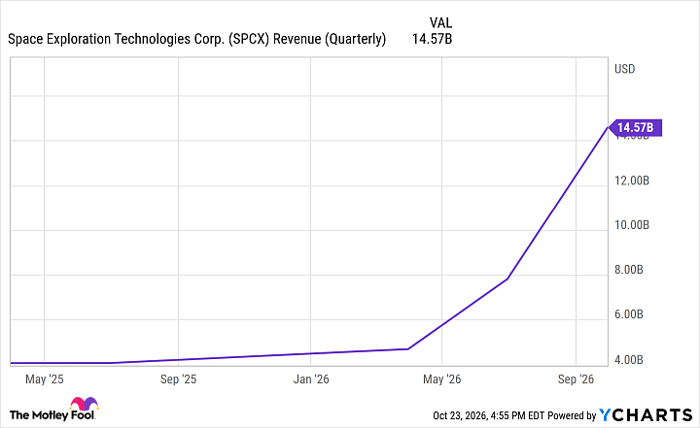
Its latest report showed Q3 revenue jumped 161% year over year, reaching $14.6 billion. And the company's net income turned positive, coming in at $4.4 billion.
Starlink had a lot to do with this -- sales jumped nearly 70% year over year -- but even its impressive growth paled in comparison to the AI unit. Super Intelligence brought in $7.6 billion in revenue, up 830% year over year and nearly three times the previous quarter's total. The unit has been building out data center capacity at a lightning pace, and as more and more of that comes online, its huge compute contracts are starting to pay.

Image source: Getty Images.
Look at the incredible revenue growth during the past year in the chart below.
SPCX Revenue (Quarterly) data by YCharts
Of course, the data center build-out is expensive -- extremely. The company spent $19.6 billion last quarter and expects to spend as much as $40 billion in the current quarter.
Bull and bear cases for SpaceX in 2030
Here's what 2030 might look like:
Bull case:
- SI: $200 billion in annual revenue. Demand for computing power stays white hot, and the company's own models get more traction.
- Connectivity: $100 billion. Starlink growth continues apace, and pricing power remains high.
- Space: $15 billion. Starship allows SpaceX to carry larger payloads for more customers.
All told, that would put SpaceX at $315 billion in annual revenue by 2030.
Bear case:
- SI: $60 billion in annual revenue. Demand grows, but competition pushes prices down and makes new data centers less lucrative. That assumes roughly 20% annual growth from the latest quarter's annualized sales.
- Connectivity: $30 billion. Starlink keeps adding customers, but the pace of growth has slowed as competition ramps up and markets get saturated.
- Space: $9 billion. Starship's development takes longer than expected.
That puts 2030 revenue at $100 billion.
What $10,000 in SpaceX could become
OK, so what would $10,000 invested today look like in 2030 under these two scenarios? Well, we have start by making a few assumptions. First, I'm going to assume a bull case of 20% net margin and a bear case of 10% net margin, leading to net income of $63 billion and $10 billion, respectively.
I'm going to assume that in the bull case, the continued high growth means investors are willing to pay 50 times earnings. In the bear case, investors are paying 20 times earnings. I'm also not accounting for any dilution from potential stock sales.
- Bull case: $10,000 becomes $16,000
- Bear case: $10,000 becomes $1,000
What stands out to me is this: if SpaceX executes at a very high level, continues to grow rapidly, and investors are still willing to pay a sizable premium, the company's sky-high current valuation makes the return just slightly better than average. The downside, however, is pretty extreme.
And at today's price, I'd want more potential upside to justify the risk of things going wrong.
Should you buy stock in Space Exploration Technologies right now?
Before you buy stock in Space Exploration Technologies, consider this:
The Motley Fool Stock Advisor analyst team just identified what they believe are the 10 best stocks for investors to buy now… and Space Exploration Technologies wasn’t one of them. The 10 stocks that made the cut could produce monster returns in the coming years.
Consider when Netflix made this list on December 17, 2004... if you invested $1,000 at the time of our recommendation, you’d have $344,608!* Or when Nvidia made this list on April 15, 2005... if you invested $1,000 at the time of our recommendation, you’d have $1,327,222!*
Now, it’s worth noting Stock Advisor’s total average return is 904% — a market-crushing outperformance compared to 211% for the S&P 500. Don't miss the latest top 10 list, available with Stock Advisor, and join an investing community built by individual investors for individual investors.
See the 10 stocks »
*Stock Advisor returns as of October 28, 2026.
Johnny Rice has no position in any of the stocks mentioned. The Motley Fool has no position in any of the stocks mentioned. The Motley Fool has a disclosure policy.
Recommended Articles


