


Prediction: This Artificial Intelligence (AI) Memory Stock Will Go Parabolic on Oct. 30
Key Points
Wall Street will closely monitor capital expenditures forecasts when Alphabet and Amazon report earnings this week.
Smart investors should listen closely to commentary around big tech's AI infrastructure budgets.
If the hyperscalers reference memory prices as a cause for higher spend, Micron stock could kick into gear.
- Motley Fool Issues Rare "Total Conviction" Buy Alert ›
As technology companies race to build data centers, demand for the memory chips that make artificial intelligence (AI) computing possible has skyrocketed. One of the leading manufacturers of memory chips for AI hyperscalers is Micron Technology (NASDAQ: MU).
So far this year, Micron stock has soared 225% -- making it the third-highest performer in the Nasdaq-100. Nevertheless, Micron's shares have experienced considerable volatility over the last couple of months and trade about 24% below their all-time high.
Missed AI’s "Act 1"? Act 2 Could Be 15x Bigger. Most investors think they missed the AI boat because they didn't buy Nvidia in 2005. But according to our analysts, we’re only at the end of "Act 1"—the R&D phase. "Act 2" is the global rollout. Continue »
I think this disconnect is about to reverse. On Oct. 28 and 29, Alphabet (NASDAQ: GOOGL) (NASDAQ: GOOG) and Amazon (NASDAQ: AMZN) are scheduled to report quarterly earnings. While investors will undoubtedly focus on their respective AI-related capital expenditures (capex), I think another topic could emerge as a major discussion point: the global memory shortage. If my prediction is accurate, Micron could begin to rally just in time for Halloween.
Amazon already warned investors about rising memory costs
For most of the AI revolution, investors primarily associated infrastructure with graphics processing units (GPUs) designed by Nvidia and application-specific integrated circuits (ASICs) designed by Broadcom. However, GPUs and custom silicon cannot operate efficiently without sufficient memory. Micron manufactures dynamic random access memory (DRAM) and high bandwidth memory (HBM), both of which are critical components of the AI chip stack.
Interestingly, Amazon CEO Andy Jassy already highlighted the growing importance of memory during the company's last earnings call. Jassy explained that Amazon planned to increase its 2026 capex budget to $220 billion -- up from its previous forecast of $200 billion -- specifically because of higher memory costs.
Meanwhile, Alphabet raised its 2026 capex forecast to $195 billion to $205 billion during its second-quarter earnings call. Management attributed the increase to accelerating infrastructure investments and capacity supply constraints. Although Alphabet did not explicitly identify memory as the culprit, its comments reinforce the underlying idea that demand for AI compute is insatiable.
As both companies prepare to report earnings this week, investors should pay close attention to any additional commentary surrounding memory availability, pricing, and infrastructure spending.

Image source: Getty Images.
Elon Musk just chimed in on AI memory as well
Amazon and Alphabet aren't the only companies confronting the memory shortage. Earlier this month, Elon Musk took to X (formerly Twitter) to discuss the bottlenecks facing AI infrastructure build-outs. Musk specifically identified RAM supply as a constraint, supporting the idea that memory availability is becoming just as important as access to advanced processors.
This distinction matters because the AI infrastructure boom is moving beyond simply procuring as many GPUs as possible. AI models need memory to support training and inference. Training involves teaching AI to recognize patterns, while inference occurs when those models are deployed to perform an actual task rather than just answer a query. Both activities require substantial memory, particularly as applications become more complex across autonomous systems, robotics, and agentic AI.
A prolonged memory shortage could create favorable conditions for Micron. When demand for a product exceeds available supply, manufacturers can command higher prices. For Micron, this is already happening and translating into accelerating revenue growth, expanding profit margins, and earnings visibility.
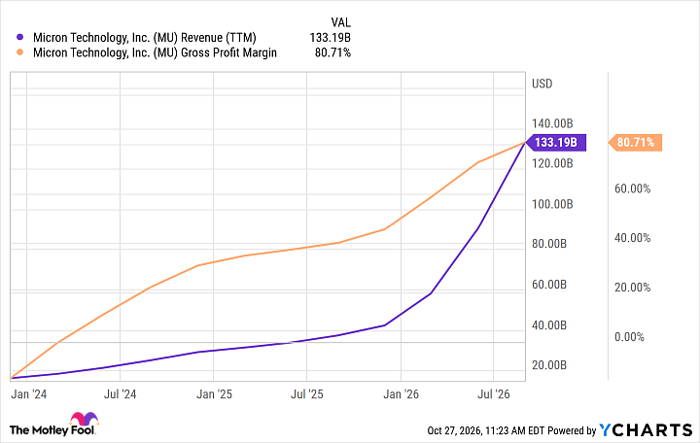
MU Revenue (TTM) data by YCharts
Oct. 30 could be a major catalyst for Micron stock
One of the biggest headwinds dragging on Micron stock right now is skepticism about the semiconductor industry's boom-and-bust cycles and whether hyperscalers can maintain the pace of their infrastructure spending. I think Amazon's and Alphabet's upcoming earnings reports will help answer that question.
If leadership explicitly emphasizes the memory shortage, rising component prices, or the increasing demand for memory-intensive AI applications, investors may begin to view Micron's growth as more durable than anticipated.
My prediction is that earnings season will become a turning point for Micron stock. If the world's largest AI developers stress the industry's memory shortage, investors should recognize that Micron's opportunity extends well beyond this year. With shares still trading meaningfully below their all-time high, positive commentary could provide a much-needed catalyst for a new rally.
Should you buy stock in Micron Technology right now?
Before you buy stock in Micron Technology, consider this:
The Motley Fool Stock Advisor analyst team just identified what they believe are the 10 best stocks for investors to buy now… and Micron Technology wasn’t one of them. The 10 stocks that made the cut could produce monster returns in the coming years.
Consider when Netflix made this list on December 17, 2004... if you invested $1,000 at the time of our recommendation, you’d have $344,608!* Or when Nvidia made this list on April 15, 2005... if you invested $1,000 at the time of our recommendation, you’d have $1,327,222!*
Now, it’s worth noting Stock Advisor’s total average return is 904% — a market-crushing outperformance compared to 211% for the S&P 500. Don't miss the latest top 10 list, available with Stock Advisor, and join an investing community built by individual investors for individual investors.
See the 10 stocks »
*Stock Advisor returns as of October 27, 2026.
Adam Spatacco has positions in Alphabet, Amazon, and Nvidia. The Motley Fool has positions in and recommends Alphabet, Amazon, Broadcom, Micron Technology, and Nvidia. The Motley Fool has a disclosure policy.
Recommended Articles


