


If a Stock Market Crash Is Coming, This Is the Vanguard ETF Warren Buffett Would Load Up On
Key Points
The S&P 500 has soared for several years as investors remain enthusiastic about artificial intelligence (AI).
Some economic indicators suggest the bull market rally is headed for weaker returns.
While the timing around a correction or crash is uncertain, one Buffett-approved ETF is a smart buy no matter what.
- Motley Fool Issues Rare "Total Conviction" Buy Alert ›
The stock market has enjoyed a historical bull market over the last several years. Fueled primarily by artificial intelligence (AI), the S&P 500 (SNPINDEX: ^GSPC) has climbed to all-time highs.
Naturally, some investors are questioning whether the rally can continue. If the stock market experiences a correction or even crashes in 2027, investors might be tempted to sell their stocks and wait for conditions to improve.
Missed AI’s "Act 1"? Act 2 Could Be 15x Bigger. Most investors think they missed the AI boat because they didn't buy Nvidia in 2005. But according to our analysts, we’re only at the end of "Act 1"—the R&D phase. "Act 2" is the global rollout. Continue »
I think doing the opposite could be considerably more rewarding in the long run. Legendary investor Warren Buffett has long supported a simple investment strategy that can help everyday investors build wealth through virtually any market environment. That strategy involves owning a low-cost S&P 500 index fund, such as the Vanguard S&P 500 ETF (NYSEMKT: VOO).
Buffett likes Vanguard funds
Buffett earned a reputation for identifying undervalued businesses and holding on to them for decades. However, his advice for most investors is different from his own stock-picking approach. Rather than attempting to identify the next Nvidia, Buffett thinks most investors are better served by purchasing a diversified basket of America's largest companies.
In his 2013 shareholder letter, Buffett explained how he instructed the trustees managing his wife's inheritance to invest the funds. His recommendation was to allocate 10% to short-term government bonds and 90% to a low-cost S&P 500 index fund. Buffett specified his preferred provider, writing, "I suggest Vanguard's."
Interestingly, Berkshire Hathaway previously owned shares of the Vanguard S&P 500 ETF. According to 13F filings, Berkshire held 43,000 shares of the fund before liquidating the position during the fourth quarter of 2024.

Image source: Getty Images.
Why the Vanguard S&P 500 ETF is a great long-term option
The beauty of the Vanguard S&P 500 ETF lies in its composition. Its holdings span technology, healthcare, financial services, consumer products, industrial businesses, and other industries. This diversification is important because each sector performs differently under certain economic conditions.
The S&P 500 has demonstrated resilience throughout history. During the dot-com crash, the index declined 49% between 2000 and 2002. During the 2008 financial crisis, it lost roughly 57% from its 2007 peak to its 2009 bottom. More recently, the S&P 500 endured a bear market in 2022 as the Federal Reserve raised interest rates to combat inflation.
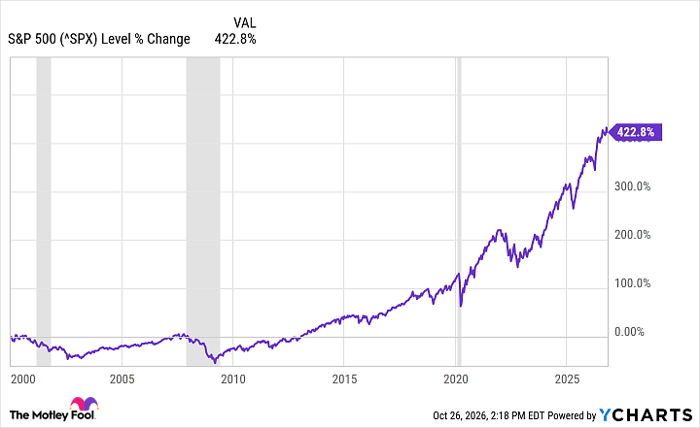
^SPX data by YCharts
The chart depicts recessions in the grey columns. Despite a number of setbacks, the S&P 500 consistently bounced back and reached new highs. This resilience reflects a distinct characteristic of the index: Its composition changes over time. Companies that become irrelevant are eventually replaced by stronger businesses, allowing the index to evolve alongside the American economy.
VOO also offers the advantage of low costs. The fund charges an annual expense ratio of just 0.03%. This means you pay $3 a year for every $10,000 invested. Keeping expenses low allows investors to retain more of their gains, which can make a meaningful difference as your contributions compound over decades.
A stock market crash could create a generational buying opportunity
One of the biggest mistakes investors make during market downturns is assuming that cratering stock prices automatically signal poor investment opportunities. In reality, market crashes allow patient investors to buy the dip in quality businesses at substantially lower prices.
Of course, no one knows exactly when a market crash will occur or how long a recovery will take. This is why investors shouldn't wait for a crash before buying a stake in the Vanguard S&P 500 ETF. A more prudent strategy is to use dollar-cost averaging, investing a fixed amount at regular intervals regardless of market conditions.
Investors with long time horizons and financial flexibility will come to find that market downturns offer lucrative wealth-creation opportunities rather than reasons to run for the hills. Ultimately, Buffett's investment philosophy is rooted in a simple practice: Owning a diversified basket of blue chip American businesses over long periods is often more rewarding than attempting to predict every market fluctuation. If the stock market crashes in 2027, I see the Vanguard S&P 500 ETF as one of the smartest investments to accumulate for the next decade and beyond.
Should you buy stock in Vanguard S&P 500 ETF right now?
Before you buy stock in Vanguard S&P 500 ETF, consider this:
The Motley Fool Stock Advisor analyst team just identified what they believe are the 10 best stocks for investors to buy now… and Vanguard S&P 500 ETF wasn’t one of them. The 10 stocks that made the cut could produce monster returns in the coming years.
Consider when Netflix made this list on December 17, 2004... if you invested $1,000 at the time of our recommendation, you’d have $344,608!* Or when Nvidia made this list on April 15, 2005... if you invested $1,000 at the time of our recommendation, you’d have $1,327,222!*
Now, it’s worth noting Stock Advisor’s total average return is 904% — a market-crushing outperformance compared to 211% for the S&P 500. Don't miss the latest top 10 list, available with Stock Advisor, and join an investing community built by individual investors for individual investors.
See the 10 stocks »
*Stock Advisor returns as of October 27, 2026.
Adam Spatacco has positions in Nvidia. The Motley Fool has positions in and recommends Berkshire Hathaway, Nvidia, and Vanguard S&P 500 ETF. The Motley Fool has a disclosure policy.
Recommended Articles


