


Analysts Think Green Thumb Industries Will Double Over the Next 12 Months. Here's Why They're Probably Wrong
Key Points
Green Thumb's shares are down more than 6% so far this year.
The cannabis retailer has been consistently profitable.
Analysts' average price target for the stock is $16.
- 10 stocks we like better than Green Thumb Industries ›
Green Thumb Industries (OTC: GTBIF) is one of the few profitable cannabis stocks. While its shares are down more than 6% so far this year, analysts have an average price target of $16 per share. That's more than double the stock's current price.
Could this cannabis stock double its price in the next 12 months? While that's possible, it's not very likely, barring an extraordinary external macro or regulatory shock. Let me explain why.
Missed AI’s "Act 1"? Act 2 Could Be 15x Bigger. Most investors think they missed the AI boat because they didn't buy Nvidia in 2005. But according to our analysts, we’re only at the end of "Act 1"—the R&D phase. "Act 2" is the global rollout. Continue »
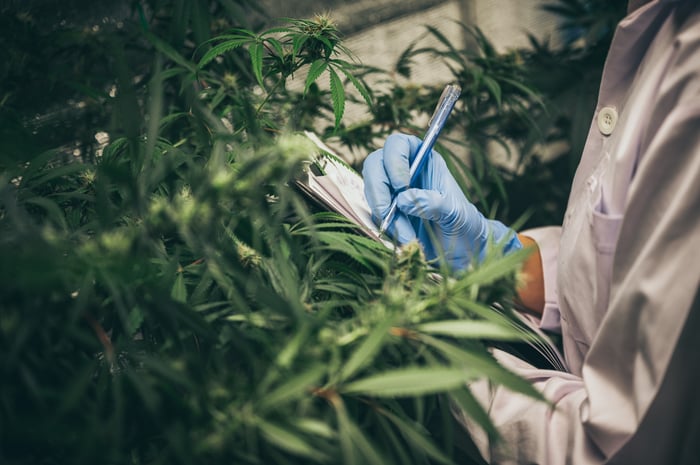
Image source: Getty Images.
Federal rescheduling isn't a panacea
The most likely regulatory shock that would lift all cannabis stocks, not just Green Thumb, would be federal rescheduling of cannabis from a Schedule I to Schedule III drug. Back in April, the Department of Justice issued an order placing Food and Drug Administration (FDA)-approved marijuana drugs and state-licensed medical cannabis into Schedule III. The order is still facing legal challenges in the U.S. Court of Appeals for the D.C. Circuit.
The Drug Enforcement Administration held evidentiary hearings on rescheduling, wrapping them up on July 15, but the final rescheduling rule must await review by the Attorney General and the DEA Administrator. That likely won't happen until late this year, and more likely next year, and federal court stays or extended appeals would push implementation further out.
Even once that happens, the impact of rescheduling is likely to be overrated. The elimination of the 280E tax burden will help Green Thumb by allowing it to deduct standard business expenses such as rent. However, the trade-off could potentially be new federal regulations that the company will have to adapt to.
The company's growth is still slow
In its recent quarterly reporting, management guided to flat sequential revenue growth due to persistent retail price compression across core state markets. Organic earnings growth alone cannot justify a doubled valuation in a year.
In the second quarter, revenue grew 4.6%, year over year, to $307 million, but earnings per share (EPS) were $0.02, up only a bit from a $0.01 loss in the same period a year ago and down from the $0.07 Green Thumb reported in the first quarter.
The company is to be commended for its fiscal restraint as it grows. It has been cash flow positive since 2020, and while it continues to open new dispensaries -- more than 120 at last count -- its trailing debt-to-earnings before interest, taxes, depreciation, and amortization (EBITDA) ratio is only 1.7, well below that of competitors such as Curaleaf, Trulieve, and Cresco Labs.
That conservative management is great for long-term results, but it also means the company isn't likely to make a big acquisition that would double its stock price in the next year.
The cannabis sector suffers from investor fatigue
Investor fatigue in the cannabis sector is a psychological and structural phenomenon built over years of regulatory false starts, broken legislative promises, and severe valuation compression.
For nearly a decade, cannabis stock rallies have been driven by regulatory headlines rather than organic financial growth. Whenever news breaks, including executive orders or DEA announcements, initial surges are met with aggressive profit-taking. Retail and institutional investors have learned that federal progress moves slowly through administrative court challenges, leading to cynicism and brief holding periods.
In addition, major institutional funds are legally or structurally prohibited from buying U.S. plant-touching cannabis stocks because the plant remains federally illegal for the time being. Without institutional buying power, trading volume stays thin on OTC exchanges, preventing sustained multi-month price expansions.
Even well-run operators such as Green Thumb face severe retail price deflation across core adult-use markets. As state markets mature and illegal or unregulated hemp-derived markets siphon market share, top-line revenue growth has normalized into single digits, curbing the hyper-growth narrative that once justified speculative multiples.
Should you buy stock in Green Thumb Industries right now?
Before you buy stock in Green Thumb Industries, consider this:
The Motley Fool Stock Advisor analyst team just identified what they believe are the 10 best stocks for investors to buy now… and Green Thumb Industries wasn’t one of them. The 10 stocks that made the cut could produce monster returns in the coming years.
Consider when Netflix made this list on December 17, 2004... if you invested $1,000 at the time of our recommendation, you’d have $433,160!* Or when Nvidia made this list on April 15, 2005... if you invested $1,000 at the time of our recommendation, you’d have $1,296,254!*
Now, it’s worth noting Stock Advisor’s total average return is 949% — a market-crushing outperformance compared to 212% for the S&P 500. Don't miss the latest top 10 list, available with Stock Advisor, and join an investing community built by individual investors for individual investors.
See the 10 stocks »
*Stock Advisor returns as of September 15, 2026.
James Halley has no position in any of the stocks mentioned. The Motley Fool recommends Cresco Labs and Green Thumb Industries. The Motley Fool has a disclosure policy.
Recommended Articles


