


The 10-Year Treasury Yield Just Passed 5%. Here’s How That Impacts Dividend-Paying Consumer Stocks.
Key Points
Higher bond yields make dividend-paying consumer stocks less attractive.
U.S. government debt carries a high credit rating, while the U.S. dollar remains the world's reserve currency.
However, $40 trillion in total debt and the interest payments on it make longer-dated U.S. Treasury notes and bonds riskier.
- These 10 stocks could mint the next wave of millionaires ›
The yield on the U.S. 10-year Treasury note briefly surpassed 5% on Sept. 14. This occurred briefly in 2023, and since then, the 10-year hasn't been this high since 2007.
Yields have blasted higher since the Iran war broke out at the very end of February. Higher inflation expectations, partly from the war, as well as mounting debt, which recently topped $40 trillion, have sent longer-term yields higher.
Missed Nvidia in 2009? This Rare Signal Is Flashing Again. In 2009, a "Double Down" signal flashed for a little-known chipmaker called Nvidia. For the first time in years, that same "Total Conviction" signal is flashing for a company 1/100th the size of Nvidia. Continue »
While bonds function very differently from stocks, bond yields can be quite impactful in the economy and broader stock market.
Here's how the surging 10-year yield impacts dividend-paying consumer stocks.

Image source: Getty Images.
Higher bond yields make consumer-paying dividend stocks less attractive
Dividend stocks offer investors a way to earn annual passive income, which can be a much more reliable stream than investing in a stock for appreciation, since predicting when appreciation will occur, also known as timing the market, is very difficult.
But dividend stocks also carry risk because the dividend is supported by the earnings and free cash flows that the company generates, so if the business starts to struggle, that can put the dividend at risk.
When investors purchase U.S. Treasury bills, notes, and bonds, they are betting on the U.S. government and the U.S. dollar, which is the world's reserve currency.
The yield you see on a Treasury represents the annual percentage rate. So when people purchase 10-year notes, they are lending the government money. The government pays them a fixed interest rate on a semiannual schedule, with the principal returned when the note matures.
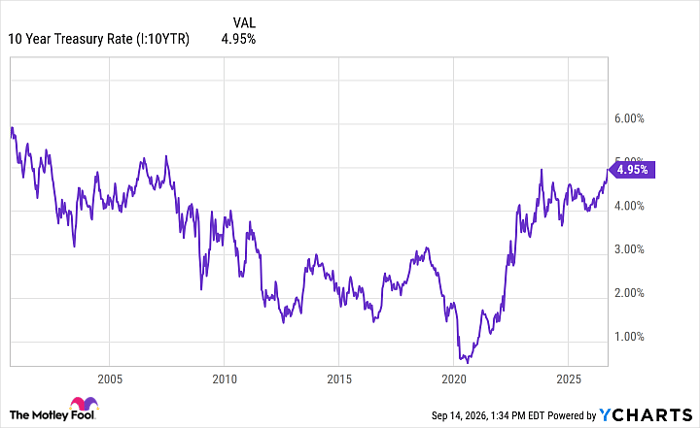
10 Year Treasury Rate data by YCharts
When bond yields rise, investing in new bonds becomes more attractive because the U.S. government has historically maintained a strong financial reputation.
With the 10-year hitting a multi-decade high of 5%, that's going to be appealing to many investors and likely draw interest away from dividend-paying consumer stocks.
After all, there aren't that many reliable dividend payers that will be able to yield 5% for the next decade.
U.S. debt does not carry the same stature it used to
While U.S. Treasury bills, notes, and bonds remain among the safest assets in the world, they have lost some of their stature in recent years.
That's because U.S. government debt has topped $40 trillion this year, a figure many people struggle to wrap their heads around.
There's a wide dispute among economists about whether this total debt number truly matters, but what does matter right now are the annual interest payments the government is making.
Interest payments on the debt consume 15% of the total budget. Meanwhile, the debt has contributed to a $1.8 trillion deficit through July of fiscal year 2026, which ends at the conclusion of September. This means that spending exceeds revenue by $1.8 trillion.
In recent years, this dynamic has led credit rating agencies to downgrade U.S. debt, which still carries a high rating but not the absolute highest rating it once held.
Investors have also been more wary of carrying U.S. debt, particularly for longer-dated bonds.
Shorter-term debt is likely to be repaid, but some investors no longer view longer-dated debt, such as a 30-year Treasury bond, as safe as it once was.
This has driven up longer-term bond yields, as investors want more compensation for the additional risk. Now, I still feel very good about 10-year Treasury debt. Yielding around 5%, that's going to trump most dividend stocks.
But against the 30-year bond, I would certainly consider dividend stocks, such as Dividend Kings with a sustainable 3% to 5% yield, although due diligence is still required.
Where to invest $1,000 right now
When our analyst team has a stock tip, it can pay to listen. After all, Stock Advisor’s total average return is 950%* — a market-crushing outperformance compared to 212% for the S&P 500.
They just revealed what they believe are the 10 best stocks for investors to buy right now, available when you join Stock Advisor.
See the stocks »
*Stock Advisor returns as of September 14, 2026.
The Motley Fool has a disclosure policy.
Recommended Articles


