


Federal Reserve: 1 Thing All Investors Need to Know Before Sept. 16
Key Points
The Federal Reserve has held interest rates steady in both Federal Open Market Committee meetings since Kevin Warsh became the Fed Chair.
Continuing inflation is putting more pressure on the Fed to increase interest rates.
Small-cap stocks and debt-heavy companies could suffer from higher interest rates.
- These 10 stocks could mint the next wave of millionaires ›
One of the more talked-about economic topics over the past year has been inflation and the Federal Reserve's (Fed) response (or lack thereof, rather). During the last Federal Open Market Committee (FOMC) meeting in July, the Fed kept rates steady for the second consecutive time under new Fed Chair Kevin Warsh.
That said, one thing investors need to know before the Sept. 15-16 FOMC meetings is that interest rates are very likely to rise, though by how much remains to be seen.
Missed Nvidia in 2009? This Rare Signal Is Flashing Again. In 2009, a "Double Down" signal flashed for a little-known chipmaker called Nvidia. For the first time in years, that same "Total Conviction" signal is flashing for a company 1/100th the size of Nvidia. Continue »
Image source: Getty Images.
The relationship between inflation and interest rates
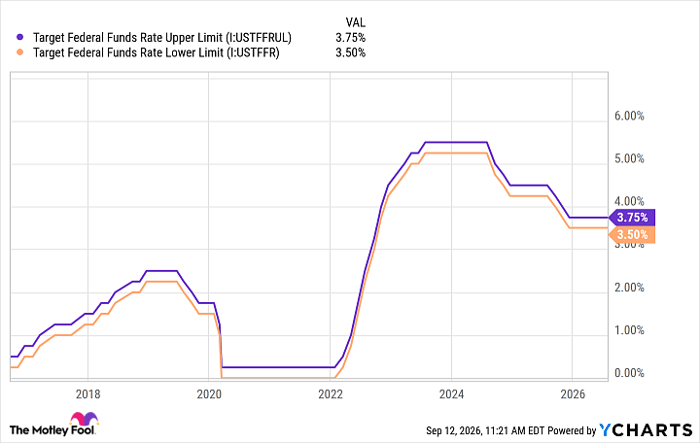
The Fed interest rate (also known as the federal funds rate) sets the baseline borrowing cost for things like credit cards, auto loans, and mortgages. When interest rates are low, borrowing is cheaper, which tends to make people and businesses spend more. The more people spend, the higher the demand goes, giving companies leeway to raise prices and drive up inflation.
To combat this, the Fed will increase interest rates to make borrowing more expensive and potentially deter spending. The idea is that more expensive borrowing will cause people to spend less, creating a domino effect that slows demand and, in turn, lowers prices.
Where are interest rates headed?
Warsh has taken a strong stance against providing forward guidance on interest rates. But with the latest inflation reports, the consensus is an expected increase. In August, inflation (based on the CPI-U) rose 3.4% on an annualized basis, repeating July's 3.4% annualized increase.
Ideally, the Fed wants to keep inflation around 2%, so 3.4% in back-to-back months isn't ideal. The lowest annualized inflation rise in the past 12 months was 2.4% in both January and February of this year.
Rarely does the Fed raise interest rates by more than 75 basis points at a time (that's the largest single-meeting increase in the past decade), and I don't expect that to change this go around. However, even if a modest increase occurs at the next meeting on Sept. 16, it's almost certain it won't be the last in the near future because of current inflation and the current jump in oil prices related to conflicts in the Middle East.
Data by YCharts.
What higher interest rates mean for investors
There's both good and could-be-better news for investors. The good news is that higher interest rates also apply to things like savings accounts, newly issued bonds, and other fixed-income assets.
For stocks, interest rates don't dictate daily stock movements, but higher rates increase companies' borrowing costs, potentially cutting into profits and margins, which doesn't always go over well with investors.
Higher bond yields are also more attractive to investors because they don't have to take on the risk that comes with investing in stocks. Potentially earning 10% is great, yes. But many investors would gladly take 4% risk-free (or very low risk).
Together, those two factors have often caused small-cap stocks, debt-heavy businesses, and young growth stocks to lag a bit after an interest rate increase. Higher interest rates do, however, sometimes work in favor of companies with large cash piles and banks.
You shouldn't run to or away from those stocks because you're anticipating an increase, but be prepared for the potential higher-than-usual volatility that could happen with an increase.
Where to invest $1,000 right now
When our analyst team has a stock tip, it can pay to listen. After all, Stock Advisor’s total average return is 950%* — a market-crushing outperformance compared to 212% for the S&P 500.
They just revealed what they believe are the 10 best stocks for investors to buy right now, available when you join Stock Advisor.
See the stocks »
*Stock Advisor returns as of September 14, 2026.
The Motley Fool has a disclosure policy.
Recommended Articles


