


Sam Altman Backs Controlling Pace of Frontier AI Development, OpenAI to Introduce Independent Safety Assessments
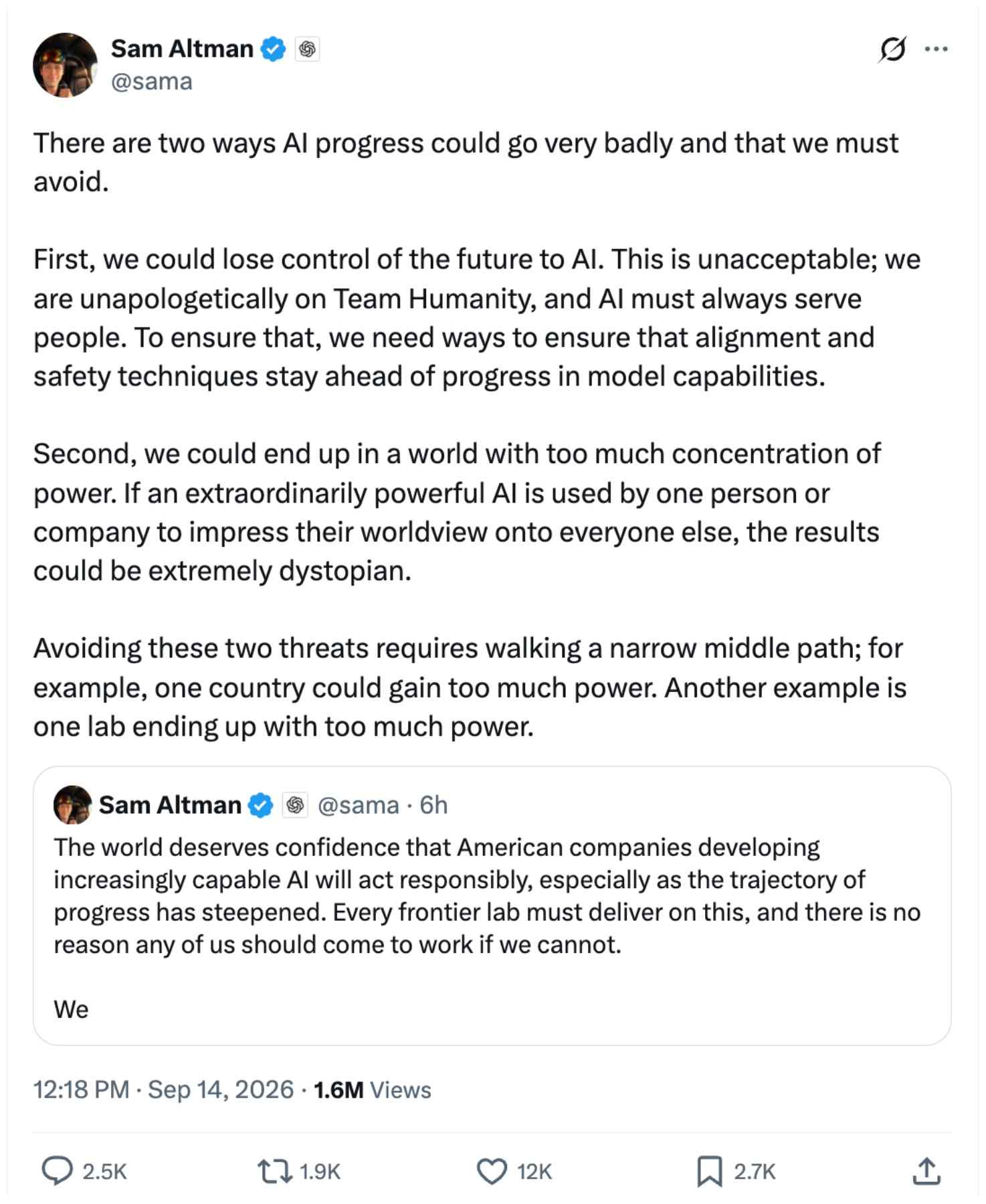
TradingKey - OpenAI CEO Sam Altman posted on social media platform X on September 14 in support of establishing a federal safety framework for frontier AI companies. He stated that the competitive pressures facing the U.S. in the AI sector should not be a justification for companies to act recklessly or allow model capabilities to outpace safety and monitoring capabilities.
[Source: X]
Altman outlined two main categories of risks: first, humanity could lose control of the future, so AI must always serve humans; second, advanced AI could lead to an over-concentration of power, giving a small number of individuals, companies, or even nations excessive influence.
OpenAI supports the introduction of independent evaluators. Altman believes that frontier AI companies should not wait for relevant legislation or antitrust exemptions, but should immediately start developing shared safety standards. As model capabilities advance, alignment and safety technologies must stay ahead, and monitoring measures must keep pace.
OpenAI Adds Safety Arguments Before Training Frontier Models
Altman stated that pacing development does not mean halting research and development. While safety arguments and continuous monitoring will increase costs and may slow down some training progress, model development and technological advancement will continue.
Previously, responsible scaling policies adopted by some frontier AI companies and the preparedness framework established by OpenAI primarily focused on fully trained models and their deployment risks. Altman believes safety management should also cover the model development and evaluation process.
For frontier reinforcement learning training expected to significantly enhance model capabilities, OpenAI has begun establishing clear safety arguments prior to training while retaining safety evaluations before model release. The company hopes other frontier AI firms will draw on its approach and propose their own solutions, driving the formation of shared standards for model misalignment, monitoring, and safety.
Altman stated that pacing development is not equal to halting research and development. Safety arguments and continuous monitoring require more resources and will cause the improvement rate of frontier AI capabilities to be lower than it would be without such measures, but related research and development will still move forward.
OpenAI Responds to Three Anthropic Recommendations
Altman's comments came in response to recommendations proposed on September 12 by Anthropic CEO Dario Amodei. Amodei noted that as AI becomes increasingly involved in developing next-generation models, model capabilities could advance faster than the industry can understand and control the associated risks.
Amodei proposed three measures: frontier AI companies providing third-party evaluation teams with continuous, near-employee-level access; promoting the establishment of shared safety standards among relevant companies in democratic nations; and pursuing international coordination involving countries such as the U.S. and China.
Anthropic has committed to bringing in external evaluation teams. Altman also stated that OpenAI will adopt similar independent evaluation arrangements, although the company has not yet disclosed the evaluators' specific access privileges and implementation timeline.
On the issue of development speed, Trump's priorities differ from those of some leaders at frontier AI companies. Trump believes the U.S. has no need to slow AI development, to avoid eroding its lead over China. Altman, meanwhile, advocates continuing R&D while ensuring that alignment, safety, and monitoring measures do not fall behind advances in model capabilities.
Recommended Articles


