


Should You Buy Snowflake Stock After Its Recent Surge? The Answer Might Shock You.
Key Points
Its stocks has rocketed 67% higher so far in 2026, but its sky-high valuation could limit further upside.
The company offers cloud platforms that help users to aggregate their data and develop AI software.
Revenue growth accelerated in its most recent quarter, but its bottom-line losses continue to pile up.
- 10 stocks we like better than Snowflake ›
Data is the lifeblood of every artificial intelligence (AI) software application. The more information a business can feed into its AI models, the smarter and more useful its software will be. But since most large organizations host their valuable digital assets across multiple different cloud platforms like Amazon Web Services and Microsoft Azure, their AI models often draw information from fragmented data sets.
Snowflake's (NYSE: SNOW) Data Cloud solves this problem by bringing data together from across different cloud environments, and it offers an expanding portfolio of tools and services to help businesses turn it into powerful AI software.
Missed Nvidia in 2009? This Rare Signal Is Flashing Again. In 2009, a "Double Down" signal flashed for a little-known chipmaker called Nvidia. For the first time in years, that same "Total Conviction" signal is flashing for a company 1/100th the size of Nvidia. Continue »
The stock is up 67% in 2026 and is closing in on a fresh record high for the first time in five years, but despite the company's spectacular operating results over the last few quarters, here's why investors might want to think twice about adding it to their portfolio.

Image source: Getty Images.
At the center of the enterprise AI revolution
Snowflake built a flagship AI platform called Cortex AI, where companies can pair their internal data with leading AI models from third-party developers like Anthropic and Meta Platforms to create AI agents, chatbots, and other software applications. The platform includes a series of ready-made tools to make the process easier, including CoCo (formerly Cortex Code), an AI-powered coding assistant.
Then there is CoWork, a powerful AI assistant that can help every knowledge worker -- even those in nontechnical jobs -- extract value from an organization's data. It even plugs into every major email and customer-relationship management platform so employees can use it to accelerate workflows, whether they want to identify sales trends or summarize meeting notes.
Cortex AI also features processing tools to help pull data from unstructured sources like contracts and invoices, which can be useful when training and deploying AI models.
Snowflake had a record 14,554 total customers at the conclusion of its fiscal 2027 second quarter (ended July 31), and 9,100 of them had deployed CoCo, while 5,800 were using CoWork, so there is clear demand for these new AI products.
Accelerating revenue growth
Product revenue was $1.49 billion during the second quarter, a 37% increase from the year-ago period. That growth accelerated from 34% in the first quarter, highlighting the company's strong momentum. This great result prompted management to lift its product revenue guidance for fiscal 2027 by $230 million to $6.07 billion.
However, the company is spending heavily in areas like marketing and research and development to deliver that top-line growth, making it difficult to achieve profitability on the basis of generally accepted accounting principles (GAAP). The company lost $487 million during the first half of fiscal 2027 alone, and while that was an improvement from its year-ago net loss of $727 million, profitability still seems way out of reach for now.
On a positive note, Snowflake did generate an adjusted first-half profit of $383 million after excluding one-off and noncash expenses, which included $890 million in stock-based compensation. Although stock-based comp isn't a cash expense, investors still pay for it by way of dilution; every time Snowflake issues new shares to its employees, every existing share held by investors becomes slightly less valuable, so this cost can't be dismissed.
In my opinion, Snowflake must find a way to turn the AI tailwind into consistent GAAP profits, because the company's history suggests it will otherwise wind up with billions of dollars in annual losses once its revenue growth inevitably slows down at some point in the future. That won't be good for its stock price.
Upside could be limited from here
Following its recent gains, the stock is now trading at a sky-high price-to-sales ratio (P/S) of 23.1, making it almost four times as expensive as the Nasdaq-100 index, which has a P/S of 6.1. In other words, it looks overvalued compared to a basket of America's largest technology companies.
There aren't many good comparisons to Snowflake in the public markets because of its unique product portfolio, but its stock is substantially more expensive than other cloud giants like Amazon, Microsoft, and Alphabet, which also offer broad portfolios of AI services.
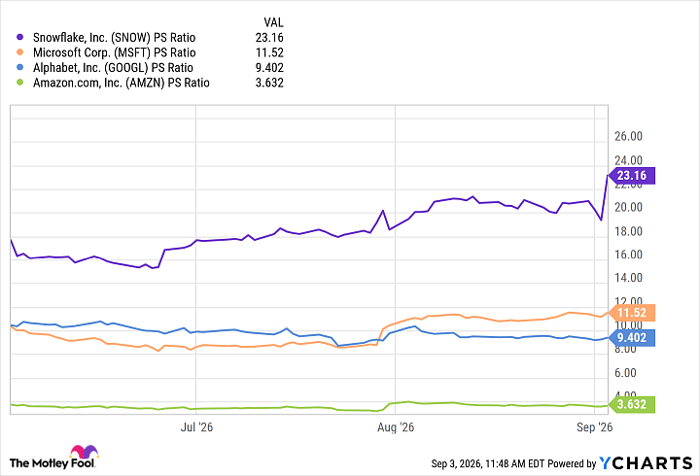
SNOW PS Ratio data by YCharts.
Amazon, Microsoft, and Alphabet operate many different businesses outside of cloud computing, so they aren't the perfect companies to compare with Snowflake in terms of valuation. But Amazon Web Services grew its revenue by 37% during its most recent quarter, while Azure's revenue jumped by 43%, and Google Cloud's revenue surged by 82%. And they each generated significantly more revenue than Snowflake did, making their growth rates even more impressive.
Therefore, it's difficult to justify Snowflake's premium valuation relative to those cloud giants, and I actually think it will limit the potential upside of its stock from current levels. As a result, it probably isn't a great buy right now.
Should you buy stock in Snowflake right now?
Before you buy stock in Snowflake, consider this:
The Motley Fool Stock Advisor analyst team just identified what they believe are the 10 best stocks for investors to buy now… and Snowflake wasn’t one of them. The 10 stocks that made the cut could produce monster returns in the coming years.
Consider when Netflix made this list on December 17, 2004... if you invested $1,000 at the time of our recommendation, you’d have $421,997!* Or when Nvidia made this list on April 15, 2005... if you invested $1,000 at the time of our recommendation, you’d have $1,413,876!*
Now, it’s worth noting Stock Advisor’s total average return is 978% — a market-crushing outperformance compared to 213% for the S&P 500. Don't miss the latest top 10 list, available with Stock Advisor, and join an investing community built by individual investors for individual investors.
See the 10 stocks »
*Stock Advisor returns as of September 6, 2026.
Anthony Di Pizio has no position in any of the stocks mentioned. The Motley Fool has positions in and recommends Alphabet, Amazon, Meta Platforms, Microsoft, and Snowflake. The Motley Fool has a disclosure policy.
Recommended Articles


