


Arm Holdings Rebounds as Agentic AI Demand Puts $258 Breakout in Focus
TradingKey - Arm opens September 4 with their last closed deal at $242.59 showing a 3.29% increase from the previous close, almost matching the chart provided at $242.64. Premarket trading sitting at $247.67 has $247.50 the first active resistance. The more important resistance still stands at $255.20-$258.44. With record Q1 revenue, data-center royalties more than doubling and new support from NVIDIA Vera, IBM Z/LinuxONE, Fujitsu MONAKA and Arm AGI CPU, the data-center and AI story continues to expand past smartphones.
Q1 Revenue Reached a Record $1.29 Billion
Arm reported $1.29 billion in fiscal Q1 2027 revenue, up 22% from the previous fiscal year. In dollar amount, royalty revenue increased 22% to $715 million, and licensing revenue increased 23% to $574 million. Non-GAAP operating income reached $531 million, at a 41.2% margin.
The biggest change within the mix was data-center royalty revenue. More than doubling from the previous year, this demonstrated that Arm's earnings began expanding beyond smartphones into data-center and cloud-based workloads.
Q2 Guidance Remains Strong
Arm set their fiscal Q2 revenue at around $1.38 billion and adjusted EPS at around $0.47. There was a sell-off of the stock following the July report, as management warned of a potential sequential decline in smartphone royalties. This should not be seen as a deflection in the momentum of their AI business.
The central investment question is most impacted by the progress of server and AI royalties. Is it possible to create a large enough base of these royalties to counteract the reliance Arm has had in the past on mobile?
Agentic AI Creates a New CPU Growth Engine
Arm’s September 2 Hot Chips update highlighted how the next iteration of AI will require more processing. Agentic systems must carry out tasks by running code, querying databases, calling external tools, and instructing accelerators by managing memory and coordinating services.
At the event, four of Arm’s six major CPU research papers were dedicated to Arm ecosystem companies: NVIDIA’s Vera, IBM’s future Z/LinuxONE dual architecture processor, Fujitsu MONAKA, and the Arm AGI CPU. Arm was central to four of the six CPU papers presented on the first day. This breadth of customer interest is important because it indicates how Arm is providing a potentially disruptive technology across hyperscale AI, enterprise computing, and high-performance AI systems.
Arm AGI CPU Expands the Revenue Model
Arm’s innovative Neoverse V3 based design offers customers a way to deploy products based on complete processor chips, as opposed to Arm’s traditional licensing of IP. Each design is able to offer up to 136 cores and up to 96 PCIe Gen 6 lanes along with integrated support for CXL 3.0 technology. The design also offers 12 memory channels and a power budget for each chip of up to 300W.
Arm will be able to charge higher per design prices, which can potentially increase revenue, but there will be additional execution challenges. Moving into complete production silicon requires a significant time and financial commitment and increased supply chain commitment. Also Arm must ensure they will not lose customers by building their own chips using Arm’s intellectual property.
IBM, Fujitsu and NVIDIA Validate the Ecosystem
IBM is adding Arm-based AArch64 computing support to their line of Z and LinuxONE processors, making it one more pathway to banking and enterprise processing. IBM is developing a future dual-architecture processor for Z and LinuxONE that can natively execute Arm and IBM Z/LinuxONE instructions. Fujitsu’s 144-core MONAKA processor not only strengthens Arm’s position in the HPC market, but also delivers an energy efficient data center. Finally, NVIDIA Vera strengthens Arm’s role as the CPU platform paired with leading AI accelerators.
These designs are increasingly important due to the increased importance of power efficiency vs. pure computing. With AI data centers facing increased power and cooling constraints, Arm’s power efficient architecture is increasingly important.
Valuation and Execution Remain the Main Risks
Arm’s largest challenge will not be weak demand. It will be unmet expectations. The stock still has a premium value, so any small compromise in their business activity, licensing, or AGI work could drive a significant stock decrease.
There will also be a strain along Arm’s complete silicon route. The company does not want to abandon their competitive advantages, but they also do not want to cannibalize their market too much.
Arm Technical Analysis: $258.44 Is the Decisive Breakout Level
ARM closed at $242.59, almost at the chart's $242.64 level, after recovering from the $230 area. The price is still below the dominant downward trendline, so the broader pattern has not yet turned fully bullish.
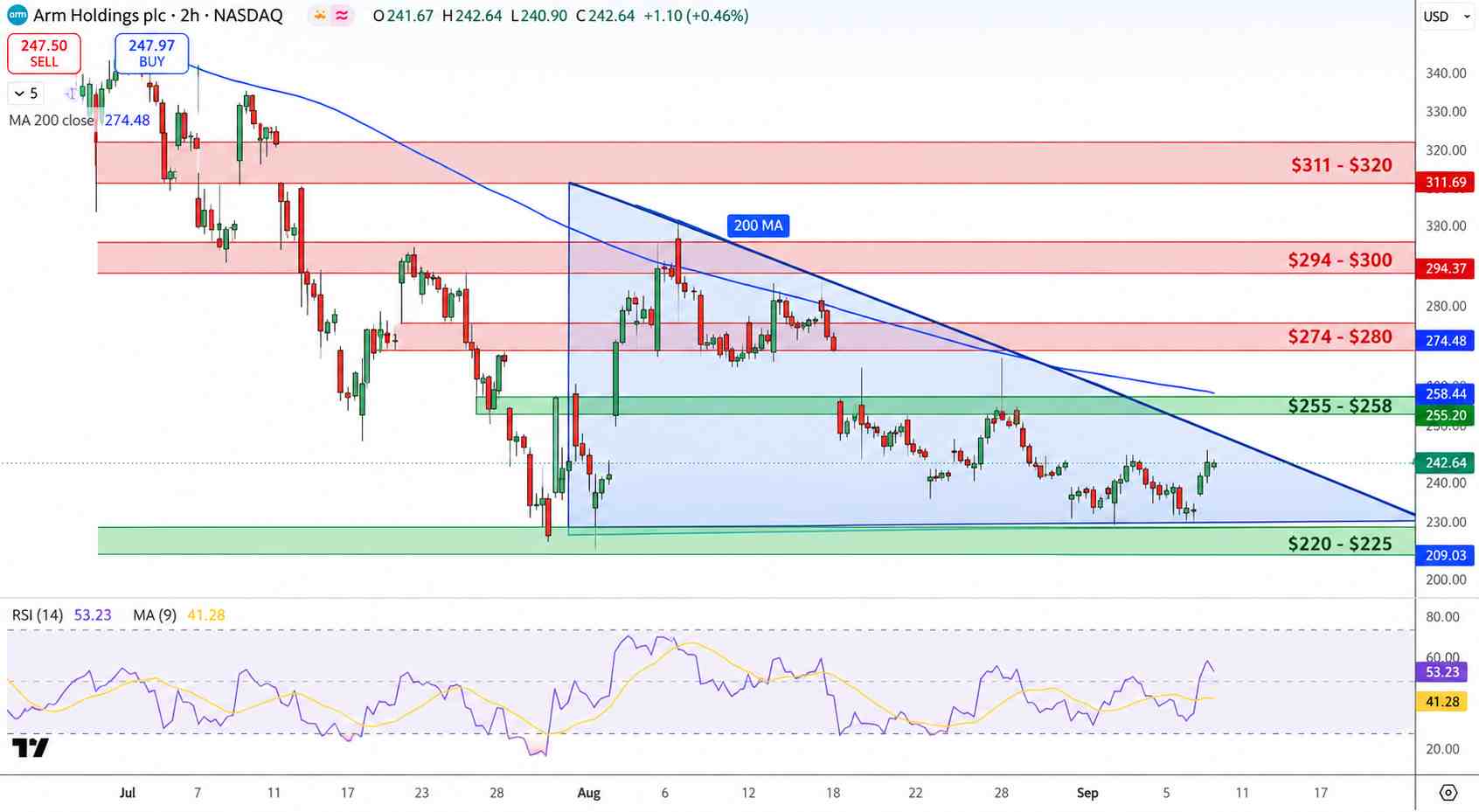
Arm Price Chart - Source: Tradingview
The $247.50 level is the initial hurdle. However, the more important level is the resistance zone of $255.20-$258.44. A close of 2 hours above $258.44 would bring about significant changes to the structure and bring $274.48 and then $294.37 into focus.
RSI at 53 has some upward momentum, but is above the 50 neutral level and above its signal line around 41. Below support price, the key zone is $220-$225. A break below that would invalidate the recovery and bring $209.03 support into focus.
Key Levels
· Permanent close: $242.59
· Pre-market indicator: Approx. $247.67
· First level of resistance: $247.50
· Resistance breakout zone: $255.20-$258.44
· First potential level of upside move: $274.48
· Potential level of upside move: $294.37
· Important support zone: $220-$225
· Potential level of downside move: $209.03
· RSI: Approx. 53, neutral
Why is Arm stock in focus?
Arm is gaining share across data centre, cloud and agentic-AI workloads while data centre royalties have more than doubled. NVIDIA Vera, IBM Z/LinuxONE, Fujitsu MONAKA and Arm AGI CPU all confirm that shift.
What level confirms another ARM breakout?
A sustained 2-hour close above $258.44 would clear the dominant descending resistance and strengthen the case for $274.48 and then $294.37.
Bottom Line
Arm's AI thesis is shifting in the area that is most important: Agentic and Distributed AI workloads place greater emphasis on CPUs. The fundamentals remain bullish, but valuation and the execution of complete chips continue to place risk at a premium. Technically, Arm continues to trade in recovery mode above $220 - $225 and $255.20 - $258.44 is the zone that needs to break before the bias shifts more materially to the bullish side of $274 - $294.
Recommended Articles


