


Amazon, Alphabet, and Microsoft: Two I'm Buying and One I'm Selling
Key Points
Amazon and Alphabet are seeing their cloud growth rates rapidly accelerate.
Microsoft is the cheapest of the three from one valuation measure.
- 10 stocks we like better than Alphabet ›
Amazon (NASDAQ: AMZN), Microsoft (NASDAQ: MSFT), and Alphabet (NASDAQ: GOOG) (NASDAQ: GOOGL) are generally recognized as the big three hyperscalers. These three also operate the leading cloud computing platforms, which are a huge part of the AI build-out. Most companies don't have computing capacity available to run AI workloads, so they rent computing power from these three. There isn't enough capacity available, so this trio is spending hundreds of billions of dollars on data center capital expenditures this year and is likely to do the same in 2027. That will lead to monster growth for these companies, but are they all solid buys right now?
Of the three, there are two that I think are smart buys, while one is the odd stock out. Which one is the one to avoid? Let's find out.
Missed Nvidia in 2009? This Rare Signal Is Flashing Again. In 2009, a "Double Down" signal flashed for a little-known chipmaker called Nvidia. For the first time in years, that same "Total Conviction" signal is flashing for a company 1/100th the size of Nvidia. Continue »

Image source: Getty Images.
One stands out with a faster growth rate
All three of these companies are fairly similar: They have a primary business but also a booming cloud computing segment. Amazon has its commerce business, Microsoft has a business software product lineup, and Alphabet has the Google Search empire. All three of these businesses generate significant cash flows, allowing them to invest in cloud computing, which requires heavy upfront investment but then enables massive cash generation in the future.
When it comes to growth rates, Alphabet is by far the fastest-growing. In Q2, Google Cloud's revenue increased 82% year over year. It's also doing it profitably, as its operating margin rose from 21% to 36% over the year. It's hard to pick apart those results, and Google Cloud is by far the fastest-growing. But it's also accelerating. Its growth rate in Q1 was 63%. With more computing capacity coming online, don't be surprised to see this growth rate cross triple digits over the next few quarters.
Amazon Web Services (AWS) and Microsoft Azure are closer in their growth rates, but there is one glaring defect in Microsoft's results that makes me question its strength. AWS' growth rate in Q2 was 37% versus Azure's 43%. However, in Q1, AWS' growth rate was 28% versus Azure's 40%. Why is that a big deal? Well, AWS' growth rate is rapidly accelerating (similar to Google Cloud's), while Azure's is staying fairly stagnant.
This could be a one-off quarterly issue, and if Microsoft reports rapidly accelerating Azure revenue next quarter, it could solve the problem. But if Azure continues its 40% or so growth rate while its peers are experiencing accelerating growth, it could be a red flag that Microsoft isn't capturing as much market opportunity as possible in one of the biggest technological arms races we've ever seen.
As a result, I prefer the other two to Microsoft right now, but is there also a valuation component to be aware of?
Valuing these three isn't straightforward
Each of these companies has invested billions into up-and-coming AI companies, which skews their earnings-per-share (EPS) metric, which affects their price-to-earnings (P/E) ratios. As a result, valuing the stocks based on operating income makes the most sense.
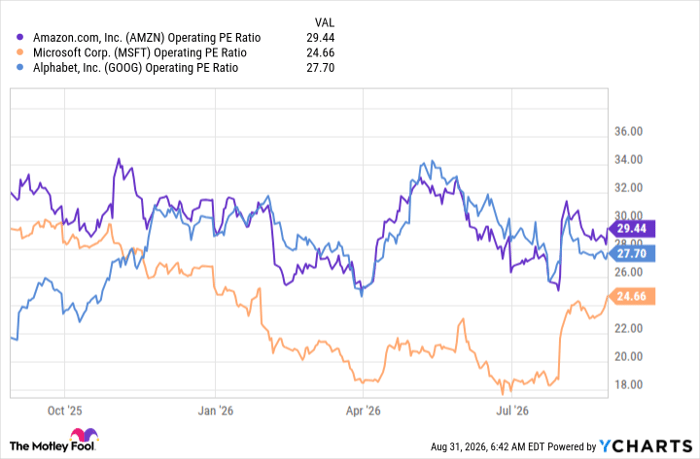
AMZN Operating PE Ratio data by YCharts
From this standpoint, Microsoft is by far the cheapest. This could be the market adjusting for the discrepancy seen in Azure versus the other cloud computing providers. If it is, then the market may have priced the stock correctly to account for AWS' and Google Cloud's rapid acceleration.
However, I'm still picking Amazon and Alphabet over Microsoft despite a cheaper price tag due to their growth acceleration. I think grabbing market share is a better long-term setup than a lower price now, and that makes them top AI stocks to buy and hold over the next few years as the AI arms race ramps up.
Should you buy stock in Alphabet right now?
Before you buy stock in Alphabet, consider this:
The Motley Fool Stock Advisor analyst team just identified what they believe are the 10 best stocks for investors to buy now… and Alphabet wasn’t one of them. The 10 stocks that made the cut could produce monster returns in the coming years.
Consider when Netflix made this list on December 17, 2004... if you invested $1,000 at the time of our recommendation, you’d have $445,833!* Or when Nvidia made this list on April 15, 2005... if you invested $1,000 at the time of our recommendation, you’d have $1,402,153!*
Now, it’s worth noting Stock Advisor’s total average return is 993% — a market-crushing outperformance compared to 214% for the S&P 500. Don't miss the latest top 10 list, available with Stock Advisor, and join an investing community built by individual investors for individual investors.
See the 10 stocks »
*Stock Advisor returns as of September 5, 2026.
Keithen Drury has positions in Alphabet, Amazon, and Microsoft. The Motley Fool has positions in and recommends Alphabet, Amazon, and Microsoft. The Motley Fool has a disclosure policy.
Recommended Articles


