


All It Takes Is 336 Shares of Realty Income Stock to Generate $1,000 in Yearly Dividends. Here's Whether the Payout Is Safe.
Key Points
The dividend has risen for 32 straight years.
Many of America's top companies lease its properties.
- 10 stocks we like better than Realty Income ›
Realty Income (NYSE: O) often escapes the notice of both investors and average Americans alike. Although many people may not recognize its name, they likely spend time in some of its nearly 15,600 properties regularly.
The company has existed since 1969, and it became a real estate investment trust (REIT) in 1994. It's payout has steadily risen over that 32-year history, and today, one has to buy 336 shares for around $20,600 to generate $1,000 in annual dividend income.
Missed Nvidia in 2009? This Rare Signal Is Flashing Again. In 2009, a "Double Down" signal flashed for a little-known chipmaker called Nvidia. For the first time in years, that same "Total Conviction" signal is flashing for a company 1/100th the size of Nvidia. Continue »
However, whether that payout is sustainable means understanding its business and how much cash it generates. Let's take a closer look to see whether investors can truly trust its dividend.

Image source: The Motley Fool.
The state of Realty Income
Realty Income specializes in net leased, single-tenant commercial properties. Under these arrangements, the tenants cover the costs of maintenance, insurance, and property taxes.
Properties like this have become increasingly popular for some of America's best-known companies. Walmart, Dollar General, and FedEx are among Realty Income's tenants, giving the company a stable revenue base.
Additionally, its properties were 98.8% occupied as of the end of the second quarter of 2026. These consistently high occupancies prompted it to buy or develop more of these properties over the years. The company slightly trimmed its property count in 2025 to unload properties it could not lease, but it has again added properties in 2026. Hence, its property base remains on a long-term growth trajectory.
The Realty Income dividend
Realty Income stands out as a dividend payer by making 12 dividend payments annually and even billing itself as the "monthly dividend company."
Moreover, it has raised its dividend every year since the 1994 IPO and typically passes along modest payout hikes every few months. Today's annual dividend stands at just over $3.25 per share, and shareholders benefit from a dividend yield of 4.85%, well over the S&P 500 (SNPINDEX: ^GSPC) average of 1.04%. Also, given the stock's performance over the current decade, the dividend is the primary source of returns.
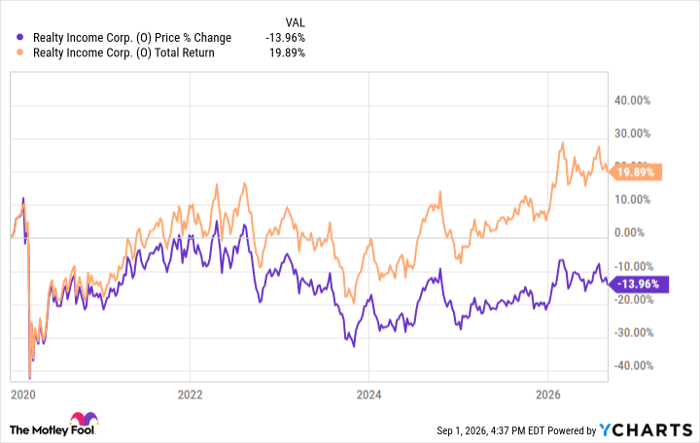
O data by YCharts
The good news is that Realty Income's dividend is sustainable. Over the trailing 12 months, it earned $4.27 per share in funds from operations (FFO) income, a measure of the REIT's free cash flow. This is well above the $3.25-per-share dividend, leaving room for payout hikes and investment in the business.
Also, while most dividend stocks can theoretically cut dividends at any time, REITs like Realty Income must pay out at least 90% of their net income as dividends, making it unlikely that shareholders will lose this monthly income stream.
Furthermore, abandoning a 32-year streak of dividend increases tends to undermine confidence in a stock. Realty Income pays out well over 90% of its income, making a dividend cut theoretically possible. Still, given its aforementioned sustainability, investors can expect the payout hikes to continue.
Finally, Realty Income compares well with fixed-income investments such as bonds or certificates of deposit (CDs). While stock prices often fall and can struggle for years to move higher, with the 10-year Treasury at 4.80% as of this writing, Realty Income's dividend is generating higher cash returns than most fixed-income options.
Additionally, fixed-income instruments do not offer payout increases or the potential for long-term stock returns that could further boost total returns. Thus, if one can hold Realty Income over the long term, it makes sense for income investors to choose it over bonds or CDs.
Investing in Realty Income
Investors can almost certainly rely on Realty Income to earn a stream of income that is generous, rising, and, most importantly, sustainable.
Admittedly, the REIT is not as low-risk as a fixed-income instrument, and payout hikes and falling stock prices pose risks.
Fortunately, the company benefits from a high occupancy and a client base that can be relied on to cover lease payments. Moreover, it has long been in a growth mode, as evidenced by its 32-year streak of payout hikes that lag its FFO income. This means that if one is willing to hold Realty Income stock for the long term, dividend and stock price growth should sustainably deliver profits to its shareholders.
Should you buy stock in Realty Income right now?
Before you buy stock in Realty Income, consider this:
The Motley Fool Stock Advisor analyst team just identified what they believe are the 10 best stocks for investors to buy now… and Realty Income wasn’t one of them. The 10 stocks that made the cut could produce monster returns in the coming years.
Consider when Netflix made this list on December 17, 2004... if you invested $1,000 at the time of our recommendation, you’d have $445,833!* Or when Nvidia made this list on April 15, 2005... if you invested $1,000 at the time of our recommendation, you’d have $1,402,153!*
Now, it’s worth noting Stock Advisor’s total average return is 993% — a market-crushing outperformance compared to 214% for the S&P 500. Don't miss the latest top 10 list, available with Stock Advisor, and join an investing community built by individual investors for individual investors.
See the 10 stocks »
*Stock Advisor returns as of September 5, 2026.
Will Healy has positions in Realty Income. The Motley Fool has positions in and recommends Realty Income and Walmart. The Motley Fool recommends FedEx. The Motley Fool has a disclosure policy.
Recommended Articles


