


Forget the Chip Shortage -- Anthropic's Real Constraint Is Electricity. Here's the Energy Stock That Wins.
Key Points
AI data centers are facing power shortages as hyperscalers continue their rapid build-out.
GE Vernova is well-positioned to capitalize on the rising demand for power solutions.
The company has seen a significant surge in orders for its heavy-duty gas turbines.
- 10 stocks we like better than GE Vernova ›
Investors are buzzing about memory chip shortages amid the rapid artificial intelligence (AI) data center build-out. But a harder constraint has emerged: Data centers cannot get enough power. As a result, electricity has become one of the biggest bottlenecks for hyperscalers today.
In Anthropic's policy paper, "Build AI in America," the company notes that training a single frontier AI model in the future could require gigawatts of power. By 2028, the U.S. AI sector could require 50 gigawatts (GW) of electricity.
Missed Nvidia in 2009? This Rare Signal Is Flashing Again. In 2009, a "Double Down" signal flashed for a little-known chipmaker called Nvidia. For the first time in years, that same "Total Conviction" signal is flashing for a company 1/100th the size of Nvidia. Continue »
Getting more energy online is no easy feat. Transmission line construction, substation approvals, and grid interconnections are lengthy bureaucratic processes, and Anthropic CEO Dario Amodei doesn't want the cost of training and inference falling on ordinary Americans.
As a result, hyperscalers' attention has turned to alternative power solutions, like those offered by GE Vernova (NYSE: GEV). Here's why GE Vernova can continue to ride the AI trade higher over the next several years.
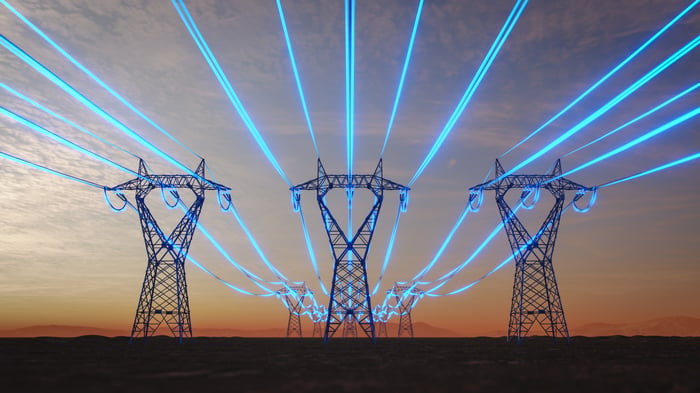
Image source: Getty Images.
GE Vernova benefits from historic demand for its power solutions
GE Vernova is perfectly positioned for the electricity boom. The company provides a range of power solutions, including grid solutions, energy management systems, wind turbines, and gas turbines. The company's installed base, spanning more than 100 countries, generates one-quarter of the world's electricity.
The company's strongest product right now is its gas turbines. GE Vernova's heavy-duty gas turbines and aeroderivative turbines help meet hyperscalers' near-term power demands. For example, its aeroderivatives can be shipped, installed, and commissioned in as little as six months and provide bridge power while long-term electricity expansion takes place.
Meanwhile, its HA-class gas turbines provide efficient baseload power, which hyperscalers need as their power demands grow. In the second quarter, GE Vernova's heavy-duty gas equipment orders jumped fourfold in the second quarter. It booked 52 heavy-duty gas units during the period. The company's backlog reached a staggering $176 billion by the end of the quarter.
GE Vernova is a key player in Project Kilby in Texas, working alongside Chevron and Microsoft to build a 2.67-GW co-located power facility for Microsoft's AI data center. The facility will utilize GE Vernova's gas turbines and electrical infrastructure to deliver power directly to Microsoft without burdening the regional power grid.
Powerful tailwinds should benefit the energy stock long term
GE Vernova CEO Scott Strazik noted that "the long-cycle electric power industry is in the early stages of a multi-decade growth opportunity" during the company's second-quarter earnings call.
The company expects to have 125 GW of gas equipment orders under contract by the end of this year and is expanding capacity to provide 30 GW of gas equipment by 2030, up from the 20 GW annual output projected for the third quarter.
AI hyperscalers need power, and a lot of it. Given the long timeline for connecting to the power grid, coupled with pushback from local communities, more companies are turning to GE Vernova for power -- which should be a powerful tailwind for the stock for years to come.
Should you buy stock in GE Vernova right now?
Before you buy stock in GE Vernova, consider this:
The Motley Fool Stock Advisor analyst team just identified what they believe are the 10 best stocks for investors to buy now… and GE Vernova wasn’t one of them. The 10 stocks that made the cut could produce monster returns in the coming years.
Consider when Netflix made this list on December 17, 2004... if you invested $1,000 at the time of our recommendation, you’d have $437,097!* Or when Nvidia made this list on April 15, 2005... if you invested $1,000 at the time of our recommendation, you’d have $1,355,077!*
Now, it’s worth noting Stock Advisor’s total average return is 978% — a market-crushing outperformance compared to 213% for the S&P 500. Don't miss the latest top 10 list, available with Stock Advisor, and join an investing community built by individual investors for individual investors.
See the 10 stocks »
*Stock Advisor returns as of September 2, 2026.
Courtney Carlsen has positions in Chevron, GE Vernova, and Microsoft. The Motley Fool has positions in and recommends Chevron, GE Vernova, and Microsoft. The Motley Fool has a disclosure policy.
Recommended Articles


