


Who Decides the Most Important Interest Rate in the World? Understanding What Gold Is Really Trading Through the Fed, the U.S. Treasury, and the Bond Market
For a long time, gold investors have relied on a very familiar framework: when the Federal Reserve raises rates, gold comes under pressure; when the Fed cuts rates, gold benefits. The logic is straightforward. Gold itself pays no interest. If cash and U.S. Treasuries can offer higher returns, the opportunity cost of holding gold naturally rises. Conversely, when interest rates fall, that opportunity cost declines, making gold relatively more attractive.
There is nothing fundamentally wrong with this framework. But increasingly, it is no longer enough. Markets often produce combinations that appear contradictory at first glance. The Fed may send dovish signals, yet 10-year or even 30-year Treasury yields rise instead of falling. Long-term yields may climb sharply, yet gold does not come under the sustained pressure it once did. At times, Treasury prices fall and long-term yields rise while gold rallies at the same time. If we simply apply the formula of “rates up, gold down,” these moves become difficult to explain.
The problem may begin with the way the question is framed. We often talk about “U.S. interest rates” as if there were only one interest rate in the United States and as if the Federal Reserve determined it. In reality, the system works very differently. The Fed can control the price of very short-term money extremely effectively, but it cannot arbitrarily determine the cost of borrowing for 10 or 30 years. The U.S. Treasury cannot directly set market interest rates either, but it can decide how much debt to issue and at which maturities. And when those securities actually trade in the market, global bond investors ultimately decide what yield is attractive enough based on their own views of inflation, growth, fiscal policy, and risk.
For gold investors, this distinction matters enormously. Gold’s true competitor is not simply the Fed Funds Rate. It is the real return available on U.S. dollar assets—and, just as importantly, how credible and durable that return appears to be. To understand the relationship between gold and interest rates, we first need to answer a more basic question: Who actually determines U.S. interest rates?
1. There Has Never Been Just One “U.S. Interest Rate”
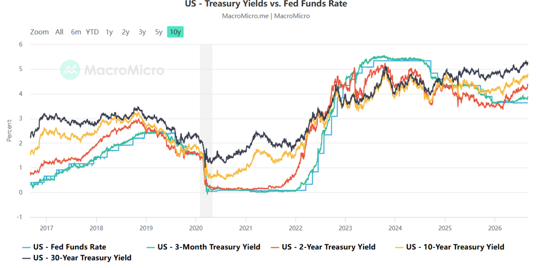
Open any financial terminal and you will see an entire U.S. yield curve. From 3-month Treasury bills to 2-year, 5-year, 10-year, and 30-year Treasury securities, every maturity has its own price and yield. Mortgage rates and corporate bond yields are then priced off these benchmarks. So when a headline simply says “U.S. interest rates are rising,” it may actually be describing several completely different market developments.
Source: MacroMicro
The simplest way to understand these rates is to place them along a timeline. The closer the maturity is to overnight funding or a few months, the more directly the Federal Reserve influences it. The further out the maturity extends, the greater the role of market pricing.
What the Fed can directly control is the very short end of the money market. Through mechanisms including interest on reserve balances, open-market operations, and repo facilities, the Fed keeps the effective federal funds rate trading near the target range set by the Federal Open Market Committee. In July 2026, the FOMC maintained the federal funds target range at 3.50%–3.75%, while using its reserve and overnight repo framework to support the functioning of short-term money markets.
So if the Fed cuts rates by 25 basis points, it does have the ability to bring overnight funding costs down accordingly. But that does not mean the 10-year Treasury yield must also fall by 25 basis points the next day, much less that the 30-year mortgage rate will mechanically decline by the same amount.
The 2-year Treasury yield still tends to listen closely to the Fed, and the reason is straightforward. If an investor buys a 2-year Treasury today, one of the most important questions is where the Fed is likely to keep policy rates over the next two years. A hotter-than-expected CPI print, a very weak employment report, or a major FOMC communication can therefore quickly change expectations for future rate hikes or cuts and cause large moves in the 2-year yield.
But once we extend the maturity to 10 or 30 years, the problem changes completely. Anyone lending money to the U.S. government for 30 years cannot think only about whether the Fed will cut rates next month. Over three decades, the economy will move through multiple cycles. The inflation regime may change. Fiscal deficits may widen. Treasury supply may increase. Even the monetary-policy framework itself may evolve. The longer the maturity, the more the yield reflects forces beyond simply what the Fed is expected to do next.
This is the first step that is often overlooked in gold analysis. When yields rise, we should not immediately conclude that gold must come under pressure. We should first ask: Which interest rate is actually rising?
2. What Really Makes Up the 10-Year Treasury Yield?
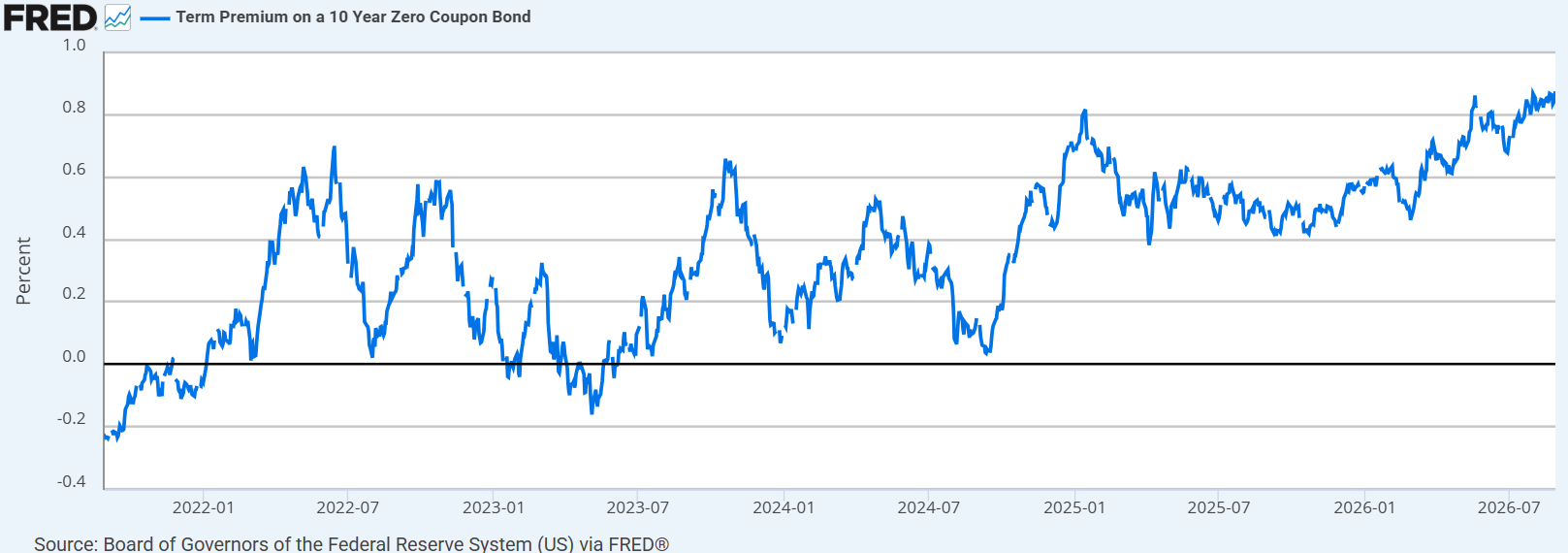
When we break down a long-term Treasury yield, one of the most useful frameworks is surprisingly simple: A long-term yield can roughly be thought of as the expected average level of future short-term interest rates plus a term premium.
Source: FRED
The first component is relatively intuitive. If the market believes the Fed will maintain higher policy rates on average over the next ten years, the 10-year Treasury must offer a higher yield. Otherwise, investors could simply keep rolling over short-term securities. Conversely, if investors believe the economy will remain weak for an extended period and the Fed will need to keep rates low for many years, long-term yields will also tend to be suppressed.
The second component is easier to overlook. The term premium is not a number announced by a central bank. It is the additional compensation investors demand for bearing long-term interest-rate risk. The Federal Reserve Bank of New York has long used term-structure models to decompose Treasury yields into expectations of future short-term rates and a term premium. The concept may sound academic, but in plain English it asks a very simple question: If you want me to lend money for ten years today instead of giving me the option to reconsider three months from now, how much extra compensation do I require?
Why would a long-term investor require that compensation? Because too many things can happen over ten years that cannot be known today. Inflation may turn out higher than expected. Economic growth may change. The Fed may need to raise rates again. The government may issue much more debt. Investors may even reassess the long-term fiscal position of the United States. The longer the maturity of the bond, the more sensitive its value becomes to these uncertainties.
As a result, the same move in the 10-year Treasury yield—from 4% to 5%—can carry very different meanings. In one scenario, the market believes the Fed will keep short-term interest rates higher in the future. In another, expectations for the Fed have barely changed, but investors are demanding more compensation for holding long-dated Treasuries.
On the screen, both scenarios produce the same 5% yield.
But the implications for gold are not the same. If yields rise mainly because economic growth is stronger and real returns on capital are improving, U.S. dollar assets become more attractive. Gold, which generates no cash flow, then faces a higher opportunity cost. But if yields rise mainly because investors are demanding greater compensation for risk—for example, because they are more uncertain about future inflation, fiscal deficits, or long-term Treasury supply—then the higher yield itself may be telling us something different: investors now require greater compensation before they are willing to hold long-term claims denominated in dollars.
This is why there is no permanently stable mechanical relationship between gold and Treasury yields. Gold is not simply reacting to the yield itself. It is reacting to why that yield is moving.
3. The Treasury Cannot Set Interest Rates, but It Can Change How Much Risk the Market Must Absorb
Next comes the U.S. Treasury.
The Treasury and the Federal Reserve are often discussed together, but they perform entirely different functions. The Federal Reserve conducts monetary policy. The Treasury finances the U.S. government. When government spending exceeds tax revenue, the Treasury must issue debt to raise funds. But it must decide not only how much to borrow, but also at which maturities to borrow.
Suppose the U.S. government needs an additional $1 trillion in financing over the next year. In theory, it could issue more 3-month and 6-month Treasury bills, or it could increase issuance of 5-year, 10-year, or even 30-year securities. The government may ultimately borrow exactly the same amount of money, but the market impact can be very different.
The difference comes down to duration risk.
Short-term Treasury bills mature quickly, so their prices are not very sensitive to changes in long-term interest rates. A 30-year Treasury bond is very different. If market interest rates rise significantly, its price can fall sharply. So when the Treasury increases issuance of long-dated securities, it is not simply supplying the market with more “safe assets.” It is asking private investors to absorb more long-term interest-rate risk.
If pension funds, insurance companies, foreign central banks, and other long-term buyers have sufficient demand, that new supply may be absorbed relatively easily. But if long-duration Treasury supply grows faster than structural demand, the market needs another mechanism to attract buyers: higher yields. This is why the Treasury can influence long-term interest rates even though it has no authority to directly set the 10-year or 30-year Treasury yield.
The Treasury has long described its debt-management objective clearly: to finance the government at the lowest cost over time while maintaining regular and predictable issuance. That regularity and predictability are not minor administrative details. The Treasury itself has explained that if investors fear a sudden surge of supply at a particular maturity, they may demand a higher yield as compensation for that supply uncertainty. Predictable issuance can therefore help reduce this component of the risk premium.
In other words, the structure of Treasury issuance can itself influence the term premium.
This is why markets have become increasingly focused in recent years on how much the Treasury issues in short-term Bills, intermediate-term Notes, and long-term Bonds. At first glance, this may look like a technical debt-management issue. In practice, it determines how much duration risk the private sector must absorb. As fiscal deficits grow, this supply effect becomes increasingly important.
At the same time, it is important not to swing to the opposite extreme. The Treasury cannot simply manipulate long-term interest rates whenever it chooses by changing the maturity structure of issuance. U.S. debt management has long emphasized regular and predictable issuance precisely because the goal is to avoid constantly adjusting financing strategy around short-term market timing. The Treasury has also repeatedly emphasized that its objective is to minimize long-term borrowing costs—not to time short-term moves in yields.
It can influence long-term rates. It cannot command them. The final price is still determined by the people buying the bonds.
4. The Government Decides How Much to Borrow. The Market Decides the Price
One of the unique characteristics of U.S. Treasuries is that the United States has one of the deepest and most liquid sovereign bond markets in the world. But that does not mean the Treasury can borrow at whatever yield it wants.
The Treasury brings securities to auction, and global investors bid for them. Pension funds, insurance companies, mutual funds, banks, foreign central banks, foreign private institutions, and hedge funds all decide what price is attractive enough based on their own objectives. If demand is strong, bond prices can be higher and yields lower. If demand weakens, prices have to fall and yields have to rise until enough buyers emerge to absorb the new supply.
This is the clearing price.
It is simply a normal market process. A seller can decide how many houses to put on the market, but cannot force buyers to accept the seller’s preferred price. If a 4% yield on long-term Treasuries is sufficient to attract large amounts of global capital, the market may clear around that level. But if marginal investors conclude that inflation risk, fiscal risk, or duration risk has increased, then 4% may no longer be enough. They may demand 4.5% or more.
The Treasury market does not need to experience a dramatic episode in which “nobody wants to buy” for demand to have changed. Often, the most important shift is much subtler: Investors who were previously willing to buy at a given price now require a higher return.
That is also why the identity of Treasury buyers increasingly matters. Different buyers have different levels of price sensitivity. Pension funds may have a natural need for long-duration assets because they must match long-term liabilities. Central banks managing foreign-exchange reserves place greater emphasis on safety and liquidity. Hedge funds, by contrast, may participate in relative-value trades without any intention of holding the bonds to maturity. If the marginal buyer changes, the behavior of the entire yield curve can change as well.
This is one reason U.S. Treasuries serve as the so-called global risk-free rate. The yield is not simply an administratively imposed number set by the government. It is a market price formed through continuous trading by global capital. In its own debt-management framework, the Treasury also explicitly recognizes market depth, liquidity, and broad auction participation as important conditions for keeping long-term borrowing costs low.
So if we had to summarize the relationship between the U.S. Treasury and the market in a single sentence, it would be this: The U.S. government decides how much it needs to borrow, but its creditors decide the price at which they are willing to lend.
5. The Real Complexity Is That the Fed, the Treasury, and the Market Do Not Always Want the Same Thing
During relatively stable economic periods, these three forces do not necessarily come into obvious conflict. The Fed wants stable inflation and healthy employment. The Treasury wants to finance the government reliably at a low long-term cost. Investors want returns that adequately compensate them for risk. If inflation is stable, fiscal conditions are manageable, and Treasury supply can be absorbed smoothly by the market, the yield curve can reflect economic fundamentals and policy expectations relatively calmly.
Problems tend to emerge when debt levels are large, financing needs continue rising, and inflation has not fully disappeared.
Suppose the Fed believes inflation remains too high and therefore does not want financial conditions to ease prematurely. That means short-term policy rates may need to stay elevated. But from the Treasury’s perspective, the higher interest rates are, the more expensive newly issued debt and refinancing of existing debt become. Government interest expense gradually rises. From a fiscal perspective, lower long-term financing costs are naturally preferable.
Meanwhile, bond investors may be looking at a different picture altogether. They may see persistent fiscal deficits, larger future Treasury issuance, and inflation uncertainty that has not completely disappeared. As a result, they may demand a higher term premium before they are willing to lock money into 10-year or 30-year Treasuries.
A tension then emerges among the three groups. The Fed is concerned with whether monetary policy is sufficiently restrictive to control inflation. The Treasury is concerned with whether government financing remains stable and inexpensive. Bond investors are concerned with whether the current yield adequately compensates them for long-term risk.
This is why recent discussions around the U.S. Treasury, the maturity structure of Treasury issuance, and long-term borrowing costs have attracted so much market attention. What matters is not whether one specific Treasury operation can push the 10-year or 30-year yield down by a few dozen basis points. The more important point is that markets are increasingly recognizing that as debt and financing needs expand, the interaction between fiscal policy, debt management, and long-term interest rates becomes more important.
And this issue is not particularly dependent on any one moment in time. As long as the United States remains the world’s most important sovereign debt issuer, and as long as U.S. Treasuries remain a global pricing benchmark, the relationship among the Fed, the Treasury, and the bond market will continue to matter. What changes from one period to another is simply which force dominates.
6. For Gold, What Matters Is Not How High Yields Are, but What They Are Pricing
Once we understand the structure of interest rates, the most useful lesson for gold investors is not to memorize another rule such as “rates up, gold down.” It is to learn how to identify what the market is actually pricing. Instead of focusing only on the next FOMC meeting, looking at changes across different parts of the Treasury curve can often provide much more information.
A practical sequence is to begin with the 2-year Treasury yield. It is highly sensitive to expectations for Fed policy. If the 2-year yield suddenly rises sharply, that usually means the market is repricing the expected path of future rate hikes, rate cuts, or how long policy rates are likely to remain elevated. For gold, the first question is therefore whether the short-term monetary-policy environment has changed—not whether gold must automatically move in one direction.
The next step is to look at the 10-year and 30-year yields. If the 2-year yield has already fallen significantly but the 10-year or 30-year yield remains elevated—or even continues to rise—then the market may no longer be focused primarily on what the Fed will do next. At that point, investors need to consider whether long-term inflation expectations, the term premium, and Treasury supply are playing a larger role. This is particularly important for gold because the same elevated 10-year yield can represent very different macroeconomic environments.
The third step is to look at the 10-year U.S. Treasury Inflation-Protected Securities, or TIPS, real yield. Compared with nominal Treasury yields, real yields are closer to the true opportunity cost faced by gold. If real yields continue to rise, investors can earn higher inflation-adjusted returns from low-credit-risk dollar assets. That generally creates more direct pressure on gold. But if nominal Treasury yields are high while real yields are not rising to the same degree, looking only at the 10-year nominal Treasury yield can exaggerate the pressure facing gold.
Finally, use the U.S. dollar and gold itself as confirmation. Real-world combinations extend far beyond just two scenarios, but two representative cases are especially useful as reference points. If the 2-year yield and real yields are rising, the dollar is strengthening, and gold is weakening, the market is usually pricing tighter monetary conditions and higher real returns. If, by contrast, the rise is concentrated mainly in long-term yields while the short end is not moving materially higher, the dollar is softer, and gold remains strong, the market may instead be repricing the term premium, fiscal risk, inflation uncertainty, or longer-term policy uncertainty. Other combinations tend to send more mixed signals and require additional variables to interpret.
The key mistake to avoid is treating any single indicator as an on/off switch for gold. The 2-year yield, the 10-year yield, real yields, and the dollar each provide different information. What matters is the combination. When several indicators point in the same direction, the macro logic behind gold is usually easier to identify. When they contradict one another, that contradiction itself is often a sign that the market is transitioning from one pricing regime to another.
So the next time Treasury yields move sharply, instead of immediately asking whether gold should rise or fall, it is more useful to break the move down in sequence: What is the short end pricing? What is the long end pricing? Have real yields changed? And which interpretation is the dollar confirming? That is how the Treasury market becomes a genuine analytical tool for gold rather than simply another version of the old “rates up, gold down” formula.
Conclusion: No One Truly Controls Long-Term Interest Rates
So who actually determines U.S. interest rates?
If we are talking about the overnight policy rate, the answer is mainly the Federal Reserve. If we are talking about the 2-year Treasury yield, market expectations for the future path of Fed policy play a major role. But once the question moves to the 10-year or 30-year Treasury yield, there is no longer a single controller.
The Fed influences expectations for future short-term rates. The U.S. Treasury influences how much long-term interest-rate risk the market must absorb through the size and maturity structure of debt issuance. Economic growth and inflation shape investors’ expectations for the future. And global bond buyers ultimately decide what yield is high enough to make holding those securities worthwhile. The long-term Treasury yields we see every day are simply the market prices that emerge from the interaction of all these forces.
This is why the long end of the yield curve is not something the Fed controls remotely. The Fed can influence it. The Treasury can influence it. Economic fundamentals and Treasury supply can influence it. But ultimately, the price still has to clear in the market. In one period, monetary policy may dominate. In another, inflation expectations may dominate. And at other times, fiscal financing needs and the term premium may become more important.
For gold investors, understanding this distinction means there is no need to mechanically translate every move in Treasury yields into a bullish or bearish signal for gold. The more useful approach is to first identify which part of the yield curve is moving and what force is driving it. The short end primarily reflects expectations for monetary policy. The long end contains much more information about growth, inflation, Treasury supply, and compensation for long-term risk. Real yields, meanwhile, are closer to the true opportunity cost faced by gold.
So the next time the 10-year Treasury yield suddenly rises, instead of immediately wondering whether gold is about to fall, ask a more important question first: What exactly is pushing that yield higher?
Once that question is answered, looking at real yields, the U.S. dollar, and gold’s own price action will often tell us far more than simply trying to predict the next Federal Reserve meeting. For gold investors, what ultimately matters is not any single interest-rate number in isolation. It is the repricing taking place underneath those rates.
Recommended Articles


