


RTX's $289 Billion Backlog Is Mainly Commercial, Not Defense. Here's Why That Split Is the Real Story.
Key Points
Commercial aerospace strength supports RTX's defense business and financial flexibility.
A strong commercial backlog enables the defense business to walk away from unprofitable contracts and avoid problematic ones.
- 10 stocks we like better than RTX ›
The 60/40 split between the commercial aerospace and defense backlogs at RTX (NYSE: RTX) has benefited the company significantly, and not just from a strong recovery in commercial aerospace. There's a strong case for arguing that the commercial aerospace business and backlog have improved the defense business and backlog.
Commercial aerospace and defense are working together
Historically, the commercial aerospace industry was seen as cyclical, characterized by alternating growth spurts and slowdowns. In contrast, the defense industry was seen as steady and low-growth, with the U.S. government as its primary customer.
Missed Nvidia in 2009? This Rare Signal Is Flashing Again. In 2009, a "Double Down" signal flashed for a little-known chipmaker called Nvidia. For the first time in years, that same "Total Conviction" signal is flashing for a company 1/100th the size of Nvidia. Continue »
This combination was one reason for the merger of the former United Technologies' heavy commercial aerospace business and the defense-focused Raytheon Company, which ultimately produced RTX. Earnings and cash flow from the defense business would support the commercial aerospace business through any cyclical downturn, enabling it to continue investing in its long-cycle solutions and prosper when the cycle turned up again.
Indeed, the defense business did support RTX during a costly (multibillion-dollar charge) issue with powder metal coating on the geared turbofan (GTF) engine.
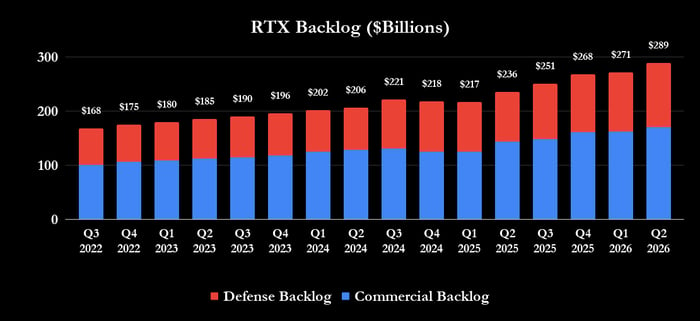
Data source: RTX presentations. Chart by the author.
Why the commercial aerospace backlog also supports the defense business
Aside from the strong profitability of the commercial aerospace business, it helps the defense business avoid overstretching in an era when peers like Boeing and Lockheed Martin have come under pressure to take on difficult, and at times loss-making, fixed-price development programs to satisfy a U.S. government that appears to be negotiating much harder over complex and technically demanding contracts.
An example of this flexibility is RTX terminating a fixed-price contract for a classified program with a foreign customer in 2024 and taking a $575 million charge (a modest figure compared to Boeing's multibillion-dollar charges) in the second quarter of 2024. RTX walked away from the contract because it was "not within our core competency," according to CEO Chris Calio, and it had been taken on before RTX's formation.

Image source: Getty Images.
RTX can arguably take a more disciplined approach to procuring defense contracts (often focusing on non-novel solutions such as Patriot missiles) and walk away from unfavorable defense contracts, given its excellent commercial aerospace backlog.
Should you buy stock in RTX right now?
Before you buy stock in RTX, consider this:
The Motley Fool Stock Advisor analyst team just identified what they believe are the 10 best stocks for investors to buy now… and RTX wasn’t one of them. The 10 stocks that made the cut could produce monster returns in the coming years.
Consider when Netflix made this list on December 17, 2004... if you invested $1,000 at the time of our recommendation, you’d have $440,710!* Or when Nvidia made this list on April 15, 2005... if you invested $1,000 at the time of our recommendation, you’d have $1,335,252!*
Now, it’s worth noting Stock Advisor’s total average return is 978% — a market-crushing outperformance compared to 213% for the S&P 500. Don't miss the latest top 10 list, available with Stock Advisor, and join an investing community built by individual investors for individual investors.
See the 10 stocks »
*Stock Advisor returns as of August 30, 2026.
Lee Samaha has no position in any of the stocks mentioned. The Motley Fool has positions in and recommends Boeing, Lockheed Martin, and RTX. The Motley Fool has a disclosure policy.
Recommended Articles


