


Bull Market or Bear Market: The Real Difference Is What You Do Next
Key Points
A bull market is a prolonged gain in stock prices, while a bear market is marked by a 20% market decline.
Since 1872, the U.S. stock market has experienced 26 bull markets and 26 bear markets.
In the long run, the stock market has gone up, achieving a 10% annualized return over nearly 100 years.
- 10 stocks we like better than Vanguard Morningstar Total Stock Market ETF ›
The U.S. stock market has a long-term track record of strong positive returns. The S&P 500 index (SNPINDEX: ^GSPC) has delivered average annual returns of 10% per year for the past nearly 100 years. When a bull market is happening, there is a strong upward trend in stock prices. During a bull market, investors feel confident and excited about the future. Lots of people make money.
But stocks don't always go up. Sometimes the economy gets shaky, the world goes into crisis, companies run into problems and underperform their earnings estimates, and investors hit the sell button. When a stock market index like the S&P 500 declines by 20% or more from a recent high, this is called a bear market.
Missed Nvidia in 2009? This Rare Signal Is Flashing Again. In 2009, a "Double Down" signal flashed for a little-known chipmaker called Nvidia. For the first time in years, that same "Total Conviction" signal is flashing for a company 1/100th the size of Nvidia. Continue »
According to research from Fidelity, since 1872, there have been 26 bull markets and 26 bear markets. I've experienced major bull markets and bear markets during my more than 20 years as an investor. I've lived through the dot-com bust, the 2008 global financial crisis, the 2020 pandemic, and more.
Sometimes when stocks are on a long winning streak like they have been in 2026, I get a little nervous -- in the back of my mind, I know the good times can't last forever. But that's OK, because even when stocks go into a major bear market drawdown, they tend to bounce back and power forward to new highs.
Let's look at the difference between a bull market and a bear market -- and see how investors should try to navigate the inevitable ups and downs of the stock market.
Image source: Getty Images.
What's the difference between a bull market and a bear market?
The biggest difference between a bull and bear market is the direction of stock prices. Stocks going up mean a bull market, and stocks going down mean a bear market. But this is more than just the day-to-day fluctuations of stock prices.
A bull market or bear market is not just a short-term "correction," and it doesn't only affect a few companies' shares. Instead, these powerful shifts touch the entire stock market (as measured by a major index like the S&P 500 or the tech-heavy Nasdaq-100 index) for a prolonged time frame.
The S&P 500 or the Nasdaq-100 or other major stock indexes like the small-cap Russell 2000 index can go up or down by 1% or more in a single day. They might gain or lose 5% to 10% in a few weeks or months. That's not unusual, and it doesn't count as a bull or bear market.
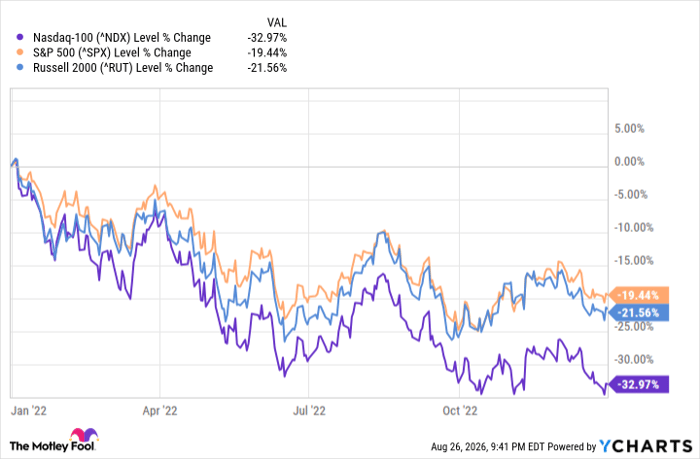
But a big bull market might mean that one of these indexes is up 20% or more in one year. A bear market might mean that a stock index is down 20% from its recent high. For example, 2022 was the most recent bear market in the U.S. stock market. The tech-heavy Nasdaq-100 lost nearly 33% of its value that year, while the S&P 500 declined by 19.4%, and the small-cap Russell 2000 lost 21.6%.
^NDX data by YCharts
How should you invest in a bear market vs. a bull market?
When you buy stocks, you are making a long-term bet on a brighter future. Even if stocks go into a bear market the day after you buy your shares, hopefully you are taking a long-term view and are willing to hold onto your stocks for at least five years.
It's easy to say but sometimes hard to do: Most people should try to ignore whether we're in a bear market or a bull market. Try not to pay attention to short-term moves in the markets. Don't change your investing strategy. Just keep buying stocks (and perhaps some bonds) as part of your long-term financial plan.
As for me, I keep buying the Vanguard Morningstar Total Stock Market ETF (NYSEMKT: VTI) out of every paycheck. This total stock market ETF holds 3,515 stocks of companies of all sizes and sectors. Through good times and bad, bull markets and bear markets, it has delivered average annual returns of about 14.5% for the past 10 years.
Bear markets mean stocks are on sale
Sometimes people are afraid to invest during a bear market. What if stocks go down even more? But the lowest moments in a bear market are often the best times to buy stocks, because that's when you can give yourself a better chance of future gains. If anything, a bear market should make you want to put more cash to work in the stock market -- because a 20% downturn in share prices means that stocks are effectively on sale.
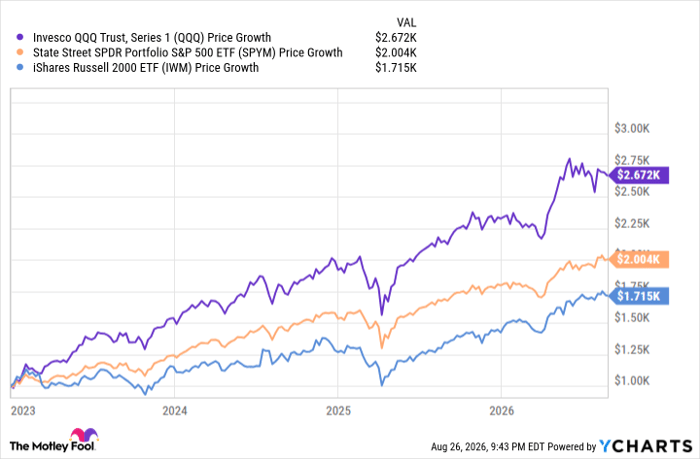
For example, let's say you had invested a total of $3,000 on Jan. 1, 2023, during one of the lowest points of the most recent bear market. If you put $1,000 each into the State Street SPDR Portfolio S&P 500 ETF (NYSEMKT: SPYM), the Invesco QQQ Trust (NASDAQ: QQQ), and the iShares Russell 2000 ETF (NYSEMKT: IWM), here's how much money you'd have today:
QQQ data by YCharts
Bear markets can be stressful for everyone, and especially painful for shareholders who lose money in the short run. But bear markets can also be the best stock-buying opportunities for long-term investors. As a long-term investor, I try to just stick to my long-term investment plan of saving for the future. I keep buying stocks with every paycheck, every payday.
Should you buy stock in Vanguard Morningstar Total Stock Market ETF right now?
Before you buy stock in Vanguard Morningstar Total Stock Market ETF, consider this:
The Motley Fool Stock Advisor analyst team just identified what they believe are the 10 best stocks for investors to buy now… and Vanguard Morningstar Total Stock Market ETF wasn’t one of them. The 10 stocks that made the cut could produce monster returns in the coming years.
Consider when Netflix made this list on December 17, 2004... if you invested $1,000 at the time of our recommendation, you’d have $430,571!* Or when Nvidia made this list on April 15, 2005... if you invested $1,000 at the time of our recommendation, you’d have $1,399,268!*
Now, it’s worth noting Stock Advisor’s total average return is 986% — a market-crushing outperformance compared to 214% for the S&P 500. Don't miss the latest top 10 list, available with Stock Advisor, and join an investing community built by individual investors for individual investors.
See the 10 stocks »
*Stock Advisor returns as of August 28, 2026.
Ben Gran has positions in Vanguard Morningstar Total Stock Market ETF. The Motley Fool has no position in any of the stocks mentioned. The Motley Fool has a disclosure policy.
Recommended Articles


