

If Donald Trump's Trade War Triggers a Stock Market Crash, History Says This Is the First Thing Investors Should Do

Source The Motley Fool

Key Points

  • President Trump has escalated the trade war with Canada, imposing new 50% tariffs on a wide range of Canadian goods.

  • If the moves trigger a stock market crash, investors shouldn't panic.

  • History says the best thing for investors to do during a crash is to stay invested.

  • These 10 stocks could mint the next wave of millionaires ›

Over the weekend, trade talks between U.S. and Canadian negotiators collapsed. President Donald Trump immediately slapped 50% tariffs on a wide range of Canadian products, including Canadian whiskey and hockey sticks.

Canadian Prime Minister Mark Carney said that Canada would match Trump's tariffs "dollar for dollar." In response, Trump further escalated the trade war by doubling tariffs on imported automobiles and auto parts from Canada to 50%.

Missed Nvidia in 2009? This Rare Signal Is Flashing Again. In 2009, a "Double Down" signal flashed for a little-known chipmaker called Nvidia. For the first time in years, that same "Total Conviction" signal is flashing for a company 1/100th the size of Nvidia. Continue »

Unsurprisingly, the S&P 500 (SNPINDEX: ^GSPC) opened lower on Monday. The trade war comes at a fragile time for the market: More investors are bearish than bullish, according to data from the American Association of Individual Investors.

If the trade war continues to escalate, it could easily trigger a market downturn or even a major crash. But if that happens, how should stock market investors react? Well, history shows that during a downturn, there's one thing investors should do to succeed over the long term.
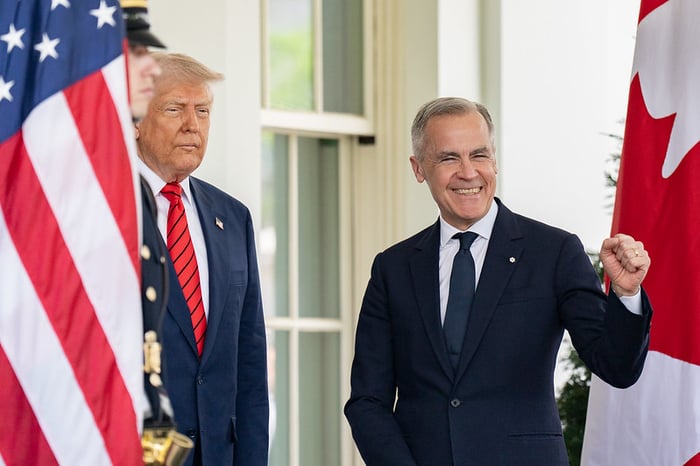
President Donald Trump and Prime Minister of Canada Mark Carney stand between U.S. and Canadian flags.

President Donald Trump and Canadian Prime Minister Mark Carney on May 6, 2025. Image source: Official White House Photo by Gabriel B Kotico.

Here's what history says to do first

It may sound counterintuitive, but history says the first thing investors should do in the event of a market crash is:

Nothing.

You read that right. The temptation is to react quickly, getting out of the market before it falls even further. But making rash moves like this has historically set investors up to fail.

Selling stocks after a crash has already begun often means selling them at a loss. Even investors who move quickly will be selling at a sub-optimal price.

Instead of panic-selling, an investor should take a deep breath and do nothing. At least at first.

A bear in front of a red line chart going downward.

Image source: Getty Images.

Why it's historically been the best thing to do

An investor who sells their stocks when they're down 25% can pat themselves on the back if the stocks eventually go down 50%, but that satisfaction may be short-lived.

Usually, an investor who panic-sells during a crash waits before getting back in. If the crash ushers in a recession, they may wait until the recession is over.

But research from The Motley Fool shows that the stock market usually starts making big gains before the end of a recession. Investors who kept their money in stocks during recessions almost always had better long-term returns than investors who pulled their money out.

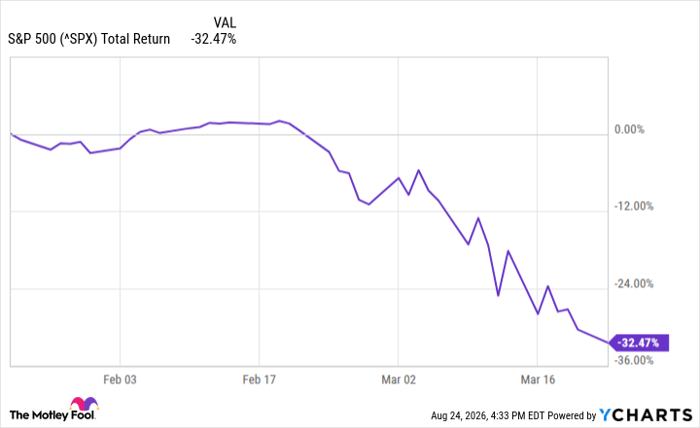
For example, take a look at the COVID-19 crash of 2020: If you'd bought an S&P 500 index fund on Jan. 23, you'd have lost almost one-third of your money just two months later:
^SPX Chart

Data by YCharts.

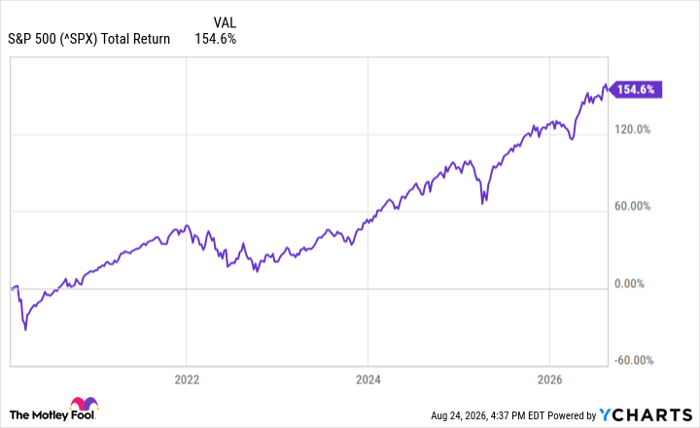
But if you stayed the course and kept your money in the market, look how well you would have done since:
^SPX Chart

Data by YCharts.

Investors who kept their money in the market and bought more stocks at post-crash prices were the ones who walked away with the biggest long-term gains. That's especially true for short-lived dips like the COVID-19 crash and the "Liberation Day" crash of 2025.

Of course, there's no way to predict when a crash will occur or how long a bear market or a recession might go on once it begins. But history shows that staying invested in a diversified stock portfolio is the best way for an investor to succeed in the long term, crash or no crash.

Where to invest $1,000 right now

When our analyst team has a stock tip, it can pay to listen. After all, Stock Advisor’s total average return is 958%* — a market-crushing outperformance compared to 212% for the S&P 500.

They just revealed what they believe are the 10 best stocks for investors to buy right now, available when you join Stock Advisor.

See the stocks »

*Stock Advisor returns as of August 26, 2026.

John Bromels has no position in any of the stocks mentioned. The Motley Fool has no position in any of the stocks mentioned. The Motley Fool has a disclosure policy.

Disclaimer: For information purposes only. Past performance is not indicative of future results.
placeholder
Pinduoduo Earnings Incoming: Morgan Stanley Sees Long-Term Profit Potential​Insights – On November 21, Chinese e-commerce giant Pinduoduo (PDD) will release its Q3 2024 earnings.
Author  Mitrade
Nov 20, 2024
​Insights – On November 21, Chinese e-commerce giant Pinduoduo (PDD) will release its Q3 2024 earnings.
placeholder
Bitcoin ETF Inflows For 2025 Now Outpace 2024, Data ShowsUS Bitcoin spot exchange-traded funds (ETFs) have seen more inflows this year so far compared to the same point in 2024, according to data.
Author  Bitcoinist
Jul 16, 2025
US Bitcoin spot exchange-traded funds (ETFs) have seen more inflows this year so far compared to the same point in 2024, according to data.
placeholder
Bitcoin briefly loses 2025 gains as crypto plunges over the weekend.Bitcoin experienced a sharp decline this weekend, briefly erasing its 2025 gains and dipping below its year-opening value of $93,507. The cryptocurrency fell to a low of $93,029 on Sunday, representing a 25% drop from its all-time high in October. Although it has rebounded slightly to around $94,209, the pressures on the market remain significant. The downturn occurred despite the reopening of the U.S. government on Thursday, which many had hoped would provide essential support for crypto markets. This year initially appeared promising for cryptocurrencies, particularly after the inauguration of President Donald Trump, who has established the most pro-crypto administration thus far. However, ongoing political tensions—including Trump's tariff strategies and the recent government shutdown, lasting a historic 43 days—have contributed to several rapid price pullbacks for Bitcoin throughout the year. Market dynamics are also being influenced by Bitcoin whales—investors holding large amounts of Bitcoin—who have been offloading portions of their assets, consequently stalling price rallies even as positive regulatory developments emerge. Despite these sell-offs, analysts from Glassnode argue that this behavior aligns with typical patterns seen among long-term investors during the concluding stages of bull markets, suggesting it is not indicative of a mass exodus. Notably, Bitcoin is not alone in its struggles, as Ethereum and Solana have also recorded declines of 7.95% and 28.3%, respectively, since the start of the year, while numerous altcoins have faced even steeper losses. Looking ahead, questions linger regarding the viability of the four-year cycle thesis, particularly given the increasing institutional support and regulatory frameworks now in place in the crypto landscape. Matt Hougan, chief investment officer at Bitwise, remains optimistic, suggesting a potential Bitcoin resurgence in 2026 driven by the “debasement trade” thesis and a broader trend toward increased adoption of stablecoins, tokenization, and decentralized finance. Hougan emphasized the soundness of the underlying fundamentals, pointing to a positive outlook for the sector in the longer term.
Author  Mitrade
Nov 17, 2025
Bitcoin experienced a sharp decline this weekend, briefly erasing its 2025 gains and dipping below its year-opening value of $93,507. The cryptocurrency fell to a low of $93,029 on Sunday, representing a 25% drop from its all-time high in October. Although it has rebounded slightly to around $94,209, the pressures on the market remain significant. The downturn occurred despite the reopening of the U.S. government on Thursday, which many had hoped would provide essential support for crypto markets. This year initially appeared promising for cryptocurrencies, particularly after the inauguration of President Donald Trump, who has established the most pro-crypto administration thus far. However, ongoing political tensions—including Trump's tariff strategies and the recent government shutdown, lasting a historic 43 days—have contributed to several rapid price pullbacks for Bitcoin throughout the year. Market dynamics are also being influenced by Bitcoin whales—investors holding large amounts of Bitcoin—who have been offloading portions of their assets, consequently stalling price rallies even as positive regulatory developments emerge. Despite these sell-offs, analysts from Glassnode argue that this behavior aligns with typical patterns seen among long-term investors during the concluding stages of bull markets, suggesting it is not indicative of a mass exodus. Notably, Bitcoin is not alone in its struggles, as Ethereum and Solana have also recorded declines of 7.95% and 28.3%, respectively, since the start of the year, while numerous altcoins have faced even steeper losses. Looking ahead, questions linger regarding the viability of the four-year cycle thesis, particularly given the increasing institutional support and regulatory frameworks now in place in the crypto landscape. Matt Hougan, chief investment officer at Bitwise, remains optimistic, suggesting a potential Bitcoin resurgence in 2026 driven by the “debasement trade” thesis and a broader trend toward increased adoption of stablecoins, tokenization, and decentralized finance. Hougan emphasized the soundness of the underlying fundamentals, pointing to a positive outlook for the sector in the longer term.
placeholder
Gold Price Forecast: US Treasury Yield Slump Pushes Gold Above $4,500, Will Gold Keep Rising?As of the Asian session on August 20, gold prices (XAUUSD) surged again today after breaking above $4,500 on Wednesday, reaching a nearly two-month high of $4,527.12 before pulling back i
Author  TradingKey
Aug 20, Thu
As of the Asian session on August 20, gold prices (XAUUSD) surged again today after breaking above $4,500 on Wednesday, reaching a nearly two-month high of $4,527.12 before pulling back i
placeholder
Ethereum Price Forecast: BitMine scoops 32K ETH, hints at further gainsEthereum (ETH) treasury company BitMine Immersion Technologies (BMNR) expanded its digital asset holdings last week with another round of acquisitions.
Author  FXStreet
Yesterday 01: 29
Ethereum (ETH) treasury company BitMine Immersion Technologies (BMNR) expanded its digital asset holdings last week with another round of acquisitions.
goTop
quote