


This Artificial Intelligence (AI) Stock Could Fall by 13%, According to Wall Street -- but Here's Why I Refuse to Sell
Key Points
Duolingo operates the world's largest digital language education platform, and management recently decided to prioritize user growth over monetization.
Wall Street is worried this shift will result in weaker revenue and earnings growth, so analysts are forecasting a decline in Duolingo stock.
I bought Duolingo stock in April, and I think Wall Street is too pessimistic about the company.
- 10 stocks we like better than Duolingo ›
I bought Duolingo (NASDAQ: DUOL) stock shortly after it fell to its 52-week low of $90.03 in April, which marked a staggering 83% decline from last year's record high of $540.68. It has since recovered to around $146.84 as of the market close on Monday, Aug. 24, and while I am very bullish on its prospects from here, Wall Street isn't convinced.
The 27 analysts covering the stock tracked by The Wall Street Journal have put an average price target of $127.07 on it, which suggests the stock could decline by around 13% over the next 12 months. Duolingo operates the world's largest digital language education platform, and Wall Street is concerned about management's plan to focus on user growth at the expense of monetization over the next couple of years, which could hurt the company's financial performance.
Missed Nvidia in 2009? This Rare Signal Is Flashing Again. In 2009, a "Double Down" signal flashed for a little-known chipmaker called Nvidia. For the first time in years, that same "Total Conviction" signal is flashing for a company 1/100th the size of Nvidia. Continue »
However, if the strategy pays off, Duolingo's business could be in the strongest position in its history sometime around 2028. Here's why I plan to stick around to reap the potential rewards.

Image source: The Motley Fool.
A bigger user base will be a net positive in the long run
Duolingo designed a highly interactive mobile app that places fun language lessons at the fingertips of anybody with a smartphone. It had 58.7 million daily active users at the conclusion of the second quarter, a 23% increase from the year-ago period. Surprisingly, the company spends very little money on marketing, but it has an enormous social media following thanks to its quirky content, which generates roughly 1 billion impressions per quarter.
Duolingo monetizes users of its free tier by showing them ads, but most of its revenue comes from the 12.7 million subscribers who pay to unlock additional features so they can accelerate their learning. But management's new strategy is to offer more premium features to free users, which could reduce the incentive for people to pay to subscribe. However, it should also entice more language learners to try out the platform.
While this strategy could slow Duolingo's revenue growth in the near term, management thinks it will help increase the platform's daily active user base to 100 million by 2028. This will make it harder for any new competitors to disrupt Duolingo. Plus, when the company decides to focus on monetization again in the future, it will have far more users to attempt to convert into paying subscribers, which is why I think any potential financial headwinds this strategy will create will be temporary.
Duolingo is leaning into artificial intelligence
Artificial intelligence (AI) has been another concern; some investors feel that chatbots and advanced translation tools could disrupt Duolingo's business. But these new tools don't necessarily educate their users, so they aren't a substitute for Duolingo, which teaches languages from the ground up.
Moreover, Duolingo is now using AI to enhance the learning experience with new features. Video Call, for example, uses a digital avatar to help learners practice their foreign language speaking skills. Previously, Video Call was exclusively available to subscribers of Duolingo Max, the platform's most expensive plan, but the company is now rolling it out to subscribers of the cheaper Super Duolingo tier.
Management has reduced the cost of each call from $0.30 to under $0.01 by using open-source AI models, so it's now more economical for it to offer the service to a wider audience. This is important because speaking exercises can be far more engaging than traditional learning methods, and management says the number of spoken words per user who engages with Video Call continues to soar.
As a result, Duolingo is now also integrating more speaking exercises into its free lessons to help boost engagement.
Duolingo stock is cheap now
Duolingo generated $1.14 billion in revenue over the last four quarters, placing its stock at a price-to-sales (P/S) ratio of 6.3. That is significantly below its average P/S ratio of 15.2 since going public in 2021. Even if the stock doubled from here, its P/S ratio would still be well below its average.
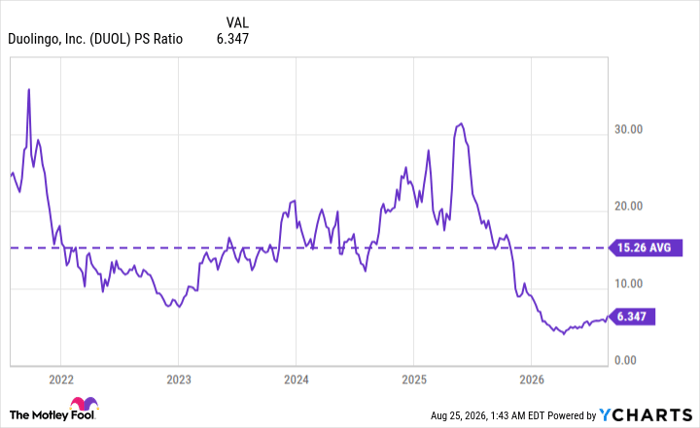
DUOL PS Ratio data by YCharts.
Plus, based on Duolingo's trailing 12-month earnings of $8.46 per share and its stock price of $146.84 at the close of trading on Monday, it has a price-to-earnings (P/E) ratio of just 17.3. That is a steep discount to both the S&P 500 (SNPINDEX: ^GSPC) and the Nasdaq-100 indexes, which currently have P/E ratios of 26.1 and 34.1, respectively. In other words, Duolingo stock is significantly cheaper than the broader market.
There is one caveat to that analysis. Wall Street's average analyst estimate (provided by Yahoo! Finance) suggests Duolingo's earnings could shrink to $7.68 per share in 2027 -- a temporary consequence of its strategy to focus on user growth instead of monetization. That places its stock at a higher forward P/E ratio of 19.1, but it still looks cheap.
Therefore, although Wall Street's average price target of $127.07 implies 13% downside for Duolingo stock, I certainly won't be selling it while it's trading at a valuation discount to the market. I plan to stick around until at least 2028, because if management's plan pays off, I think the stock will be priced significantly higher by then than it is today.
Should you buy stock in Duolingo right now?
Before you buy stock in Duolingo, consider this:
The Motley Fool Stock Advisor analyst team just identified what they believe are the 10 best stocks for investors to buy now… and Duolingo wasn’t one of them. The 10 stocks that made the cut could produce monster returns in the coming years.
Consider when Netflix made this list on December 17, 2004... if you invested $1,000 at the time of our recommendation, you’d have $431,488!* Or when Nvidia made this list on April 15, 2005... if you invested $1,000 at the time of our recommendation, you’d have $1,279,584!*
Now, it’s worth noting Stock Advisor’s total average return is 958% — a market-crushing outperformance compared to 212% for the S&P 500. Don't miss the latest top 10 list, available with Stock Advisor, and join an investing community built by individual investors for individual investors.
See the 10 stocks »
*Stock Advisor returns as of August 26, 2026.
Anthony Di Pizio has positions in Duolingo. The Motley Fool has positions in and recommends Duolingo. The Motley Fool has a disclosure policy.
Recommended Articles


