

The Retail Model Is Changing. Here's What Investors Need to Know About What's Driving Growth at Walmart and Target.

Source The Motley Fool

Key Points

  • The market was disappointed by Walmart's latest update, which showed slowing in-store comps, but other growth drivers are picking up the slack.

  • Walmart and Target are both experiencing high growth in advertising, marketplace, and membership fees.

  • Walmart stock trades at more than double Target stock's P/E ratio.

  • These 10 stocks could mint the next wave of millionaires ›

Walmart (NASDAQ: WMT) and Target (NYSE: TGT) both released earnings last week, and while they both reported strong growth, they got very different market reactions. Walmart stock fell 10% after earnings in one day, while Target stock gained 10%.

The market was unimpressed by Walmart's 5.9% sales growth in the 2026 fiscal second quarter (ended July 31), as U.S. comparable sales (comps) growth decelerated to 2.6% due to lower-priced pharmaceuticals. Target, on the other hand, had some of its best performance in years, with a 5.3% increase in sales in fiscal Q2 2026 (ended Aug. 1), driven by a 3.8% increase in comps. Target is in recovery mode, and investors are excited about its turnaround.

Missed Nvidia in 2009? This Rare Signal Is Flashing Again. In 2009, a "Double Down" signal flashed for a little-known chipmaker called Nvidia. For the first time in years, that same "Total Conviction" signal is flashing for a company 1/100th the size of Nvidia. Continue »

Person in Walmart uniform.

Image source: Walmart.

Both companies are operating in a different retail environment than they used to. In fact, while comps growth will certainly remain an important part of the story, other factors are playing a much bigger role than before, and the market isn't necessarily coming around to that yet.

The emergence of the non-core revenue sources

Walmart and Target are both retailers, which means their core business model is buying products at wholesale prices, marking them up to account for costs, and selling them at a profit.

However, while this remains their bread and butter, both companies are undergoing transformations that rely on other revenue sources, specifically membership and advertising. Walmart CFO John David Rainey said it clearly: "Our business is fundamentally changing. And if you look at the profit drivers of our business, almost half of the growth came from areas like membership, advertising, marketplace, and we expect this to continue." Advertising sales at Walmart increased 38% year over year, and membership fees increased a record 17%.

In-store comps were down in the low single digits in Q2, continuing a trend. However, store comps matter less as the company's model changes. E-commerce now accounts for 23% of Walmart's U.S. sales, about double what it was five years ago. Stores are increasingly responsible for fulfilling online orders, and they act as distribution hubs, not just stores, which is how Walmart can fulfill orders so quickly. In fact, you might find products available online from your local stores, but not on the shelves in the store, if they're in a designated back space for online delivery.

Against this backdrop, comps growth is less meaningful to the total business, and Walmart is switching gears to drive growth in other areas.

People shopping at Target back-to-school store display.

Image source: Target.

There's a similar dynamic happening at Target. While the overall comps growth was impressive, store comps increased only 2.7% year over year. Digital sales increased by 8.7%, indicating a larger shift online, while non-merchandise sales increased by more than 20%. These areas include Roundel, its advertising business, which reported a near-20% increase in gross billings, and revenue from Target Plus, its third-party marketplace, and membership fees, which both grew more than 40%.

Target's stores have long served as delivery hubs, and 95% of online orders are fulfilled in stores. It fulfilled 30% more same-day and next-day units over last year in the quarter, and digital continues to climb meaningfully as a portion of the business.

Expansion is good for the bottom line, and more

Not only are these new growth drivers adding revenue to the top line, but they're also higher-margin businesses that are good for the bottom line. Walmart noted that these other categories deepen the relationships with customers and create new opportunities, and improve economics. CEO John Furner said, "The math isn't simply one plus one equals two. The value comes from how these businesses work together, with each one strengthening the others and expanding what the company can do as a whole."

Considering the changing nature of its business, I think the market's reaction to Walmart's update was harsh. However, it's an expensive stock, which means it will get judged more harshly. Even at the lower price, it trades at more than twice Target's price-to-earnings (P/E) ratio.
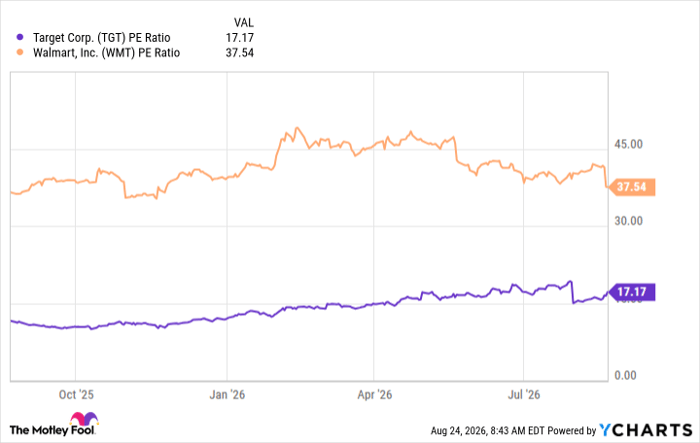
TGT PE Ratio Chart

TGT PE Ratio data by YCharts.

That implies that the market is still more confident about Walmart than Target. However, Target stock is up nearly 70% this year, and it could still be a major bargain.

Where to invest $1,000 right now

When our analyst team has a stock tip, it can pay to listen. After all, Stock Advisor’s total average return is 958%* — a market-crushing outperformance compared to 212% for the S&P 500.

They just revealed what they believe are the 10 best stocks for investors to buy right now, available when you join Stock Advisor.

See the stocks »

*Stock Advisor returns as of August 25, 2026.

Jennifer Saibil has positions in Walmart. The Motley Fool has positions in and recommends Target and Walmart. The Motley Fool has a disclosure policy.

Disclaimer: For information purposes only. Past performance is not indicative of future results.
placeholder
Pinduoduo Earnings Incoming: Morgan Stanley Sees Long-Term Profit Potential​Insights – On November 21, Chinese e-commerce giant Pinduoduo (PDD) will release its Q3 2024 earnings.
Author  Mitrade
Nov 20, 2024
​Insights – On November 21, Chinese e-commerce giant Pinduoduo (PDD) will release its Q3 2024 earnings.
placeholder
Bitcoin ETF Inflows For 2025 Now Outpace 2024, Data ShowsUS Bitcoin spot exchange-traded funds (ETFs) have seen more inflows this year so far compared to the same point in 2024, according to data.
Author  Bitcoinist
Jul 16, 2025
US Bitcoin spot exchange-traded funds (ETFs) have seen more inflows this year so far compared to the same point in 2024, according to data.
placeholder
Bitcoin briefly loses 2025 gains as crypto plunges over the weekend.Bitcoin experienced a sharp decline this weekend, briefly erasing its 2025 gains and dipping below its year-opening value of $93,507. The cryptocurrency fell to a low of $93,029 on Sunday, representing a 25% drop from its all-time high in October. Although it has rebounded slightly to around $94,209, the pressures on the market remain significant. The downturn occurred despite the reopening of the U.S. government on Thursday, which many had hoped would provide essential support for crypto markets. This year initially appeared promising for cryptocurrencies, particularly after the inauguration of President Donald Trump, who has established the most pro-crypto administration thus far. However, ongoing political tensions—including Trump's tariff strategies and the recent government shutdown, lasting a historic 43 days—have contributed to several rapid price pullbacks for Bitcoin throughout the year. Market dynamics are also being influenced by Bitcoin whales—investors holding large amounts of Bitcoin—who have been offloading portions of their assets, consequently stalling price rallies even as positive regulatory developments emerge. Despite these sell-offs, analysts from Glassnode argue that this behavior aligns with typical patterns seen among long-term investors during the concluding stages of bull markets, suggesting it is not indicative of a mass exodus. Notably, Bitcoin is not alone in its struggles, as Ethereum and Solana have also recorded declines of 7.95% and 28.3%, respectively, since the start of the year, while numerous altcoins have faced even steeper losses. Looking ahead, questions linger regarding the viability of the four-year cycle thesis, particularly given the increasing institutional support and regulatory frameworks now in place in the crypto landscape. Matt Hougan, chief investment officer at Bitwise, remains optimistic, suggesting a potential Bitcoin resurgence in 2026 driven by the “debasement trade” thesis and a broader trend toward increased adoption of stablecoins, tokenization, and decentralized finance. Hougan emphasized the soundness of the underlying fundamentals, pointing to a positive outlook for the sector in the longer term.
Author  Mitrade
Nov 17, 2025
Bitcoin experienced a sharp decline this weekend, briefly erasing its 2025 gains and dipping below its year-opening value of $93,507. The cryptocurrency fell to a low of $93,029 on Sunday, representing a 25% drop from its all-time high in October. Although it has rebounded slightly to around $94,209, the pressures on the market remain significant. The downturn occurred despite the reopening of the U.S. government on Thursday, which many had hoped would provide essential support for crypto markets. This year initially appeared promising for cryptocurrencies, particularly after the inauguration of President Donald Trump, who has established the most pro-crypto administration thus far. However, ongoing political tensions—including Trump's tariff strategies and the recent government shutdown, lasting a historic 43 days—have contributed to several rapid price pullbacks for Bitcoin throughout the year. Market dynamics are also being influenced by Bitcoin whales—investors holding large amounts of Bitcoin—who have been offloading portions of their assets, consequently stalling price rallies even as positive regulatory developments emerge. Despite these sell-offs, analysts from Glassnode argue that this behavior aligns with typical patterns seen among long-term investors during the concluding stages of bull markets, suggesting it is not indicative of a mass exodus. Notably, Bitcoin is not alone in its struggles, as Ethereum and Solana have also recorded declines of 7.95% and 28.3%, respectively, since the start of the year, while numerous altcoins have faced even steeper losses. Looking ahead, questions linger regarding the viability of the four-year cycle thesis, particularly given the increasing institutional support and regulatory frameworks now in place in the crypto landscape. Matt Hougan, chief investment officer at Bitwise, remains optimistic, suggesting a potential Bitcoin resurgence in 2026 driven by the “debasement trade” thesis and a broader trend toward increased adoption of stablecoins, tokenization, and decentralized finance. Hougan emphasized the soundness of the underlying fundamentals, pointing to a positive outlook for the sector in the longer term.
placeholder
Gold Price Forecast: US Treasury Yield Slump Pushes Gold Above $4,500, Will Gold Keep Rising?As of the Asian session on August 20, gold prices (XAUUSD) surged again today after breaking above $4,500 on Wednesday, reaching a nearly two-month high of $4,527.12 before pulling back i
Author  TradingKey
Aug 20, Thu
As of the Asian session on August 20, gold prices (XAUUSD) surged again today after breaking above $4,500 on Wednesday, reaching a nearly two-month high of $4,527.12 before pulling back i
placeholder
Ethereum Price Forecast: BitMine scoops 32K ETH, hints at further gainsEthereum (ETH) treasury company BitMine Immersion Technologies (BMNR) expanded its digital asset holdings last week with another round of acquisitions.
Author  FXStreet
Yesterday 01: 29
Ethereum (ETH) treasury company BitMine Immersion Technologies (BMNR) expanded its digital asset holdings last week with another round of acquisitions.
goTop
quote