


TradingKey Daily Market Briefing: AI Chip Stocks Rebound, Micron and AMD Rise, Nvidia Earnings and July PCE Become Market Focus
Tracking Market Trends
TradingKey - On August 25, Eastern Time, the three major U.S. stock indices closed higher across the board. Oil prices and U.S. Treasury yields pulled back in tandem, easing market concerns over a resurgence in inflation and rising long-end rates. Meanwhile, investors stepped back into tech and semiconductor stocks ahead of Nvidia's earnings release and the U.S. July PCE inflation data, driving the Nasdaq to lead gains among the three major indices. However, overall trading volume remained cautious, with the market appearing to engage in position adjustments ahead of key events.
At the close, the Dow Jones Industrial Average rose 0.30% to 53,582.7 points; the S&P 500 Index gained 0.32% to 7,677.28 points; and the Nasdaq Composite Index advanced 0.66% to 26,151.30 points.
In terms of sectors and individual stocks, AI and semiconductor shares became the core of the market rebound. Nvidia (NVDA) rose 2.19% to $213.05. With the company set to release its earnings report soon, the market regards it as a key bellwether for assessing AI chip demand, data center capital expenditures, and the sustainability of the AI trade. AMD (AMD) climbed 4.91%, while Micron Technology (MU) gained 2.48%, showing that capital was re-entering previously pressured AI hardware and memory chip assets ahead of earnings. However, Broadcom (AVGO) fell slightly, indicating ongoing divergence within the semiconductor sector.
In commodities, crude oil pulled back sharply. Brent crude (UKOIL) closed down 4.88% at $85.95 per barrel; WTI crude (USOIL) fell 4.58% to $81.1. Although the U.S. continues to threaten expanded sanctions against Iran, the market believes those measures have not yet directly impacted crude oil supply, while discussions between Iran and Oman on a safe navigation corridor through the Strait of Hormuz eased some supply disruption concerns. The drop in oil prices also drove U.S. Treasury yields lower, creating a more favorable interest rate environment for the tech stock rebound.
In precious metals, gold (XAUUSD) fluctuated at elevated levels. Spot gold rose to $4,696.82 during intraday trading, hitting a new high of more than three months, before pulling back to around $4,605. Gold's recent strength has been driven primarily by the U.S. Treasury's expanded buybacks of long-term bonds, a period of U.S. dollar weakness, fiscal sustainability concerns, and uncertainty over the Middle East situation. However, ahead of the PCE inflation data and the Jackson Hole symposium, some funds chose to take profits, causing gold prices to face resistance near the $4,700 mark.
In the crypto market, Bitcoin (BTCUSD) briefly surged past $81,000 in intraday trading before pulling back to near $78,300. Bitcoin's recent strength alongside gold reflects that some capital continues to allocate toward inflation-hedging and currency-devaluation-resistant assets. However, with tech earnings and PCE data approaching, short-term volatility in the crypto market may continue to amplify.
Market News
Nvidia's earnings report stands as the biggest test for the AI trade. Nvidia is scheduled to release its latest quarterly results after the market close on Wednesday (ET), with markets focusing heavily on data center revenue, AI chip orders, progress on the Rubin platform, gross margin shifts, and whether capital expenditures from major cloud hyperscalers continue to sustain demand. Given the pronounced volatility in AI chip stocks over the past few weeks, Nvidia's earnings will not only impact its own stock price but also shape market sentiment regarding the AI infrastructure investment cycle and semiconductor valuations. Should the earnings and guidance fail to comfortably beat expectations, AI hardware stocks may face renewed profit-taking pressure.
US July PCE data release approaches as markets await confirmation on inflation trajectory. The US Department of Commerce will release the July Personal Consumption Expenditures (PCE) price index on Wednesday (ET), the Federal Reserve's preferred inflation gauge. While relatively muted CPI and PPI figures earlier reduced concerns over near-term rate hikes, prior surges in oil prices, trade friction, and geopolitical risks could still introduce uncertainty into the inflation outlook. If the PCE reading comes in below expectations, tech stocks, gold, and Bitcoin could continue to benefit; if the data tops expectations, the US dollar and Treasury yields could rebound, pressuring high-valuation assets.
US consumer confidence falls to a seven-month low. According to Conference Board data, the US Consumer Confidence Index slipped to 89.4 in August, down from a revised 90.2 in July and marking its lowest level since January. Consumers' views on the labor market and inflation outlook weakened, indicating that high oil prices, tariff pressures, and economic uncertainty continue to weigh on household confidence. Although US stocks pushed higher that day driven by a tech-led rebound, softening consumer confidence suggests lingering underlying concerns for US economic fundamentals.
Canada announces retaliatory tariffs on roughly $20 billion in US goods. Canada stated that it will impose counter-tariffs on approximately $20 billion worth of US imports starting September 8, targeting categories including steel, aluminum, furniture, apparel, cheese, electronics, and machinery, in retaliation for earlier US tariffs on Canadian goods. Escalating US-Canada trade tensions could push up costs across North American manufacturing, auto parts, consumer products, and industrial raw materials, placing fresh pressure on corporate profit margins.
Oil prices pull back, easing inflation fears, but Iran risks persist. US economic pressure on Iran did not immediately trigger crude supply disruptions, and market expectations regarding safe passage arrangements through the Strait of Hormuz helped drive a noticeable pullback in Brent and WTI crude prices. In the short term, falling oil prices help alleviate inflation expectations and pressure on long-dated Treasury yields. However, as long as uncertainties remain around Iranian supply, transit through the Strait of Hormuz, and Middle East shipping security, the risk premium in energy markets is unlikely to dissipate entirely.
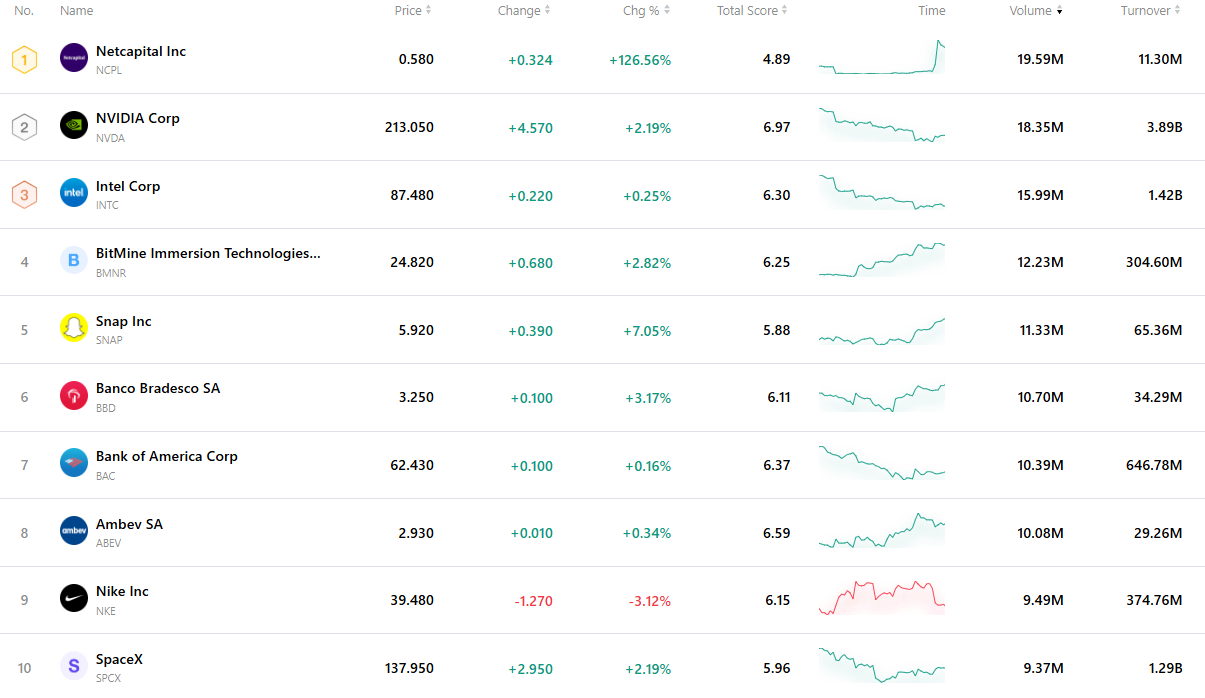
Top 10 Most Active Stocks
The table below lists the ten most actively traded stocks in the latest market. Supported by massive trading volumes and exceptional liquidity, these assets have become key benchmarks for tracking global market dynamics.
Recommended Articles


