


Prediction: If You Invest $10,000 in Micron Stock Today, It Will Be Worth This Much by 2030
Key Points
Micron specializes in high-bandwidth memory and DRAM solutions.
The shortage of HBM and DRAM relative to demand has become a critical bottleneck in the AI build-out, leading to sharp price increases.
Current forecasts may only be modeling for peak memory price cycles and missing out on Micron's future optionality.
- 10 stocks we like better than Micron Technology ›
You probably know by now that a central question to the artificial intelligence (AI) narrative is not whether the technology will consume more memory but whether producers like Micron Technology (NASDAQ: MU) can convert ongoing shortages into a durable business model that compounds through the end of the decade.
For now, discussions primarily revolve around surging demand for high-bandwidth memory (HBM) and accelerating hyperscale capital expenditure budgets. While these talking points are necessary, they don't capture the full scale of the AI memory supercycle.
Missed Nvidia in 2009? This Rare Signal Is Flashing Again. In 2009, a "Double Down" signal flashed for a little-known chipmaker called Nvidia. For the first time in years, that same "Total Conviction" signal is flashing for a company 1/100th the size of Nvidia. Continue »
In my view, what matters more is a deeper shift that most investors are overlooking: Memory is ceasing to be a pure commodity and is quietly emerging as the binding constraint on the pace of further AI development.

Image source: Micron Technology.
Memory is a core feature of advanced computing
Each successive generation of AI models is hitting the same physical limit: Processors execute more parameters than the memory subsystem can actually feed. In this sense, Micron's nodes and advanced packaging are not simple incremental product upgrades -- they are the only practical way to keep extending AI's capabilities.
In the 2030s, the AI industry will almost certainly still be chasing denser memory stacks because demand from next-generation applications in robotics, autonomous vehicles, and agentic AI will be scaling alongside future breakthroughs in lithography.
Long-term supply contracts are helping Micron lock in volume and secure price floors for a meaningful fraction of its future output. I think these agreements are more likely to expand rather than expire as sovereign AI programs -- namely from SpaceX -- and edge deployments proliferate. As a result, Micron's earnings profile should become less volatile.
Micron has historically been (correctly) viewed and priced as a highly cyclical business, but against this evolving backdrop, investors may come to see it as an AI infrastructure compounder, and rerate the stock accordingly, granting it a higher earnings multiple.
Keep an eye on Micron's capital allocation
Another thing to monitor is the sheer volume of cash Micron generates once its production capacity expansions catch up to its contracted demand. Once this happens, Micron will be under less pressure to supplement its current $250 billion manufacturing build-out with outlays for additional fabrication capabilities. Instead, management will have a choice: Return capital aggressively through buybacks or dividends, acquire complementary intellectual property in packaging, or build internally and become even more vertically integrated.
Any of these paths should transform Micron's balance sheet from a cyclical buffer into a strategic fortress. Investors who only model peak-cycle earnings inherently miss the upside embedded in a growing cash position, as this capital can fund optionality in the product roadmap or simply reduce the share count -- both of which will amplify Micron's equity value even after the initial data center build-out.
What could an investment in Micron look like by 2030?
I think the best metric to use when analyzing Micron stock is the forward price-to-earnings (P/S) ratio because it requires two transparent assumptions: a level of normalized future earnings and a multiple the market will realistically assign once the memory cycle is better understood.
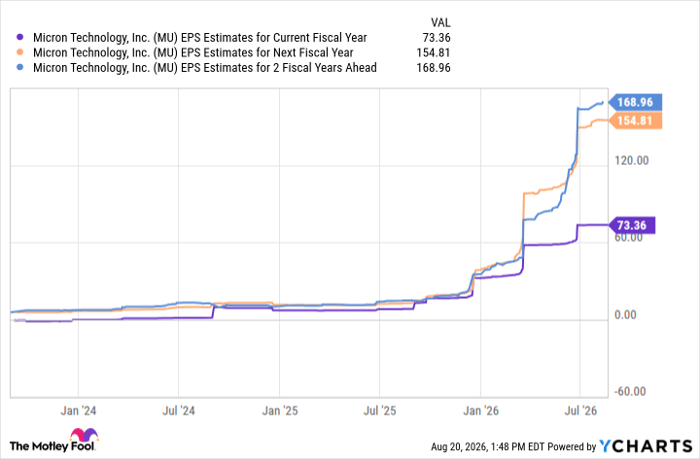
MU EPS Estimates for Current Fiscal Year data by YCharts.
In the chart above, investors can see that Wall Street analysts forecast Micron's earnings per share (EPS) will roughly double over the next year, but that growth will then begin to decelerate by calendar 2028. With these trends in mind, I've provided a scenario analysis below that shows a range of possible earnings figures and forward earnings ratios for 2030.
| Scenario | 2030 EPS | 2030 Forward P/E Ratio | 2030 Share Price |
|---|---|---|---|
| Upside case | $250 | 14 | $3,500 |
| Base case | $160 | 10 | $1,600 |
| Downside case | $100 | 8 | $800 |
Given these assumptions, a $10,000 investment made in Micron today could be worth anywhere between roughly $8,400 and $36,600 by the end of 2030. I personally think the base case, which implies about 67% upside to current trading levels, is the most realistic. The bear case ultimately leads to capital erosion, a risk that could very well occur given the historically boom-and-bust nature of the memory industry. The big takeaway here is that an investment in Micron likely carries a spread that should not be overlooked.
Should you buy stock in Micron Technology right now?
Before you buy stock in Micron Technology, consider this:
The Motley Fool Stock Advisor analyst team just identified what they believe are the 10 best stocks for investors to buy now… and Micron Technology wasn’t one of them. The 10 stocks that made the cut could produce monster returns in the coming years.
Consider when Netflix made this list on December 17, 2004... if you invested $1,000 at the time of our recommendation, you’d have $429,223!* Or when Nvidia made this list on April 15, 2005... if you invested $1,000 at the time of our recommendation, you’d have $1,317,883!*
Now, it’s worth noting Stock Advisor’s total average return is 965% — a market-crushing outperformance compared to 212% for the S&P 500. Don't miss the latest top 10 list, available with Stock Advisor, and join an investing community built by individual investors for individual investors.
See the 10 stocks »
*Stock Advisor returns as of August 24, 2026.
Adam Spatacco has no position in any of the stocks mentioned. The Motley Fool has positions in and recommends Micron Technology. The Motley Fool has a disclosure policy.
Recommended Articles


