


One Sentence in the Fed Meeting Minutes Is Nightmare Fuel for Fed Chair Kevin Warsh and the Stock Market
Key Points
Although the Dow Jones Industrial Average, S&P 500, and Nasdaq Composite have brushed off near-term headwinds, elevated inflation remains a serious concern.
FOMC policymakers highlighted the possibility of businesses setting prices and wages based on the expectation of elevated inflation becoming the new norm.
Following Treasury Secretary Scott Bessent's bond-buying program announcement, Warsh and his peers may be forced to raise interest rates to deliver price stability.
- 10 stocks we like better than S&P 500 Index ›
Outsize stock market returns under President Donald Trump have become the norm. Since early June, the Dow Jones Industrial Average (DJINDICES: ^DJI), S&P 500 (SNPINDEX: ^GSPC), and Nasdaq Composite (NASDAQINDEX: ^IXIC) have blasted to record highs.
But things aren't nearly as peachy for the U.S. economy and Wall Street as the broad-market indexes suggest. Although the evolution of artificial intelligence (AI) is successfully lifting the tide on Wall Street, elevated inflation, primarily driven by two of Donald Trump's policies -- tariffs and the Iran war -- threatens to pull the rug out from beneath investors at any moment.
Missed Nvidia in 2009? This Rare Signal Is Flashing Again. In 2009, a "Double Down" signal flashed for a little-known chipmaker called Nvidia. For the first time in years, that same "Total Conviction" signal is flashing for a company 1/100th the size of Nvidia. Continue »
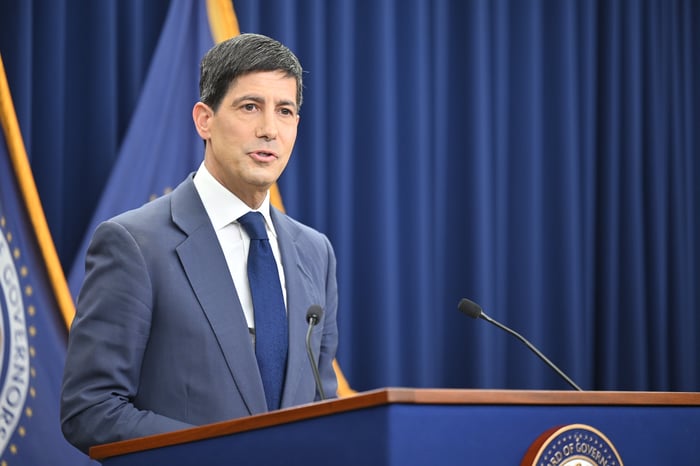
Fed Chair Kevin Warsh and his FOMC peers face some challenging decisions on inflation. Image source: Official Federal Reserve Photo.
While new Fed Chair Kevin Warsh and his Federal Open Market Committee (FOMC) colleagues have erred on the side of caution and left interest rates unchanged over the last two meetings, the recently released July 28-29 FOMC meeting minutes paint a potential worst-case scenario for the central bank and stock market.
The FOMC lays out the possibility of its most worrisome scenario taking shape
In many respects, the July Fed meeting minutes echoed what we already knew. Three regional presidents dissented in favor of a quarter-point rate hike, believing that getting ahead of elevated inflation now will prevent the need for more aggressive action down the line.
The FOMC meeting minutes also noted that the impacts of the AI build-out on consumer prices have "been limited to select categories." This is more or less in line with the June FOMC meeting minutes, with most participants expecting AI to be disinflationary over time.
However, one particular sentence under "Participants' Views on Current Conditions and the Economic Outlook" stands out for all the wrong reasons. In addition to noting that inflation risks were skewed to the upside by renewed conflict and uncertainty in the Middle East, the meeting minutes state:
Many participants highlighted the possibility that, after several years of inflation above two percent, continued elevated inflation rates could begin to affect inflation expectations and wage- and price-setting decisions.
In other words, after 65 consecutive months of headline inflation topping the FOMC's long-term target of 2%, and several successive supply shocks, including the COVID-19 pandemic, Trump's tariffs, and the Iran war, policymakers believe that businesses may begin to price in elevated inflation as the new norm. That's not the message Fed Chair Warsh has preached since taking charge, and it's an absolute nightmare scenario for him and the FOMC if they hope to deliver price stability.
65.
-- Charlie Bilello (@charliebilello) August 12, 2026
As in 65 consecutive months with US inflation above the Fed's 2% target.
The Fed has lost all credibility when it comes to fighting inflation. pic.twitter.com/WErvde2rue
The positive for Warsh and his colleagues is that Treasury bond yields at the long end of the yield curve have notably jumped this year, likely due to elevated inflation and rapidly growing national debt. Higher Treasury bond yields can increase corporate borrowing costs and modestly pump the brakes on elevated inflation.
But with Treasury Secretary Scott Bessent announcing a beefed-up bond-buying program last week, this early win for Warsh and the Fed may prove fleeting. To avoid a nightmare scenario in which businesses set wages and prices based on preexisting expectations of elevated inflation, the new Fed chair and his peers may have little choice but to raise interest rates.
If the Federal Reserve raises interest rates, it could be difficult, if not impossible, for Wall Street's AI-driven rally to sustain historically expensive valuation multiples.
Should you buy stock in S&P 500 Index right now?
Before you buy stock in S&P 500 Index, consider this:
The Motley Fool Stock Advisor analyst team just identified what they believe are the 10 best stocks for investors to buy now… and S&P 500 Index wasn’t one of them. The 10 stocks that made the cut could produce monster returns in the coming years.
Consider when Netflix made this list on December 17, 2004... if you invested $1,000 at the time of our recommendation, you’d have $429,223!* Or when Nvidia made this list on April 15, 2005... if you invested $1,000 at the time of our recommendation, you’d have $1,317,883!*
Now, it’s worth noting Stock Advisor’s total average return is 965% — a market-crushing outperformance compared to 212% for the S&P 500. Don't miss the latest top 10 list, available with Stock Advisor, and join an investing community built by individual investors for individual investors.
See the 10 stocks »
*Stock Advisor returns as of August 24, 2026.
Sean Williams has no position in any of the stocks mentioned. The Motley Fool has no position in any of the stocks mentioned. The Motley Fool has a disclosure policy.
Recommended Articles


