


Why Shell and the Other Oil Majors Aren't Price Gouging
Key Points
The geopolitical conflict in the Middle East has upended the energy sector.
With supply constrained, oil prices have risen.
Politicians often claim that companies like Shell, Exxon, and Chevron are price-gouging at times like these.
- 10 stocks we like better than Shell Plc ›
The energy sector is inherently volatile, with oil prices often fluctuating rapidly and dramatically. Wall Street seems to forget this fact every time the energy sector goes through yet another big price swing. Right now, volatility is high, and so are oil prices, thanks to the geopolitical conflict in the Middle East. It is headline-grabbing news, but it really isn't all that unusual for the energy sector.
However, there's an important political dynamic here that investors need to consider. It is highlighted by U.S. President Donald Trump's recent accusation that oil companies are price gouging, which included a call for a Department of Justice review. Here's what you need to know as you look at companies like Shell (NYSE:SHEL), ExxonMobil (NYSE:XOM), and Chevron (NYSE:CVX) today.
Missed Nvidia in 2009? This Rare Signal Is Flashing Again. In 2009, a "Double Down" signal flashed for a little-known chipmaker called Nvidia. For the first time in years, that same "Total Conviction" signal is flashing for a company 1/100th the size of Nvidia. Continue »

Image source: Getty Images.
Gasoline is an everyday necessity
One of the reasons most investors should have some energy exposure in their portfolios is the economic importance of oil and natural gas, and the products derived from them. One of the most important products here is gasoline, which still powers the vast majority of the vehicles on the road. Notably, gasoline prices tend to react very quickly to changes in oil prices. And changing gasoline prices have a very direct impact on consumers' wallets.
For politicians, that can be a big problem when oil prices are rising. Voters don't like paying more at the pump and often take out their ire in the ballot box. To make matters worse, energy companies tend to generate very large profits when oil prices are elevated
For example, Shell's revenues rose 22% in the first half of 2026 compared to the same span in 2025. And its earnings more than doubled, rising from $1.40 per share in the first half of 2025 to $2.94 per share in 2026.
Chevron also got in on the act, with revenues through the first six months of 2026 up 28% over the previous year. Earnings more than doubled, hitting $7.23 per share, up from $3.46 in the first half of 202 ExxonMobil's results were also strong, with first-half revenues up around 22% and earnings rising by roughly 66%, to $5.60 per share.
It is easy to see how consumers and politicians alike might look at the strong results from some of the world's largest energy companies and take umbrage. However, that doesn't mean the companies are price-gouging. Oil and gasoline are commodities, and Shell, Chevron, and Exxon don't control the price; the market does.
Oil downturns upend the price-gouging story
What's notable here is that there is a lot of complaining when energy companies are making lots of money, but nobody seems to care when oil prices are low. That sometimes leads Shell, Chevron, and Exxon to bleed red ink, with no mass of politicians stepping forward to suggest giving them a helping hand.
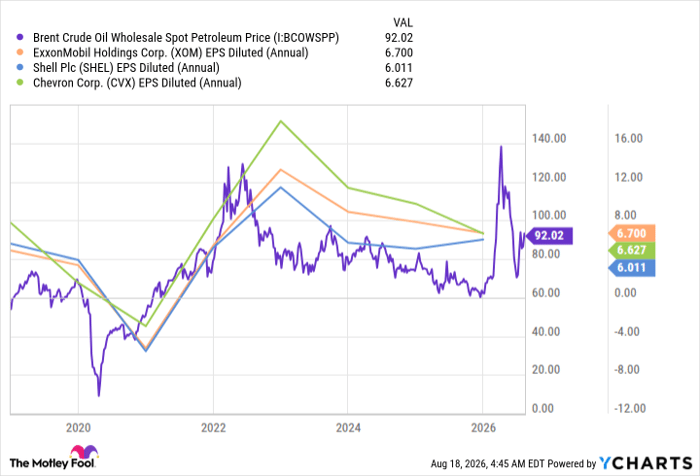
Brent Crude Oil Wholesale Spot Petroleum Price data by YCharts
That's the tell. Politicians feeling the heat from consumers angry about high energy prices are simply looking for an easy scapegoat. There are few easier targets than a large oil company making lots of money during a period of elevated energy prices. And thus, energy companies are accused of price gouging. Some companies are more inclined than others to address this issue, with TotalEnergies (NYSE:TTE) instituting a fuel price cap in its home country of France even as it pushes back against claims that it is making "superprofits."
If you include energy companies in your portfolio, however, you effectively hedge yourself against rising energy costs. That's about all you can do, and it's why owning stocks like Shell, Chevron, and Exxon is a good idea for long-term diversification. You'll feel the hit at the pump, but at least you'll benefit as the stock prices of energy companies rise along with energy prices.
Stick to the biggest and strongest companies
You could, of course, buy a small oil driller and get the same benefit. However, integrated energy majors like Shell, Chevron, and Exxon have exposure to the entire energy value chain, which helps to temper the industry's swings. Remember that oil prices go up and down.
Also, energy majors tend to offer attractive dividend yields, with Exxon at 2.5%, Shell at 3.4%, and Chevron at 3.5%. Notably, Exxon and Chevron have both increased their annual dividends for decades, suggesting they could even be a good fit for conservative dividend investors.
Should you buy stock in Shell Plc right now?
Before you buy stock in Shell Plc, consider this:
The Motley Fool Stock Advisor analyst team just identified what they believe are the 10 best stocks for investors to buy now… and Shell Plc wasn’t one of them. The 10 stocks that made the cut could produce monster returns in the coming years.
Consider when Netflix made this list on December 17, 2004... if you invested $1,000 at the time of our recommendation, you’d have $429,223!* Or when Nvidia made this list on April 15, 2005... if you invested $1,000 at the time of our recommendation, you’d have $1,318,055!*
Now, it’s worth noting Stock Advisor’s total average return is 965% — a market-crushing outperformance compared to 212% for the S&P 500. Don't miss the latest top 10 list, available with Stock Advisor, and join an investing community built by individual investors for individual investors.
See the 10 stocks »
*Stock Advisor returns as of August 22, 2026.
Reuben Gregg Brewer has positions in TotalEnergies Se. The Motley Fool has positions in and recommends Chevron. The Motley Fool has a disclosure policy.
Recommended Articles


