


Palantir (PLTR.US) In-Depth Report: Powerful Enterprise AI Implementation Capabilities, Demanding Stock Odds
Large language models (GPT/Claude/Gemini) excel at reasoning, yet they do not understand how a specific enterprise actually operates. Meanwhile, ERP, CRM, and MES systems accumulate vast amounts of operational data, but remain in isolated silos. Palantir bridges the two:
It connects large language models with an enterprise's physical world by structuring operational rules that previously resided across separate systems and inside employees' minds, creating a directly invokable digital twin for the company. This elevates large language models from simple Q&A chatbots into an operational brain that can authoritatively initiate cross-system dispatching and execute tasks, taking over enterprise productivity.
The company's scarcity is already reflected in its price. As of the close on August 20, 2026, Palantir's NTM EV/Revenue multiple stood at approximately 41x. While business growth continues to accelerate, the valuation leaves virtually no room for error. This article will examine what Palantir actually does, whether its moat can withstand competition from AI-native firms, where future growth will come from, and what risk-reward ratio remains at its current price.
I. Palantir's Core Business: Building a "Digital Twin" for Enterprises
1. From Intelligence Agencies to the Commercial Market
Founded in 2003 by Peter Thiel, current CEO Alex Karp, and others, Palantir received early backing from In-Q-Tel, the CIA's venture capital firm, initially serving US intelligence and defense agencies.
These clients possessed highly sensitive data and complex operations. Analysts could rarely articulate their requirements into a comprehensive specification, nor could they hand over data for external firms to study at leisure. Consequently, Palantir had to deploy Forward-Deployed Engineers (FDEs) to the frontlines to build systems alongside clients.
This experience endowed the company with two crucial capabilities: a team of FDEs capable of handling complex operations, and granular permissioning, security, and audit trail mechanisms built directly into the product's foundation. Palantir later expanded this methodology into commercial sectors such as manufacturing, healthcare, finance, and energy.
What Palantir does can be stated quite simply: it helps enterprises create a continuously updated digital twin, integrating company data, operational rules, and execution workflows into a single software platform where both employees and AI can operate.
2. Product Suite and Ontology: Building an Enterprise Digital Twin via Data, Logic, and Action
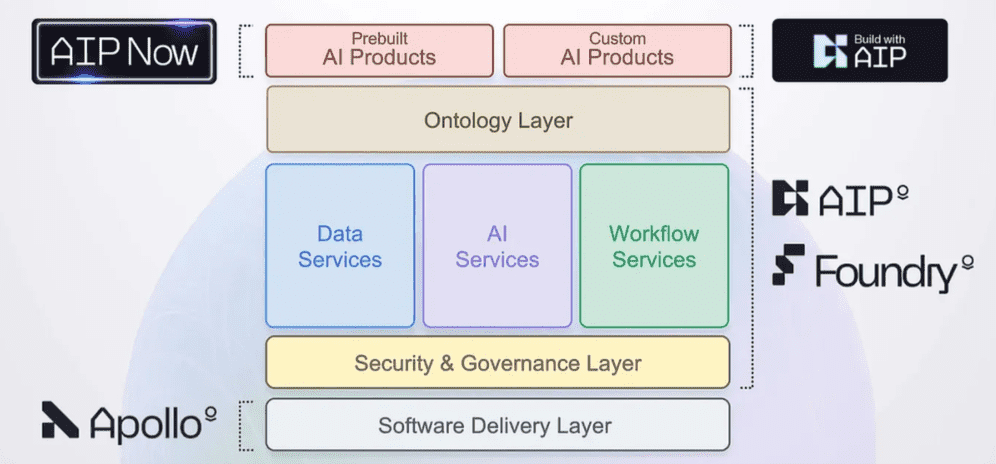
Palantir primarily offers four main products:
- Gotham: A defense and intelligence operating system supporting multi-source data fusion, entity-relationship recognition, and real-time operational decision-making (such as the US military's Project Maven AI combat system).
- Foundry: A commercial enterprise operating system that breaks down data silos across ERP, CRM, and SCM systems, enabling end-to-end operational visibility and closed-loop decision-making.
- AIP (Artificial Intelligence Platform): The core AI hub that seamlessly orchestrates mainstream LLMs (such as Claude, GPT, and Gemini) into enterprise workflows, enabling AI agents to securely invoke tools and execute tasks under strict permission controls.
- Apollo: The continuous delivery layer responsible for deploying the three products above into any environment, including public clouds, on-premises data centers, air-gapped classified networks, and even naval vessels and battlefield edge devices.
Connecting all these products is the core foundation: Ontology (Ontology Architecture).
Ontology: Encoding Enterprise Operations into Software
Large enterprises typically use dozens or even hundreds of software applications simultaneously—ERP for procurement, CRM for sales, and MES for manufacturing—interspersed with fragmented Excel spreadsheets and emails, leaving data devoid of unified business context.
Palantir first integrates these systems via connectors and data pipelines. On supported platforms such as Snowflake, Databricks, and BigQuery, Virtual Tables can directly query external data to minimize redundant data replication. Ontology then organizes this information into an enterprise digital twin:
- Data—What is happening: The enterprise's clients, orders, inventory, and equipment, as well as the relationships among them.
- Logic—How decisions should be made: Reorder thresholds for inventory, priority ordering rules, and actions requiring managerial approval.
- Action—What the system can execute: Notifying personnel, generating inventory transfer plans, initiating approvals, and writing results back to ERP or CRM systems upon authorization.
By embedding decision logic and execution pathways into algorithms, Ontology successfully constructs a context-aware digital twin for the enterprise.
Source: Palantir
3. The FDE Model: Codifying Employee Expertise into Software
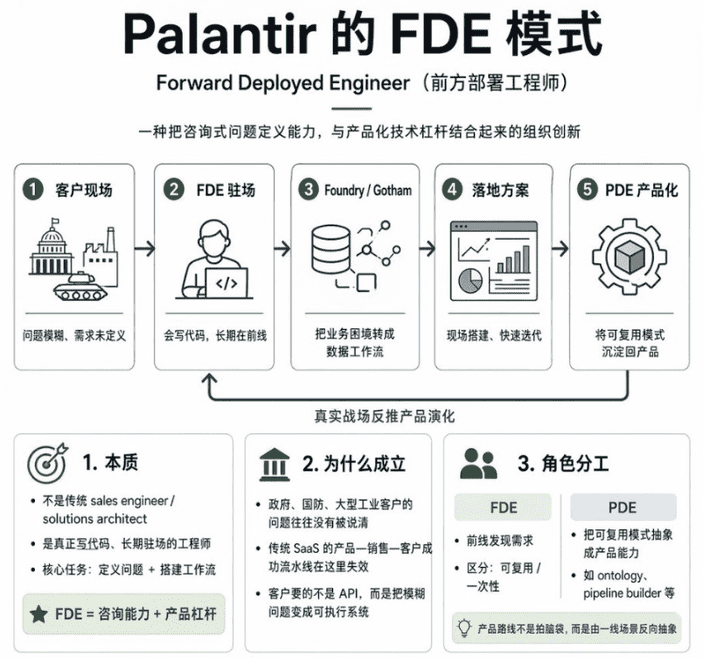
In enterprise AI implementation, the primary bottleneck lies in vague requirements and hard-to-replicate workflows. Rather than adopting the standardized model of traditional SaaS that relies heavily on pre-sales consultants, Palantir uses FDEs (Forward-Deployed Engineers) to solve the last-mile challenge of moving AI from demo to production:
- Core Positioning (Consulting Capability + Technical Leverage): FDEs are elite engineers with advanced coding skills embedded long-term at the client frontlines. Their core task is to translate vague operational pain points into runnable code and workflows on site.
- Overcoming Traditional SaaS Limitations: Facing non-standard pain points from defense and major industrial clients, FDEs leverage Foundry and AIP directly on site to build systems, bypassing traditional SaaS's cumbersome custom development process.
- R&D Feedback Loop (FDE and PDE Synergy): FDEs extract client-specific solution logic on the frontlines and pass it back to Product Development Engineers (PDEs) to build reusable modules. This ensures Palantir's product iterations are entirely driven by actual production needs rather than developers' subjective assumptions.
Source: TradingKey
II. Competitive Moat: The More Complete the Enterprise's Decision Brain, the Higher the Switching Costs
Ontology: Data is Easy to Move, Operational Workflows are Not
Ontology's moat originates from long-accumulated business logic. As adoption deepens, client order relationships, dispatching rules, approval permissions, and execution workflows are progressively encoded into the system.
These rules are shared across departments and applications. Updating an inventory rule once allows associated procurement, scheduling, and supply chain applications to inherit the new logic automatically. Integrating a new AI agent similarly allows immediate access to existing business context and permissioning. While underlying LLMs can be swapped out, the enterprise's operational playbook remains bound to Ontology.
Currently, some market observers worry that AI-native applications will render traditional software obsolete. However, we believe AI agents lack a "physical mapping" to real-world enterprise operations, such as procurement authorizations, inventory rules, and supply chain scheduling. Palantir codifies these complex operating logics into Ontology. While underlying LLMs can be replaced anytime, the enterprise's operational playbook remains tethered to Ontology. In fact, as AI agents become more prevalent, the demand for Palantir's real business context and secure execution paths will only increase.
2. FDE: Engineers Are Easy to Hire, but the Full Delivery Ecosystem Is Hard to Replicate
The hardest knowledge to capture in enterprise AI implementations often lies in frontline workers' operational experience and judgment: what equipment signals dictate a shutdown, which orders require priority delivery, or why a procurement manager chooses a specific supplier.
FDEs deploy to customer frontlines specifically to codify this expertise into rules, permissions, and operational workflows within Ontology, subsequently building applications via Foundry and AIP.
While companies like OpenAI and Anthropic are also hiring FDEs, Palantir has accumulated nearly two decades of tools, experience, and delivery methodologies, bestowing it with a first-mover advantage and mature platform that competitors cannot easily match in the short term.
3. Security Certifications and Deployment in Complex Environments Form Trust Barriers
In government, defense, and other security-sensitive sectors, system security, compliance auditing, and deployment capabilities across complex network environments often outweigh raw LLM performance. Compared with competitors, Palantir possesses:
- High-Level Security Certifications: Originating in intelligence and defense, Palantir has secured rigorous certifications, including FedRAMP High, DoD IL5, and IL6.
- Omni-Environment Deployment via Apollo: Powered by the Apollo engine, Palantir seamlessly deploys and updates software without interruption across on-premises servers, classified clouds, air-gapped networks, and frontline edge devices, addressing sensitive environment pain points that traditional SaaS cannot reach.
Security credentials and omni-environment deployment capabilities create a long-term trust barrier. Palantir's AIP provides not just a development environment, but also strict permission isolation, compliance guardrails, and traceable audit logs for every operation. Purchasing Palantir is not merely buying an AI tool, but acquiring compliance backstopping and liability attribution. Even if emerging AI vendors possess high-performing LLMs, they still face years of security reviews, procurement cycles, and stability testing, making it difficult to breach Palantir's defensive moat in the near term.
III. Future Growth: US Expansion Forms the Core Driver, International Markets Offer Call Option
1. Expanding Order Book as Existing Clients Scale Usage
In Q2 FY2026, the total contract value (TCV) signed with US commercial clients reached $2.13 billion, up 153% year-over-year. Contracted backlogs not yet recognized as revenue reached $4.9 billion, representing a 103% year-over-year surge, outpacing the 93% revenue growth rate for the period.
Simply put, Palantir is booking revenue while accumulating new orders at an even faster pace, laying a solid foundation for growth over the coming quarters.
Revenue from the same cohort of existing clients grew by a net 57% over the past year. Clients typically start by using Palantir to solve a specific issue, such as supply chain alerts. Once the initial application succeeds, the connected data and Ontology can be leveraged across procurement, scheduling, and finance departments.
This creates Palantir's "land-and-expand" trajectory: new orders acquire clients, while expanding workflows steadily increase revenue per customer.
2. Streamlined Product Deployment Allows FDEs to Scale Projects
Palantir is transforming tasks previously repeated by FDEs into standardized tools:
- AIP Bootcamp utilizes clients' live data to rapidly build their initial AI application, shortening trial and proof-of-concept timelines;
- Workflow Lineage and industry templates modularize common data, approval, and execution processes, enabling clients to build new workflows like building blocks;
- AI FDE assists engineers with code writing and basic configuration, reducing repetitive software development.
FDEs remain focused on understanding client business logic and solving the most complex challenges, while foundational work is increasingly automated by software. Consequently, the same headcount can support more clients, while individual clients can deploy new applications faster.
With Q2 revenue growing 93% and adjusted operating margin reaching 62%, rapid top-line expansion accompanied by margin expansion demonstrates that delivery efficiency is already improving.
3. Partnering with Nvidia to Unlock the Sovereign AI Market
On June 29, 2026, Palantir officially announced a strategic partnership with Nvidia to launch an "intelligence engine" designed to deploy Nvidia AI and Nemotron open-source models in sovereign environments for US government agencies and critical infrastructure enterprises.
Sovereign AI refers to governments or enterprises retaining full control over data, models, and compute infrastructure without exposing sensitive information to external cloud providers.
The division of labor is distinct: Nvidia provides accelerated computing and Nemotron open models, while Palantir manages data permissions, business context, and secure deployment via AIP, Ontology, Foundry, and Apollo. Clients can run and train models within their own data centers or air-gapped networks, maintaining complete control over data, deployment environments, and final model weights. As Jensen Huang described it, this architecture can be deployed in any air-gapped zone, fully on-premises, or even on the battlefield frontline—a solution no other vendor can currently deliver end-to-end.
This solution resolves the key pain point for government, energy, and financial clients who want to leverage advanced AI without ceding core data to external closed-source model providers. For Palantir, the partnership is expected to expand its footprint across government and critical infrastructure markets while reinforcing its secure deployment moat.
4. International Markets Have Yet to Scale; Replication Offers Upside
In Q2 FY2026, Palantir's international revenue totaled approximately $363 million, accounting for about 19% of total revenue and growing 33% year-over-year (compared to 115% growth in the US). Palantir's explosive growth in the US has not yet replicated internationally.
If AIP Bootcamp can help international clients build initial applications quickly—expanding into European, Middle Eastern, and Asia-Pacific manufacturing, energy, and financial enterprises via partners—international markets could emerge as the next growth driver.
However, given headwinds from overseas data sovereignty regulations (such as the EU AI Act) and geopolitical sensitivities, international markets are best viewed as an optional upside call option rather than a prerequisite for current growth.
IV. Risk Analysis: Great Business, Demanding Stock
1. Elevated Valuation Leaves Minimal Room for Error
Valuation remains the sharpest sword hanging over Palantir's head.
Based on the closing price on August 20, 2026, and consensus adjusted EPS estimates, Palantir trades at 2026E and 2027E forward P/E multiples of approximately 109x and 77x, respectively, with an NTM EV/Revenue multiple of around 41x. The current valuation demands that the company consistently deliver beat-and-raise quarterly results; merely meeting revenue expectations, offering soft guidance, or experiencing delays in major contract signings could trigger severe multiple compression.
2. High Product Cost: AI-Native Competitors May Siphon Incremental Budget
Databricks is rolling out Genie Ontology, Microsoft Fabric IQ is offering Ontology and Operations Agents, and OpenAI is expanding its enterprise deployment team. While these offerings have not matched Palantir's maturity in complex permissions, cross-system operations, and classified deployments, they already address data Q&A, lightweight agents, and select workflows.
While customers cannot easily displace Palantir in the short term, they may allocate simpler projects and incremental budgets to cheaper alternatives or tools bundled within existing cloud agreements to optimize overall AI spending.
3. SBC Dilution, Executive Insider Selling, and Short Interest Dynamics Will Amplify Short-Term Volatility
Beyond fundamentals and valuation, a series of structural factors is pushing Palantir's share price toward extreme volatility:
- Stock-Based Compensation (SBC) Dilution and Executive Insider Selling Pressure: In Q2 FY2026, SBC expense reached $265 million (representing ~14% of revenue). During high-growth phases, markets often overlook share count expansion stemming from SBC vesting. However, if revenue growth decelerates, accumulated share issuances will inflict noticeable EPS dilution. Meanwhile, CEO Alex Karp established a new 10b5-1 trading plan in March 2026 covering 7.08 million shares, creating persistent supply overhang on the stock at elevated valuation levels.
- Short-Seller Divergence: Michael Burry publicly disclosed in April 2026 that he held put options with strike prices of $100 expiring in December 2026 and $50 expiring in June 2027, while Citron Research previously set a price target of $40.
V. Investment Recommendation and Summary: Worth Long-Term Tracking, but Current Risk-Reward Is Unattractive
Palantir's current valuation of ~41x EV/Revenue fully prices in expectations for sustained hyper-growth.
- For Short-Term Traders: The risk-reward setup is unfavorable. Any minor quarterly miss or subtle deceleration in guidance could trigger sharp multiple compression.
- For Long-Term Investors: Palantir possesses a rare combination of enterprise context and an AI execution platform. However, great companies still require reasonable entry prices. Lacking a sufficient margin of safety, current levels favor patience over chasing highs.
Conclusion: We continue to view Palantir as one of the premier foundational software assets of the AI era. However, at current valuation levels, chasing the rally offers limited risk-adjusted upside. As an investor, waiting for a pullback driven by market sentiment or short-term earnings volatility would provide a superior risk-reward entry for building a long-term position in tranches.
Disclaimer: The analysis in this article represents a research framework based solely on publicly available information and does not constitute investment advice.
Recommended Articles


