


The U.S. Just Hit $40 Trillion in Debt — 2 Years Ahead of Schedule. Here's What Investors Need to Know.
Key Points
Mounting U.S. government debt has been a concern for decades.
However, it's also hard to know what will happen if the government doesn't get the situation under control.
In recent years, bond investors have seemingly tried to push the issue to center stage.
- These 10 stocks could mint the next wave of millionaires ›
The United States federal government has now racked up a tab of more than $40 trillion in outstanding debt. The government officially reached this threshold earlier this week.
While it's not exactly a surprise, the mounting debt continues to concern those worried about the country's finances.
Missed Nvidia in 2009? This Rare Signal Is Flashing Again. In 2009, a "Double Down" signal flashed for a little-known chipmaker called Nvidia. For the first time in years, that same "Total Conviction" signal is flashing for a company 1/100th the size of Nvidia. Continue »
According to The Wall Street Journal, outstanding public debt, excluding Social Security trust funds, is about $32.3 trillion.
Here's what investors need to know.

Image source: Getty Images.
Where it hurts
Debt concerns are not new and have been ongoing for decades, as many economists, analyts, and investors alike have worried that the country has become too reliant on fiscal stimulus.
The COVID-19 pandemic did not help the matter, with the government injecting trillions into the economy during an unprecedented time to provide stimulus checks, emergency business loans, and enhanced unemployment benefits.
Some argue that mounting debt is of no concern, given that the U.S. dollar is the world’s reserve currency and therefore the country cannot default. But high debt levels do appear to have affected parts of the economy and the stock market.
While $40 trillion may not feel like a real number, the interest the government pays on its debt every year is very real and strains the country's fiscal budget.
Thus far in fiscal year 2026, which runs from October through September of the following year, the government has spent $1.8 trillion more than it has collected in revenue. Net interest on the debt makes up 15% of expenditures.
Additionally, some experts argue that excessive debt can indirectly lead to money printing through quantitative easing, in which the Federal Reserve purchases bonds to keep yields down, thereby affecting total debt costs.
Since the Great Recession, QE has significantly increased the money supply, raising the value of financial assets, from stocks to real estate. This has led to affordability issues, especially for people who didn’t own financial assets.
That said, the Fed did raise interest rates intensely when it realized it was behind the eight-ball on inflation, starting in 2022.
Another interesting impact of the extreme debt levels has been higher bond yields, particularly toward the farther end of the yield curve for longer-dated bonds.
Longer-dated bond yields are influenced by inflation and economic growth expectations, as well as supply and demand. But yields at the longer end have also risen, due to the bond vigilantes.
This is a term for bond investors demanding higher yields due to the elevated risk that the U.S. government won't be able to fund all its obligations down the line because of its mounting debt and fiscal issues.
Recently, the yield on the 30-year U.S. Treasury bond topped 5.30%, the highest level seen since 2007. Although the 30-year yield is not tied to mortgage rates, it does influence other longer-term corporate debt and state and municipal bonds.
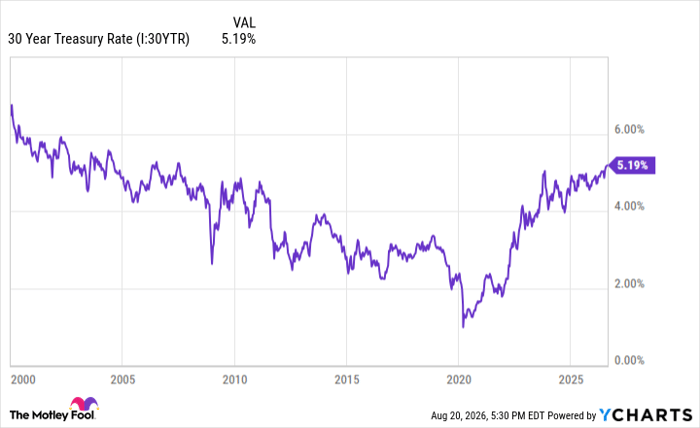
30 Year Treasury Rate data by YCharts
Also recently, U.S. Treasury Secretary Scott Bessent announced that the Treasury would repurchase at least $4 billion of longer-dated bonds, a symbolic gesture indicating that "... we believe that the yields don't reflect the underlying fundamentals."
Reducing the supply of bonds drives up demand, raising bond prices and lowering yields, which are inversely correlated.
What's next?
As debt continues to climb, nobody knows exactly what will happen next. Certainly, the situation isn't good, but it's hard to know when it truly breaks the camel's back.
Mounting debt clearly continues to impact the broader market and economy, whether through a more constrained federal budget or higher bond yields.
The market tends to not perform as well amid higher yields.
Higher debt levels are also one driver behind an investment thesis that the dollar is headed for debasement, in which it loses its purchasing power.
Gold prices have surged in recent years. The price of an ounce of Gold is now at $4,575, up 156% over the past five years and nearly 14% over the past month alone.
While some would argue the hard asset has run too far too fast, if you believe the U.S. dollar is headed for debasement, then you want to own Gold.
Where to invest $1,000 right now
When our analyst team has a stock tip, it can pay to listen. After all, Stock Advisor’s total average return is 973%* — a market-crushing outperformance compared to 213% for the S&P 500.
They just revealed what they believe are the 10 best stocks for investors to buy right now, available when you join Stock Advisor.
See the stocks »
*Stock Advisor returns as of August 20, 2026.
The Motley Fool has a disclosure policy.
Recommended Articles


