


US Stocks Close: Dow Drops 700 Points, Nasdaq Falls 1%; Memory, Optical Communication Stocks Buck Trend; Micron Rises 4%
TradingKey - A renewed surge in U.S. Treasury yields and rising oil prices both dampened market trading sentiment. All three major U.S. stock indices fell, but AI hardware stocks bucked the trend to move higher, with memory and optical communication stocks leading the gains.
At the close, the Dow Jones Industrial Average fell 1.32% to 52,759.21; the Nasdaq Composite Index fell 1.00% to 26,067.17; and the S&P 500 Index dropped 0.87% to 7,641.16.
Tech Stock Performance
Micron (MU) rose 3.97% to $974.33.
Micron officially launched Micron Research Labs. Micron plans to invest $10 billion over the next decade to support the lab's development. Leveraging Micron's leadership in technology and manufacturing, this new innovation platform will unite customers, academia, government, and the broader semiconductor industry ecosystem to explore technological breakthroughs beyond existing roadmaps and define industry technical possibilities for decades to come. Key research directions include core memory technology, advanced compute-in-memory architecture, packaging technology, and next-generation semiconductor manufacturing processes.
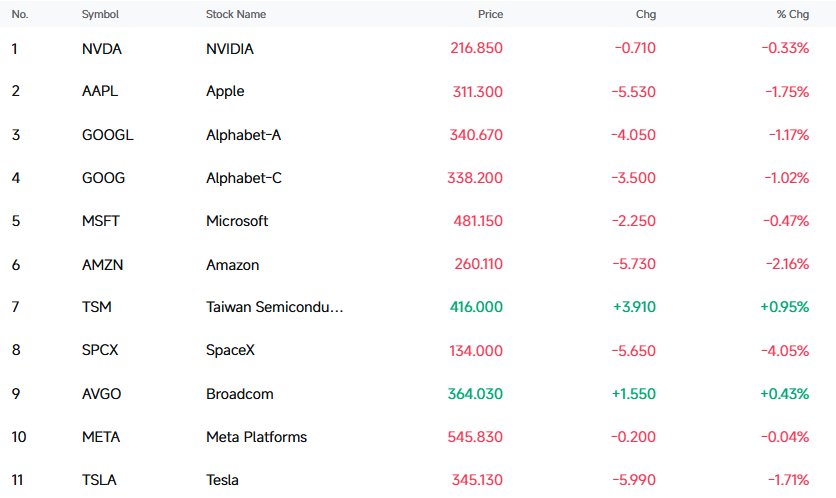
Among major tech stocks, Broadcom (AVGO) rose 0.43%. On the downside, SpaceX (SPCX) fell 4.05%, Amazon (AMZN) fell 2.16%, Apple (AAPL) fell 1.75%, Tesla (TSLA) fell 1.71%, Google (GOOGL) fell 1.17%, Microsoft (MSFT) fell 0.47%, Nvidia (NVDA) fell 0.33%, and Meta Platforms (META) fell 0.04%.
[Source: FutuBull]
The Philadelphia Semiconductor Index rose 0.53% to 11,800.02. Among its 30 constituent stocks, 14 advanced and 16 declined.
Among optical communications stocks, Lumentum (LITE) rose 6.24%, Marvell Technology (MRVL) rose 5.79%, and Applied Optoelectronics (AAOI) rose 5.66%.
Among memory stocks, SK Hynix (SKHY) rose 4.43%, Micron Technology (MU) rose 3.97%, Seagate Technology (STX) rose 2.12%, SanDisk (SNDK) rose 2.02%, and Western Digital (WDC) rose 1.51%.
Company News
Anthropic Reportedly Expected to Match SpaceX in IPO Size
Anthropic expects its IPO size to match or exceed the record set by SpaceX. SpaceX reportedly raised $75 billion in its IPO, making it the largest initial public offering in history. Due to the exercise of the so-called over-allotment option, that figure ultimately rose to $86.2 billion. Previous reports indicated that Anthropic's preliminary second-quarter revenue exceeded $11.5 billion, compared with just $787 million in the same period of 2025. As of the end of July, the company's annualized revenue had reached $65 billion.
Waymo Announces Self-Developed Chip with Computing Power Exceeding 1,000 TOPS, Already Deployed in Its Latest-Generation Robotaxi
Alphabet's autonomous driving subsidiary Waymo announced that it has developed a custom chip, claiming it can improve Robotaxi performance. Waymo stated that this ASIC chip has already been applied in Waymo's latest-generation Robotaxi. Waymo said that combining its self-developed chip with other chips and in-house designed sensors will enhance the Robotaxi's responsiveness and navigation capabilities in complex urban environments. The ASIC's dedicated accelerator can instantly extract key information from raw LiDAR, radar, and camera data streams for temporal noise reduction to enhance low-light perception. The computing power of its self-developed chip exceeds 1,000 TOPS.
Industry & Macro News
US Treasury Secretary Bessent: Bond Buyback Cap May Exceed $4 Billion
US Treasury Secretary Bessent stated regarding bond buybacks that the size (cap) of a single buyback operation may exceed $4 billion, serving in part to send a signal. "We want to show that yields do not reflect fundamentals." Meanwhile, an announcement on stepping up fiscal consolidation may be made, and "we have very likely seen the peak in the deficit." Regarding debt numbers, the $40 trillion debt figure holds no special significance, and the market is getting a bit ahead of itself. If there are any changes to the balance sheet, the Treasury and the Fed will coordinate. To be clear, interest rates are unrelated to buyback decisions. As for the inflation outlook, Bessent said market indicators show it will trend lower.
Fed's Daly: No Evidence Seen of Need to Hike Rates Preemptively; Rising Long-Term Yields Are a Global Issue
Federal Reserve official Daly stated that the rise in long-term yields is a global issue that diminishes its role as an indicator of Fed policy signals, adding that she sees no risk to the Fed's credibility. Short-term yields show the market understands the Fed's reaction function, and Fed policy is in a good place, with no evidence seen of a need to hike rates preemptively. She expects inflation shocks to gradually fade, making her "very supportive" of the Fed maintaining interest rates in July. However, vigilance is needed against the compounding effects of multiple inflation shocks, though she noted that while looking for more concerning signs of inflation, she has not seen them yet. Recent employment and inflation data have not changed the outlook, and she currently does not believe the labor market will drive inflation. Rising bond yields are not sending policy signals, and it is too early to discuss US Treasury issuance patterns. The Fed will find ways to achieve its policy goals and will continue to fulfill its mandate regardless of any action taken by the Treasury.
UBS Says Strong Corporate Earnings Will Drive S&P 500 Index to 8,100 This Year
UBS Chief Strategist Bhanu Baweja believes that strong US corporate earnings are expected to continue supporting US stocks higher, but the outlook for 2027 will face more uncertainties such as margin pressure. Baweja stated that this US earnings season has been "exceptionally strong," with corporate earnings growth at around 35% to 40%, and strong earnings momentum may drive the S&P 500 Index to continue setting new highs during the year. His baseline scenario is for the S&P 500 Index to rise to 8,100. Baweja believes it will be difficult for the market to reverse current earnings trends in the short term, but 2027 could become more challenging. If corporate profit margins are squeezed, the foundation for the stock market rally may weaken. Particularly worthy of attention are AI-adopting companies such as financial services, law firms, and consulting agencies: if these companies cannot maintain higher profit margins, their sustained investment in artificial intelligence may also cool down.
Recommended Articles


