


Opendoor Is Down 86% From Its High. Is the Housing Recovery Story Still Intact?
Key Points
Opendoor's business comeback is not happening as investors imagined.
The company continues to lose money, and its stock price has fallen as a result.
The stock does not look appealing with declining revenue and no profits.
- 10 stocks we like better than Opendoor Technologies ›
Last year, Opendoor (NASDAQ: OPEN) had a new CEO, Kaz Nejatian, take the helm, promising a massive turnaround for the struggling pandemic-era real estate technology company. The stock price rose from under $1 to $10 in a year, with investors betting that the pain was finally over.
Today, shares are back down to $3.50. The financial results for the real estate buying platform continue to deteriorate, with housing market activity frozen shut in the United States.
Missed Nvidia in 2009? This Rare Signal Is Flashing Again. In 2009, a "Double Down" signal flashed for a little-known chipmaker called Nvidia. For the first time in years, that same "Total Conviction" signal is flashing for a company 1/100th the size of Nvidia. Continue »
Here's what Opendoor's future may look like, and whether the stock looks cheap again, down 90% from 2021 highs, as a bet on an eventual reversion to the mean in homebuying activity.
A struggling turnaround
When joining Opendoor, Nejatian wanted to reinvigorate the business by becoming leaner on costs and adding new features for real estate buyers and sellers on its platform. Historically, Opendoor's business model has been to buy and sell homes directly, which has proved tough to finance as a start-up trying to hold more and more inventory on its balance sheet.
This business model broke down amid the rising interest-rate environment of 2022, which drove many transactions out of the U.S. housing market. Opendoor's revenue has steadily declined from its peak, reaching $3.2 billion over the last 12 months, down from over $15 billion at one point in 2021.
Nejatian wants to scale up home acquisitions again, but more efficiently. Last quarter, Opendoor had 6,900 acquisition contracts but spent just $5 million on marketing. That compares to a similar level of acquisitions back in Q2 2022, when Opendoor spent $81 million on marketing.
At the same time, Nejatian wants to turn over homes more quickly, reducing the time this inventory sits on the balance sheet. Opendoor is making progress in this regard, with the percentage of homes on the market at over 120 days down to 9% last quarter, compared to 10% a year prior.
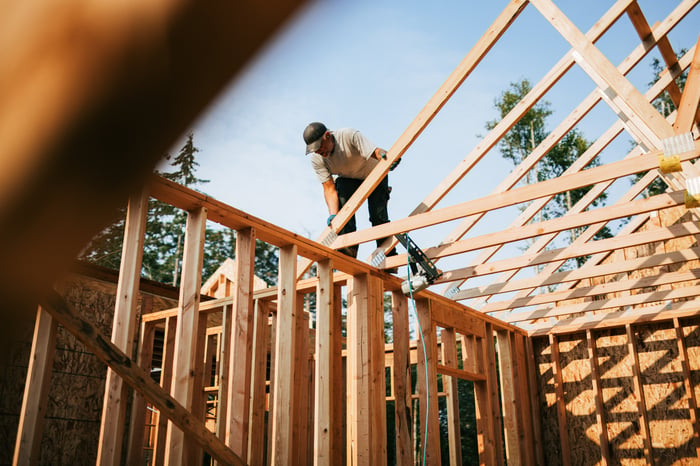
Image source: Getty Images.
Should you buy Opendoor stock?
Despite efforts to improve the core business model and layer on new products, such as automated pricing and mortgage lending through Opendoor, the business remains in rough financial shape.
Last quarter, Opendoor had a net loss of $162 million. It has never generated positive profitability, no matter how hot or cold the U.S. housing market is. Right now, the housing market is ice cold when it comes to transactions, and Opendoor and its investors are betting that an eventual turnaround will finally lead to profitability.
Investors should not automatically expect the housing market to return to the level it was at during the COVID-19 pandemic. We may be in a new environment of higher interest rates and an aging population that lessens the importance of this sector. And Opendoor operated in a hot housing environment a few years ago, and it still could not generate a profit. For these reasons, investors should stay far away from this stock.
Should you buy stock in Opendoor Technologies right now?
Before you buy stock in Opendoor Technologies, consider this:
The Motley Fool Stock Advisor analyst team just identified what they believe are the 10 best stocks for investors to buy now… and Opendoor Technologies wasn’t one of them. The 10 stocks that made the cut could produce monster returns in the coming years.
Consider when Netflix made this list on December 17, 2004... if you invested $1,000 at the time of our recommendation, you’d have $409,970!* Or when Nvidia made this list on April 15, 2005... if you invested $1,000 at the time of our recommendation, you’d have $1,381,040!*
Now, it’s worth noting Stock Advisor’s total average return is 969% — a market-crushing outperformance compared to 215% for the S&P 500. Don't miss the latest top 10 list, available with Stock Advisor, and join an investing community built by individual investors for individual investors.
See the 10 stocks »
*Stock Advisor returns as of August 19, 2026.
Brett Schafer has no position in any of the stocks mentioned. The Motley Fool has no position in any of the stocks mentioned. The Motley Fool has a disclosure policy.
Recommended Articles


