


OpenAI Quarterly Revenue Overtaken by Anthropic as Second-Quarter Loss Widens to $12.3 Billion
TradingKey - On August 18 ET, according to a report by The Wall Street Journal, OpenAI's second-quarter revenue reached $6.7 billion, up 18% quarter-over-quarter, but its operating loss widened from $9.3 billion in the first quarter to $12.3 billion, with loss growth far outpacing revenue growth.
Meanwhile, Anthropic's second-quarter revenue exceeded $11.5 billion, up 143% quarter-over-quarter, surpassing OpenAI in quarterly scale for the first time and turning its adjusted operating profit positive.
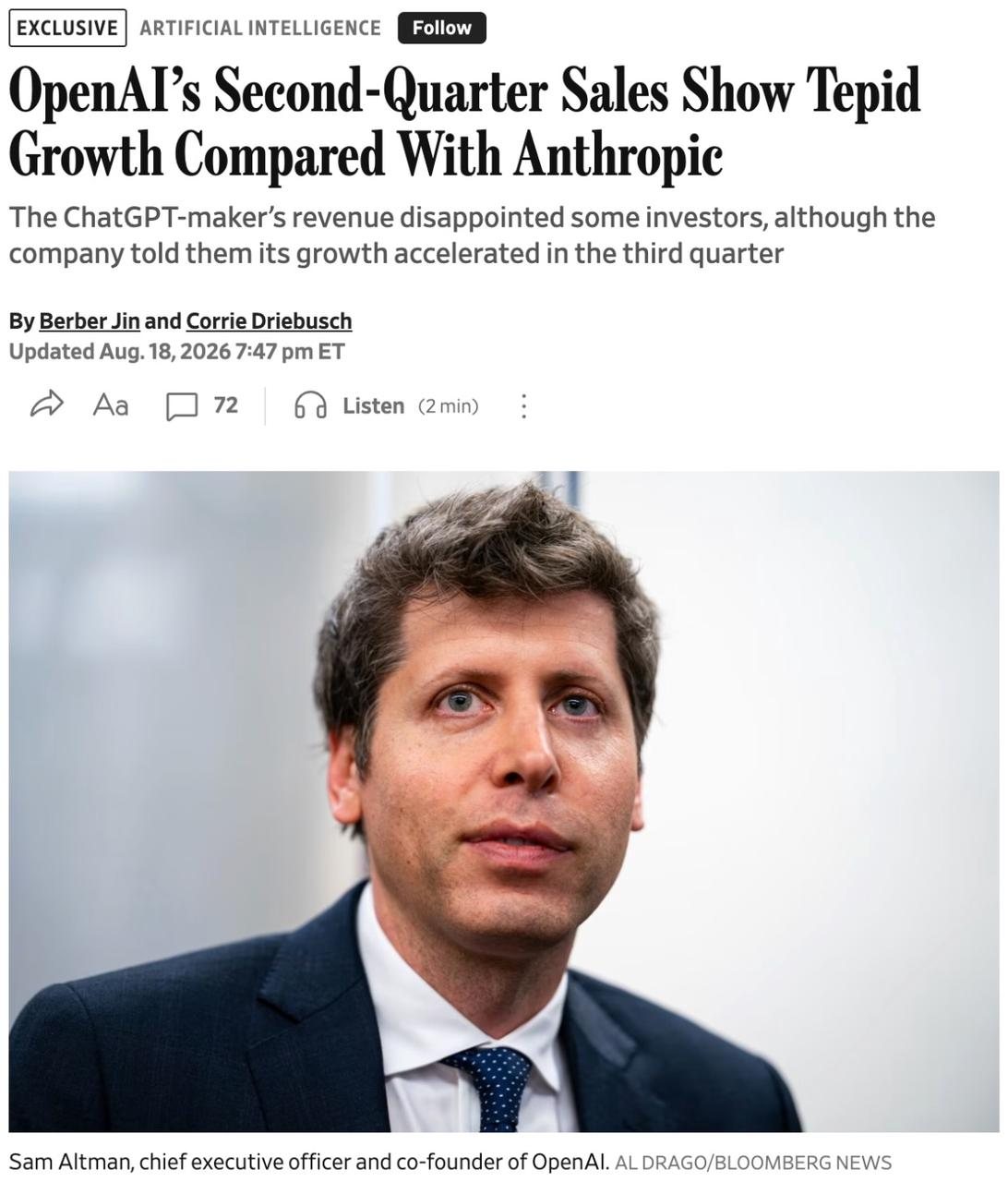
[Source: The Wall Street Journal]
Why Is the Gap Between Anthropic and OpenAI Widening?
ChatGPT's user growth has slowed, while Anthropic's coding tool Claude Code has become a phenomenal hit among Silicon Valley developers, almost single-handedly pushing its revenue to a record high.
Meanwhile, OpenAI's internal governance has fallen into turmoil. Since early 2026, 13 core executives have departed. Chief Revenue Officer Denise Dresser resigned after just eight months in office, followed by Chief Operating Officer Brad Lightcap, who announced his departure after an eight-year tenure. Earlier, Fidji Simo, CEO of Applications, transitioned to an advisory role due to health reasons.
Even more concerning for investors are the changes to its safety mechanisms. According to a Financial Times report on August 17, OpenAI officially disbanded its independent Preparedness team (focused on catastrophic risks) at the end of July.
Although an OpenAI spokesperson urgently clarified on August 18 that this was a move to "decentralize safety functions into various R&D teams" rather than a dissolution, the statement failed to dispel external doubts. Against the backdrop of multiple safety leaders having departed, the market is more inclined to believe that during this critical sprint toward an IPO, OpenAI is leaning toward "prioritizing products over safety."
Anthropic and OpenAI IPO Race
Both companies have confidentially filed for an IPO. Anthropic is expected to go public as early as September or October, targeting a valuation of $2 trillion.
OpenAI confidentially filed in June, but subsequent reports indicate its IPO may have been delayed to 2027, primarily due to a net loss of as much as $38.5 billion last year. The company was valued at approximately $852 billion in a private funding round in March, but CEO Sam Altman insists on a $1 trillion valuation target and is unwilling to accept a lower valuation.
People familiar with the matter said that OpenAI told investors growth picked up following its new model release in July, but the reality that its month-over-month growth lags behind hot AI companies such as Palantir (PLTR) and CoreWeave (CRWV) has raised concerns among some investors.
Recommended Articles


