

Japan and South Korea Stocks Plunge as Kospi Slumps Nearly 6%, SK Hynix Drops Nearly 10%, Kioxia Plummets Over 12%

Source Tradingkey

TradingKey - On August 19, Japanese and South Korean stock markets faced a new round of sell-offs. South Korea's KOSPI Index closed down 5.80% at 6,471.17 points, while Japan's Nikkei 225 Index fell 3.16% to 65,326.42 points, marking a second consecutive day of decline and hitting its lowest closing level in nearly two weeks.

The downturn in the South Korean market was particularly severe during early trading, with the KOSPI falling more than 6% shortly after the open. The Korea Exchange triggered its sidecar mechanism, halting KOSPI program sell orders for 5 minutes to cope with the unusual volatility.
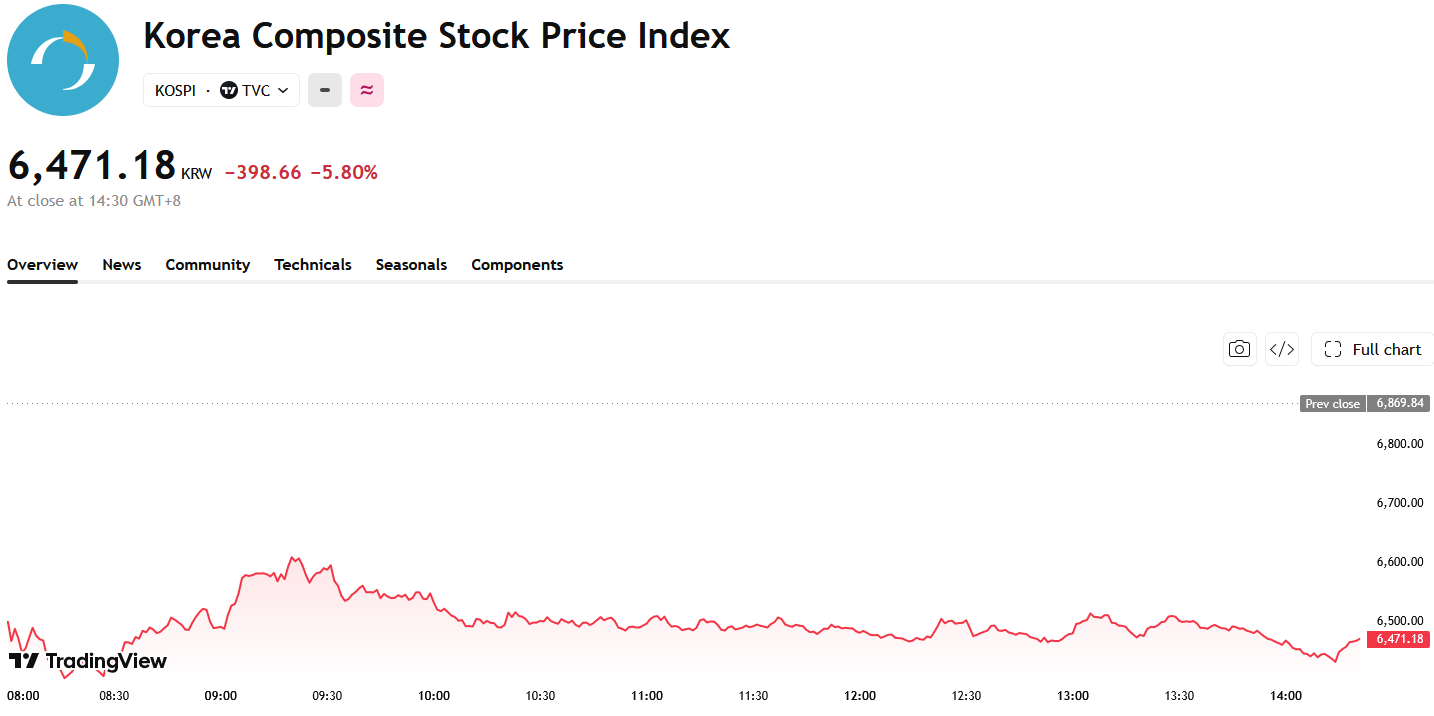
kospi-22182738996d4ba8b66be1a0d8243854

Source: TradingView

Heavyweight semiconductor and tech stocks bore the brunt of the pullback, with Samsung Electronics falling 7.82% to 247,500 won (about $177), and SK Hynix plunging 9.75% to 1,500,000 won.

Japanese tech stocks also posted sharp declines. Kioxia tumbled 12.60% to close at 49,950 yen (about $314), while SoftBank Group dropped 10.34% to 5,227 yen, as capital broadly fled AI and memory supply chain stocks.

A key factor behind this market correction was the rapid surge in global bond yields. The 30-year U.S. Treasury yield briefly climbed near its highest level since 2007, while the 10-year U.S. Treasury yield also hovered at a relatively high level not seen since early 2025.

As risk-free interest rates rose, markets began re-evaluating the pricing of high-valuation tech stocks. Companies requiring continuous massive investments to build out AI infrastructure drew heightened scrutiny regarding their future financing costs and ability to deliver earnings.

Semiconductor companies are particularly sensitive to this trend. Because chipmakers' earnings expectations are often pegged to demand growth over the coming years, rising interest rates further compress their valuation multiples.

Meanwhile, tensions in the Middle East continued to weigh on the market. The U.S. and Iran remained in a stalemate over follow-up solutions, while shipping security in the Strait of Hormuz stayed under close watch. Driven by investor concerns over potential energy supply disruptions, international crude oil prices rose for a third consecutive trading day. A further increase in energy prices could reignite global inflation and narrow the policy space for major central banks to cut interest rates in the future, dealing another blow to high-valuation tech assets.

Jung In Yun, Global CEO of Fibonacci Asset Management, noted that while the long-term growth trend of AI remains intact, rising interest rates and geopolitical risks are dampening investors' willingness to pay high valuation premiums for high-growth assets. He added that alongside macroeconomic factors, the recent stock price declines also reflected profit-taking by investors following previous significant gains.

Disclaimer: For information purposes only. Past performance is not indicative of future results.
placeholder
ECB Policy Outlook for 2026: What It Could Mean for the Euro’s Next MoveWith the ECB likely holding rates steady at 2.15% and the Fed potentially extending cuts into 2026, EUR/USD may test 1.20 if Eurozone growth proves resilient, but weaker growth and an ECB pivot could pull the pair back toward 1.13 and potentially 1.10.
Author  Mitrade
Dec 26, 2025
With the ECB likely holding rates steady at 2.15% and the Fed potentially extending cuts into 2026, EUR/USD may test 1.20 if Eurozone growth proves resilient, but weaker growth and an ECB pivot could pull the pair back toward 1.13 and potentially 1.10.
placeholder
Financial Markets 2026: Volatility Catalysts in Gold, Silver, Oil, and Blue-Chip Stocks—A CFD Trader's OutlookGet a comprehensive financial market 2026 outlook exploring key economic drivers, volatility catalysts in gold, oil and stocks, and what the evolving economic outlook means for cfd trading strategies and risk management on global markets.
Author  Rachel Weiss
May 15, Fri
Get a comprehensive financial market 2026 outlook exploring key economic drivers, volatility catalysts in gold, oil and stocks, and what the evolving economic outlook means for cfd trading strategies and risk management on global markets.
placeholder
Gold gains momentum to near $4,400 as Fed hike expectations drop despite Us-Iran tensionsGold price (XAU/USD) gains momentum to around $4,395 during the early Asian trading hours on Monday. The precious metal extends the rally as cooling US inflation data has dampened expectations for the US Federal Reserve (Fed) interest rate hike. 
Author  FXStreet
Aug 17, Mon
Gold price (XAU/USD) gains momentum to around $4,395 during the early Asian trading hours on Monday. The precious metal extends the rally as cooling US inflation data has dampened expectations for the US Federal Reserve (Fed) interest rate hike. 
placeholder
Australian Dollar gains as US Dollar struggles amid fading Fed rate hike betsAUD/USD extends its gains for the third successive day, trading around 0.7110 during the Asian hours on Tuesday. The currency pair continues to appreciate as the US Dollar (USD) remains subdued amid fading expectations for further rate hikes by the Federal Reserve (Fed).
Author  FXStreet
Yesterday 01: 23
AUD/USD extends its gains for the third successive day, trading around 0.7110 during the Asian hours on Tuesday. The currency pair continues to appreciate as the US Dollar (USD) remains subdued amid fading expectations for further rate hikes by the Federal Reserve (Fed).
placeholder
WTI rises to near $85.00 amid escalating US-Iran tensionsWest Texas Intermediate (WTI) oil price extends its gains for the fourth consecutive day, trading around $84.80 per barrel during the Asian hours on Wednesday.
Author  FXStreet
6 hours ago
West Texas Intermediate (WTI) oil price extends its gains for the fourth consecutive day, trading around $84.80 per barrel during the Asian hours on Wednesday.
goTop
quote