


Semiconductor Equipment Makers vs. Chip Designers: Who's Actually Winning the AI Cycle?
Key Points
ASML Holdings and Applied Materials provide essential equipment and expertise for making AI processors.
Nvidia and Broadcom are leading chip designers, with pricing power that could last as the artificial intelligence boom plays out.
- 10 stocks we like better than Nvidia ›
There are many ways to play the artificial intelligence (AI) boom right now, and two of the best angles are to invest in semiconductor equipment makers like ASML Holdings (NASDAQ: ASML) and Applied Materials (NASDAQ: AMAT), or by owning chip designers like Nvidia (NASDAQ: NVDA) and Broadcom (NASDAQ: AVGO).
Over the past year, ASML and Applied Materials have had higher returns, but if you go back three years, Broadcom and Nvidia win this matchup.
Missed Nvidia in 2009? This Rare Signal Is Flashing Again. In 2009, a "Double Down" signal flashed for a little-known chipmaker called Nvidia. For the first time in years, that same "Total Conviction" signal is flashing for a company 1/100th the size of Nvidia. Continue »
But which stocks will win the AI cycle over the long term? I think chip designers have one advantage.

Image source: Getty Images.
Why semiconductor equipment makers are AI winners right now
ASML Holding is a leader in advanced nodes, with a near monopoly on Extreme Ultraviolet (EUV) lithography systems for manufacturing the world's most complex AI chips. Applied Materials, for its part, provides much of the essential materials, engineering, and equipment for high-bandwidth (HBM) memory and transistors.
The share prices of both companies have soared over the past 12 months -- ASML is up 150%, and Applied Materials rose 200% -- as AI spending accelerates.
The companies are both in very good financial shape, with ASML's revenue rising 21% to about $10.8 billion and diluted non-GAAP earnings up 28% to $8.81 per share in the second quarter of 2026 (ended June 28). Applied Materials' sales rose 11% to $7.9 billion, and earnings popped 20% to $2.86 per share in the company's Q2 (ended April 26).
In short, both of these companies are the backbone of AI chip manufacturing, and their expertise in this space likely means they'll continue to benefit from continued AI investments.
That's very good news considering that capital expenditures (capex) among tech companies are estimated to top $1 trillion next year, up from about $705 billion this year.
Chip designers are long-term AI winners
Broadcom and Nvidia have benefited from AI by holding leading positions in designing some of the most-used AI processors.
Nvidia is the leading graphics processing unit (GPU) chip designer, with its processors accounting for 86% of the data center GPU market. Meanwhile, tech giants go to Broadcom when they need custom application-specific integrated circuits (ASICS) for AI, with Alphabet and OpenAI as two leading customers.
While Nvidia and Broadcom trail the share price returns of ASML and Applied Materials over the past year, they're the clear winners looking back over three years:
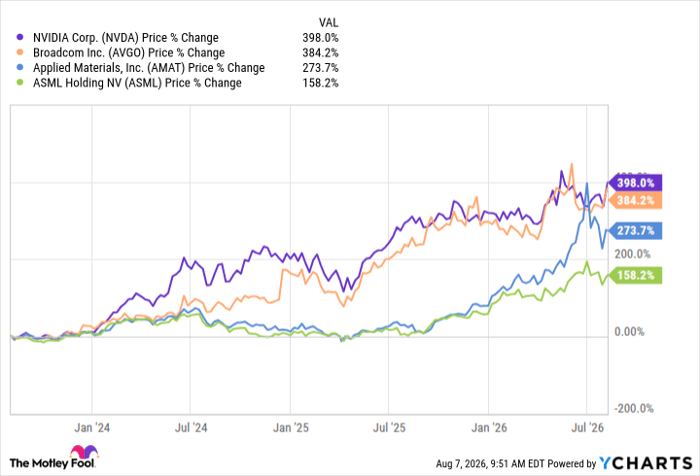 Image and data source: YCharts.
They're also massively profitable, and their revenue growth is very impressive. Nvidia's sales rose 85% in Q1 of fiscal year 2027 (ended April 26) to $81.6 billion, and its earnings jumped 140% to $1.87 per share. Broadcom's revenue spiked 48% to $21.2 billion, with earnings jumping 54% to $2.44 per share in Q2 2026 (ended May 3).
And, just like ASML and Applied Materials, the massive wave of AI spending will continue to benefit Broadcom and Nvidia.
One potential advantage for chip designers
As demand for AI chips has surged, Nvidia and Broadcom have raised prices, boosting their gross margins.
Nvidia's gross margins were 75%, and Broadcom's were 77% recently. No matter what business you're in, those are some enviable margins.
The semiconductor manufacturers don't have the same ability to earn extra profits, because it's harder to eke out more profits from expensive production and equipment. As such, ASML's most recent gross margins were about 54%, and Applied Materials' were about 50%.
Still good, but not as impressive as the chip designers.
All of this means Broadcom and Nvidia can tap into the AI boom in ways semiconductor manufacturers can't. And with the higher margins, the companies can likely ride out a potential slowdown in AI spending much more easily than the equivalent makers.
That doesn't mean ASML and Applied Materials won't continue to benefit from the AI boom, but it does give Nvidia and Broadcom a slight advantage in winning the AI boom over the long term.
Should you buy stock in Nvidia right now?
Before you buy stock in Nvidia, consider this:
The Motley Fool Stock Advisor analyst team just identified what they believe are the 10 best stocks for investors to buy now… and Nvidia wasn’t one of them. The 10 stocks that made the cut could produce monster returns in the coming years.
Consider when Netflix made this list on December 17, 2004... if you invested $1,000 at the time of our recommendation, you’d have $399,832!* Or when Nvidia made this list on April 15, 2005... if you invested $1,000 at the time of our recommendation, you’d have $1,374,595!*
Now, it’s worth noting Stock Advisor’s total average return is 968% — a market-crushing outperformance compared to 215% for the S&P 500. Don't miss the latest top 10 list, available with Stock Advisor, and join an investing community built by individual investors for individual investors.
See the 10 stocks »
*Stock Advisor returns as of August 10, 2026.
Chris Neiger has no position in any of the stocks mentioned. The Motley Fool has positions in and recommends ASML, Alphabet, Applied Materials, Broadcom, and Nvidia. The Motley Fool has a disclosure policy.
Recommended Articles


