


Palantir Stock Forecast: PLTR Breakout Eyes $173.89 After 93% Revenue Growth
TradingKey - Palantir Technologies (PLTR) reported strong Q2 earnings on August 4 and gave solid guidance. Q2 revenue was reported at $1.935 billion, growing 93% YoY and beating the consensus at $1.80 billion. Palantir also posted an adjusted EPS of $0.41, beating the estimate of $0.35. Palantir now expects total revenue for the year to be between $8.150 billion and $8.158 billion and expects U.S. commercial revenue will be over $3.424 billion, a growth rate of at least 134%. Palantir’s stock was up 29.5% on August 4 and for the first time since February 2024.
The stock was up another 172% on August 10, breaking a symmetrical triangle that had been in effect since June. The chart is now testing a $173.89 resistance level and possible targets of $183.15 and $192.05. An RSI of 78 indicates overbought conditions and has increased the technical risk of the trade from entry to profit-taking.
The Earnings Story Is Unambiguous
Revenue was the major stock driver. Palantir posted Q2 Revenue of $1.935 billion against a consensus of $1.8 billion. Palantir posted a 93% YoY revenue growth rate and reported the fastest growth rate in its history as a public company. Net income also posted solid growth, with Palantir posting a GAAP operating margin of 47% and a GAAP net income of $1.062 billion, reflecting a 55% net margin. Palantir’s operating efficiency also scored a 155% Rule of 40, a score that even among the top growth and operating efficiency scores of public software companies is a rare score.
The operating cash flow was $1.216 billion (63% profit margin on sales), and the adjusted free cash flow was $1.220 billion. By the end of the quarter, Palantir had $9.2 billion and debt that was nearly zero. This company is producing a huge amount of cash, and their revenue has grown 93%.
U.S. Commercial Is the Acceleration Engine
The U.S. commercial segment is driving the repricing with Q2 revenues of $764 million, an increase of 149% year over year and 28% quarter over quarter. This increase is due to the adoption of Palantir's Artificial Intelligence Platform (AIP), which integrates enterprise data with generative AI under a framework of governance and controls. As a result, the management team increased the full year U.S. commercial guidance to more than $3.424 billion, an increase of 134%.
Last month, Palantir embedded leading 3rd party models, including GPT-5.6 and Claude Sonnet 5, into AIP. In a model agnostic approach, enterprises select their preferred foundation models for use with the centralized governance layer for data, permissions, and workflows, which is offered by Palantir. This approach to infrastructure establishes Palantir's role as an infrastructure play irrespective of the provider of the winning AI model.
The 220 deals reported this quarter with a value of $1 million or more, of which 98 deals were valued at $5 million or more, and 73 deals valued at $10 million or more, confirmed the above. Contract value grew to $3.37 billion, a year over year growth of 49%, and the remaining deal value for U.S. commercial stood at $6.24 billion. This backlog implies that commercial revenues are likely to grow at triple digit rates for a further two quarters at least, provided that customer deployments take place.
Government Revenue Accelerated, Not Faded
There was also an expectation that government revenue would fall due to shrinking defense budgets. Un U.S. government revenue actually increased by 90% to $809 million in Q2. With instability in the world, spending has gone up on battlefield software, integration of intelligence, and AI defense systems. Palantir, also working with defense-tech company Anduril, has contracts for software regarding the Golden Dome missile defense program with the U. S. government which is a good sign of continued federal contracts.
Europe Is the Emerging Headwind
The major growth narrative adds one geopolitical asterisk: Europe is beginning to push back. French domestic intelligence’s Directorate General for Internal Security (DGSI) opted to replace Palantir Technologies with French firm ChapsVision after citing concerns on technological sovereignty. Palantir also encountered a domestic political fracas over a proposed £50 million (approximately $67 million) two-year contract with the London Metropolitan Police.
While these do not impact Q2, they do signal that the rate of European government expansion will be more modest than the United States. Although international commercial business remains strong, political pushback could diminish the potential for European government contracts.
The Technical Breakout Is Confirmed — But Overbought Conditions Matter
Palantir stock broke out of the symmetrical triangle that has constrained stock prices since before June. Price shot through resistance at $139.70, $149.66, $158.33, and reached $172 on August 10 with a relative absence of selling. The 50-day ($137.05) and the 100-day ($134.99) EMA are below price, confirming the trend is up.
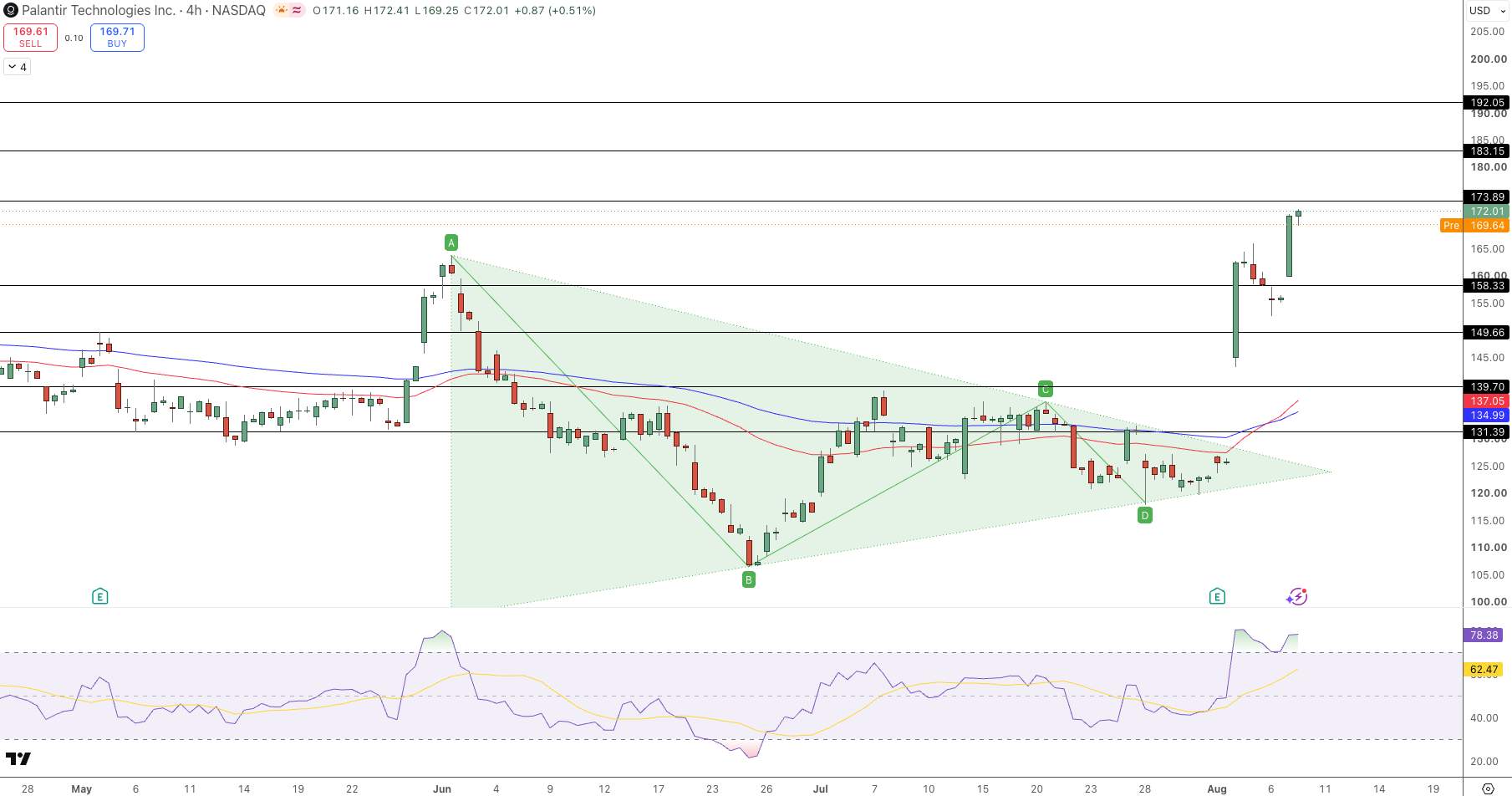
Palantir Stock Price Chart - Source: Tradingview
Palantir, with an RSI of ~78, is in overbought territory. The next resistance is $173.89, which exposes $183.15 and $192.05. Given the RSI reading, consolidation and/or a pullback is more likely than the price shooting toward those targets.
It is important to remember that a price pullback from the breakout point is quite common in price action trading. The price pullback to the breakout point is completely normal and should not cause buyers to panic. Following the breakout, buyers who could not enter are given the opportunity to enter at a lower price point. Ideal buyers would ideally want to see price pull back to the breakout point. If the price falls below $158.33, $149.66 represents the next price barrier. If the price is able to break below $149.66, the breakout will be considered a failure.
Key Levels (Aug 10 Trading)
- Immediate resistance: $173.89 (current ceiling)
- Extended targets: $183.15, $192.05 (if breakout extends)
- Critical support: $158.33 (former resistance, now support)
- Secondary support: $149.66, $139.70
- Current price: $172 (above all EMAs)
- RSI: 78 (overbought; caution warranted)
What to Watch in Q3 and Beyond
What needs to be highlighted is the Q3 2026 revenue. Management anticipates revenues of $2.160 to $2.164 billion, meaningfully above the $2.0 billion Wall Street consensus at the time of writing. Should Palantir achieve that revenue, and should they raise guidance, the story of sustained commercial acceleration is more likely. Given that scenario, the shares should find support at $158, and the overbought alert should be validated. If Q3 revenues come in below expectations, and/or guidance is reduced, shares will most likely find support at $158.
What should be included in longer-term expectations is: (1) the expansion of commercial business beyond the U.S., (2) the expansion of AIP and whether AIP sustains 149% growth of the base (3) the speed and term of U.S. government contracts, and (4) European politics and resistance and what they may represent to international business expansion.
Bottom Line
Palantir's Q2 2026 numbers are impressive. Revenues were up 93%, the Rule of 40 was 155%, remaining deal value was $6.24 billion, and cash on hand is $9.2 billion. The U.S. business is growing, and government revenues are stable. A 29.5% increase on August 4 was warranted.
However, the move to $172 triggers overbought conditions (RSI 78) and warrants caution. The stock has breached all interim resistance levels and is approaching $173.89. Should $173.89 be breached, the range of $183–192 will be likely. Should profit-taking occur, the support level will be $158.33. For traders, the risk/reward has shifted, and is more favorable, compared to the level at $140. For investors, the best entry opportunity will be at $158 to avoid buying the overbought momentum at $172.
There are still very interesting aspects of the overall story like swift business expansion, maintaining a beneficial business size, and an extensive list of incoming orders. Now we wait to see if the stock price makes a further rise or does a consolidation after the recent 30% rise.
Recommended Articles


