


Card Network or Card Lender: Which Business Model Is the Better Long-Term Buy?
Key Points
Processing credit card-based payments is actually a multilayered procedure that requires the involvement of several different companies' technologies.
One of these layers sidesteps the economically-sensitive, lending-based risk that's inherent to credit cards.
The companies best positioned to offer consistent performance for the indefinite long term have already proven their resilience.
- 10 stocks we like better than Visa ›
Most investors lump them together into the same industry category. And understandably so. From the point of view of consumers, they all seamlessly work together without a second thought.
The fact is, however, the credit card business is multilayered; each layer's businesses and business models are distinct. And these differences change the investment thesis for each of these groups' stocks, making only one of these roles the best foundation for a long-term buy.
Missed Nvidia in 2009? This Rare Signal Is Flashing Again. In 2009, a "Double Down" signal flashed for a little-known chipmaker called Nvidia. For the first time in years, that same "Total Conviction" signal is flashing for a company 1/100th the size of Nvidia. Continue »
But first things first.
How the credit card business really works
There are three different components at work whenever you use plastic to make a purchase.
The first of these is the obvious one staring you in the face -- the card-swiping device. These usually aren't owned by the merchant. Rather, they're supplied by players like Verifone or increasingly, Block (NYSE: XYZ) (formerly Square). These outfits keep a few cents' worth of every transaction and may also charge a monthly subscription fee.
At the other end of every card-based transaction is the consumer and his or her credit card issuer. Bank of America (NYSE: BAC) and Citigroup (NYSE: C) are among the biggest issuers, which of course assume all the lending-based risk. But, JPMorgan Chase (NYSE: JPM) is the biggest credit lending name in terms of total purchase volume.

Image source: Getty Images.
There's a critical layer between these two, however, that keeps this aspect of consumerism humming. Those are payment network operators Visa (NYSE: V) and Mastercard (NYSE: MA), which handle everything that happens between card readers and transaction approvals, keeping track of who's-owed-what between merchants and lenders. For their trouble, Mastercard and Visa also keep a small fraction of every dollar processed through their networks.
So where do American Express (NYSE: AXP) and Capital One (NYSE: COF) fit in? These two companies are both payment network operators and issuers, albeit smaller players in each aspect of the business.
And the winner is...
The question remains, however: Which of these business models makes for the best long-term investment?
They each have their obvious upsides, particularly given that cards are increasingly being used to cover everyday expenses like utility bills, parking, groceries, and quick trips to convenience stores.
If there's only room in your buy-and-hold portfolio for one of these names, it's arguably a payment network operator like Visa or Mastercard. They don't have the growth potential that lenders like Citi or Capital One might bring to the table. But they also don't face risks of loan write-downs or defaults when the economy sours. To this end, with the exception of the headwind from the COVID-19 pandemic, at no point in the past 10 years has Visa or Mastercard experienced a decline in 12-month revenue or earnings before interest, taxes, depreciation, and amortization (EBITDA).
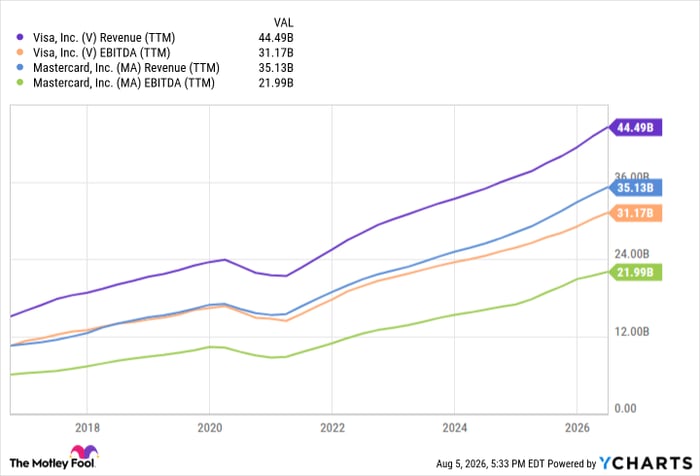
V Revenue (TTM) data by YCharts.
Consistent, predictable performance is a big part of any long-term holding's net success.
Their other long-term upside is their duopoly-like control of the entire payment-middleman portion of the credit card market. Although American Express and Capital One (through its Discover arm) are also in the payment network business, Visa and Mastercard are well entrenched simply because they've both been around for so long. This leaves them well positioned to tack on new profit centers as opportunities surface, like the customer engagement and loyalty tools Mastercard offers to merchants.
Should you buy stock in Visa right now?
Before you buy stock in Visa, consider this:
The Motley Fool Stock Advisor analyst team just identified what they believe are the 10 best stocks for investors to buy now… and Visa wasn’t one of them. The 10 stocks that made the cut could produce monster returns in the coming years.
Consider when Netflix made this list on December 17, 2004... if you invested $1,000 at the time of our recommendation, you’d have $400,155!* Or when Nvidia made this list on April 15, 2005... if you invested $1,000 at the time of our recommendation, you’d have $1,345,502!*
Now, it’s worth noting Stock Advisor’s total average return is 955% — a market-crushing outperformance compared to 214% for the S&P 500. Don't miss the latest top 10 list, available with Stock Advisor, and join an investing community built by individual investors for individual investors.
See the 10 stocks »
*Stock Advisor returns as of August 6, 2026.
Bank of America is an advertising partner of Motley Fool Money. American Express is an advertising partner of Motley Fool Money. Citigroup is an advertising partner of Motley Fool Money. JPMorgan Chase is an advertising partner of Motley Fool Money. James Brumley has no position in any of the stocks mentioned. The Motley Fool has positions in and recommends American Express, Block, JPMorgan Chase, and Mastercard. The Motley Fool recommends Capital One Financial. The Motley Fool has a disclosure policy.
Recommended Articles


